


It is 9:40 on a Tuesday night, and a high school senior is on your university's website, typing "can I transfer community college credits into nursing" into the search bar. What she gets back is a list of loosely related pages: a faculty bio, a 2019 news release, a PDF of a committee agenda. What she does not get is the transfer credit policy page that your registrar's office spent weeks writing. She closes the tab. Nobody in enrollment management will ever know she was there.
This is the invisible enrollment leak, and almost every university has it. The institution spends heavily to drive prospective students to the website through paid search, recruitment travel, and email campaigns managed in Slate or Salesforce Education Cloud. Then, at the exact moment a motivated visitor asks a specific question, the site's search function fails them. The answer exists. It simply cannot be found.
Why university websites defeat their own search
University websites are among the largest and most complicated content estates on the public internet. A public university CETDIGIT recently worked with operates two Drupal instances carrying roughly 77,000 published content pages and nearly 18,000 PDF documents, including course catalog entries imported from Banner, faculty profiles, program pages, news, and events. That is not unusual for a mid-sized public institution. Content is created by hundreds of editors across colleges, departments, athletics, advancement, and administrative units, each with different habits, different metadata discipline, and different ideas about what a page title should say.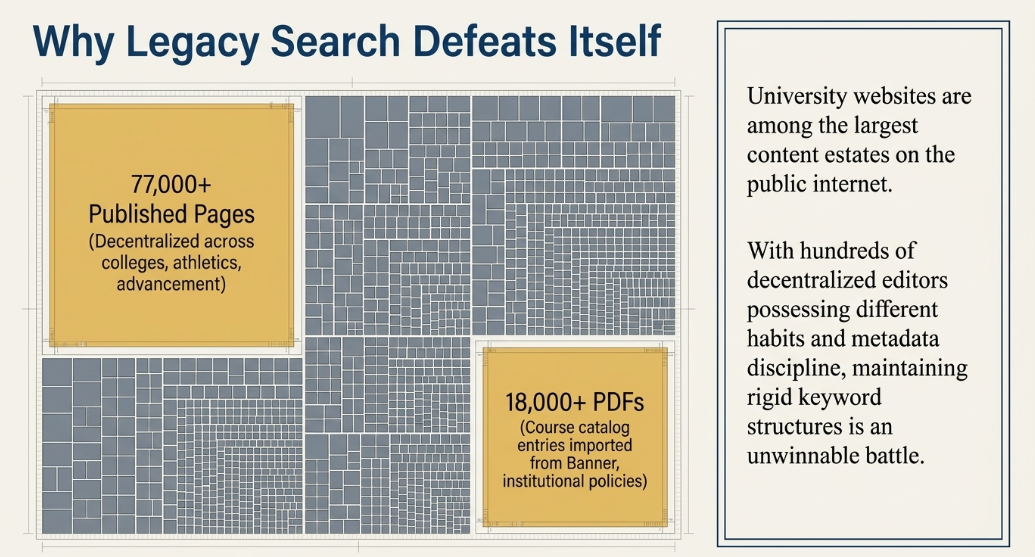
Legacy keyword search cannot cope with this. Tools like Google Programmable Search Engine return a generic experience the web team cannot tune, cannot brand, and increasingly cannot make accessible. Keyword matching also fails the way real people ask questions. A prospective student types "how much does it cost to live on campus" while the relevant page is titled "Housing and Dining Rates AY 2026-27." A parent asks about "financial aid deadlines" while the content lives in a PDF three clicks below the admissions homepage. The web team sees the wreckage in analytics as zero-result searches and one-page sessions, but has no levers to fix it.
There is a compliance dimension too. Under WCAG 2.1 AA and Section 508 obligations, which many states now reinforce with their own information technology accessibility statutes, an inaccessible search interface is not a cosmetic problem. It is a legal exposure and, more importantly, a barrier for students who rely on screen readers and keyboard navigation. Many bolt-on search widgets fail these standards outright.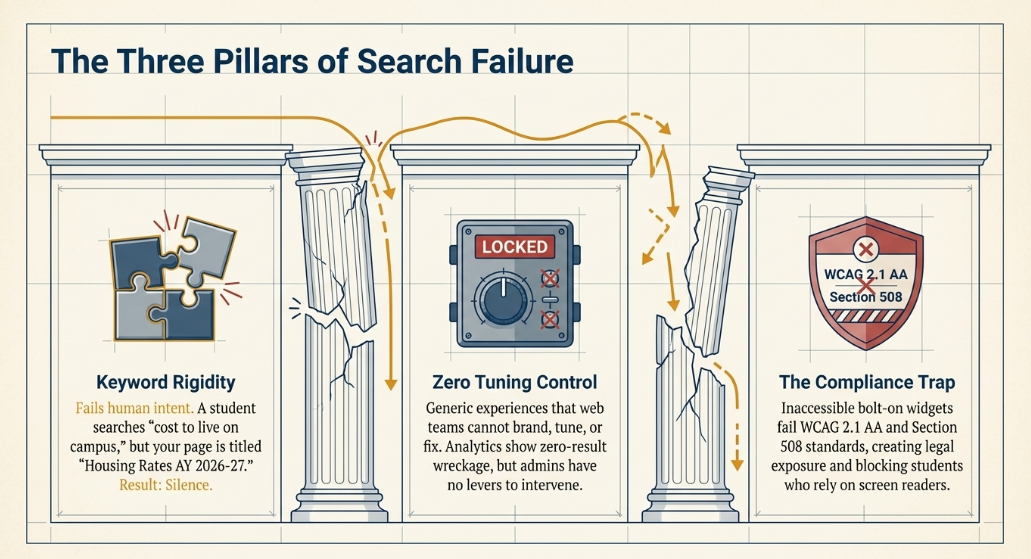
What AI-driven search actually changes
Modern AI search replaces keyword matching with hybrid retrieval: semantic vector search that understands what a query means, combined with keyword precision for exact terms like course codes and building names. The student who asks about transferring community college credits gets the transfer policy page, because the system understands the intent behind the sentence rather than matching individual words.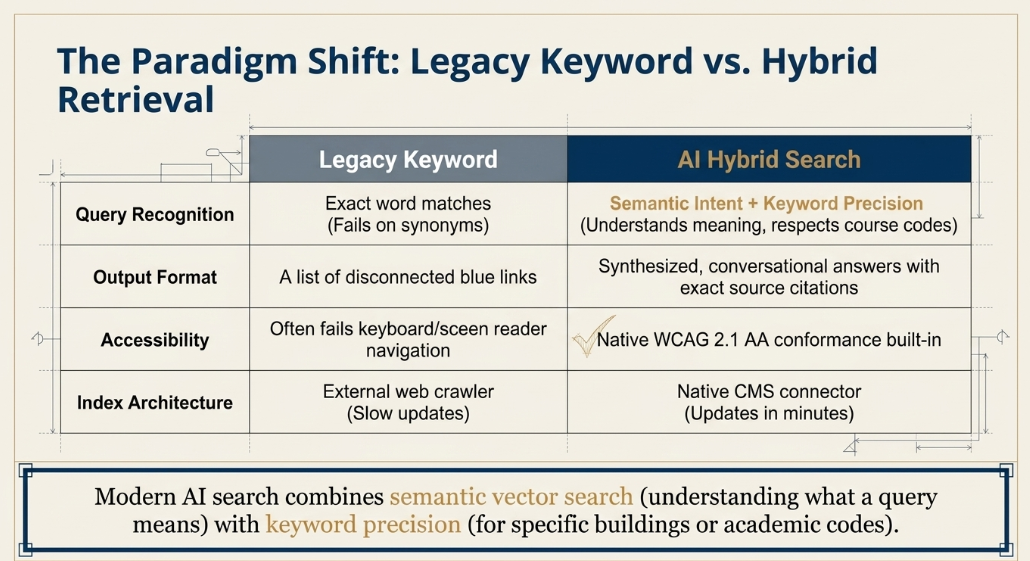
Done properly for higher education, several disciplines matter enormously. First, answers must be grounded exclusively in the university's own indexed content, with citations pointing back to the source page, so search never invents a deadline or a tuition figure. This is the retrieval-augmented generation pattern, and in a university setting the mandatory-citation part is non-negotiable. Second, the index should draw directly from the CMS through a native connector rather than crawling from the outside, so the web team controls exactly what is included, excluded, and weighted, and freshly published pages appear in results within minutes. Third, only public content should ever be indexed. FERPA-protected student records, authenticated portals, and anything behind SSO stay out of the index entirely, which keeps the search platform cleanly outside FERPA scope.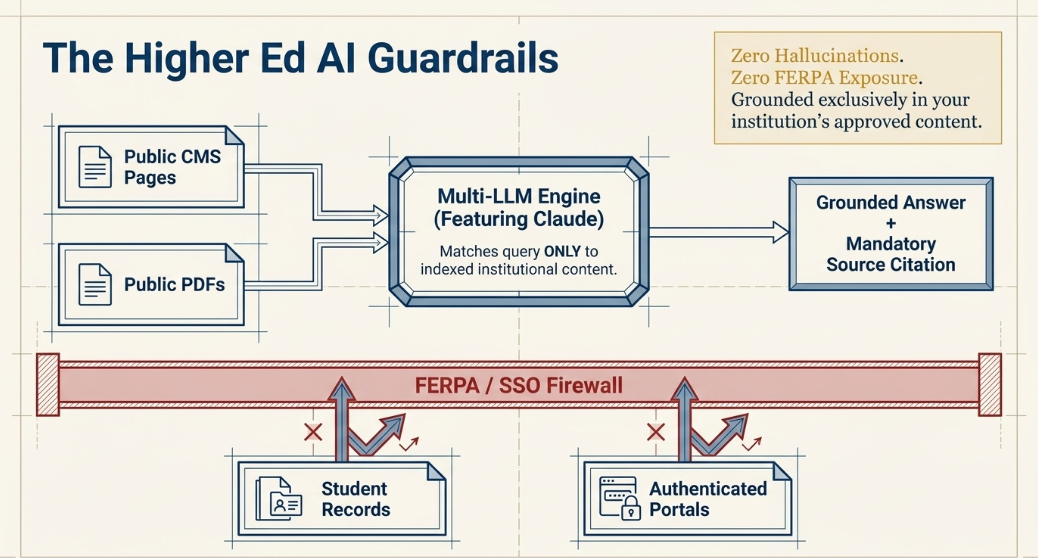
Governance is what makes the system livable for the people who run it. A web strategy team should be able to promote results for high-stakes queries, manage synonyms that reflect campus vocabulary, set business rules aligned to the university's editorial style guide, and review an audit log of every configuration change, all without filing a developer ticket. Universities typically train a dozen or more editors and administrators on these consoles across central web, online-programs, and development teams.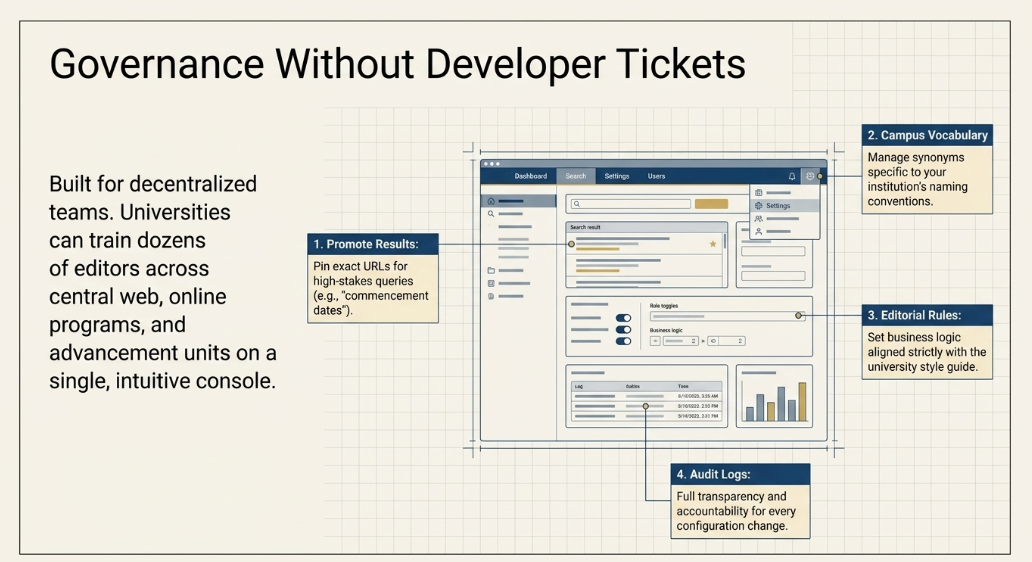
Search analytics as enrollment intelligence
The most underrated output of a modern search platform is the query log. Zero-result searches are a ranked list of questions your audience is asking that your website does not answer. If hundreds of visitors a month search for "weekend MBA" and get nothing, that is not a search problem; it is a content gap the graduate school should hear about. Piped into Google Analytics 4 alongside existing web data, search behavior becomes a live map of prospective-student intent, one that marketing and enrollment teams can act on in weekly meetings rather than discovering in an annual site audit. Content-quality reporting can go further, flagging the pages and PDFs whose structure makes them invisible to both search engines and AI assistants, and prioritizing remediation.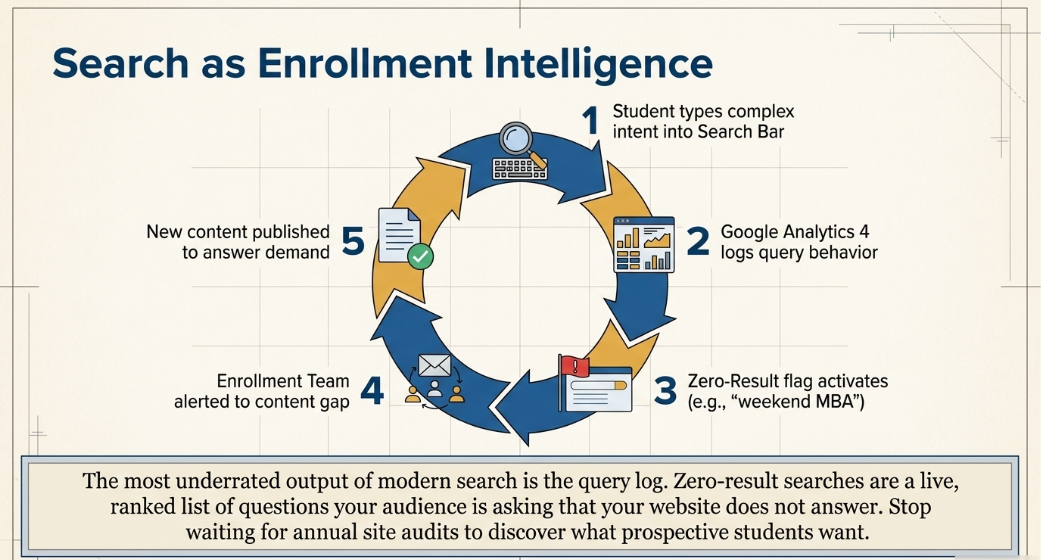
What buying this looks like for a university
Higher education procures technology carefully, and search is no exception. Expect a formal RFP through procurement, addenda answering vendor questions, and evaluation criteria that weigh experience with comparable institutions, accessibility conformance documentation such as a VPAT and a solution-level accessibility report, a HECVAT security review, U.S. data residency, and insurance requirements including cyber liability. Vendors who live in the higher education world arrive with those artifacts prepared; vendors who do not learn about them for the first time in the addenda process. Implementation for a large university site typically runs about a semester end to end, from discovery workshops through index build, relevance tuning with real query logs, accessibility verification with screen-reader testing, and training, timed so a launch lands before the fall recruiting cycle peaks.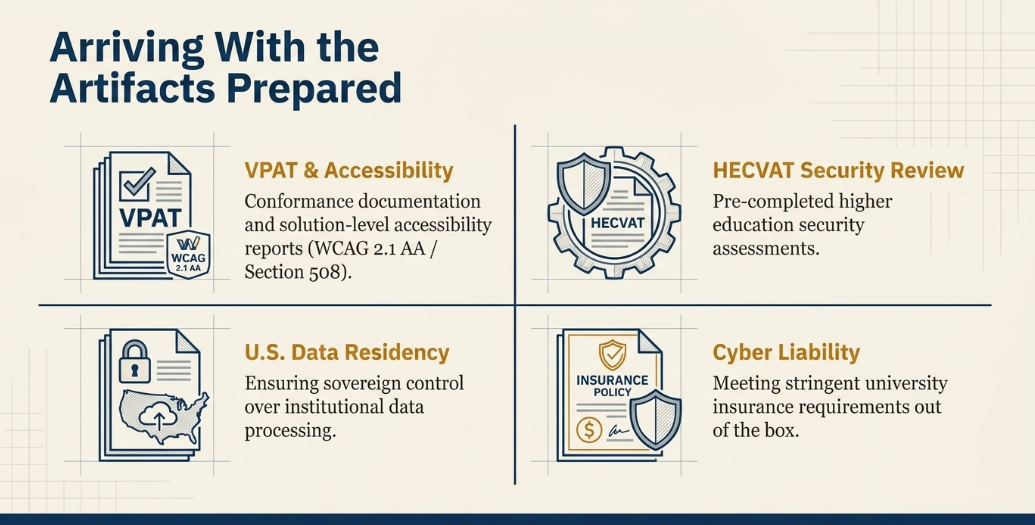
This is the environment CETDIGIT's CETRAI platform was built for: a multi-LLM architecture with Claude as the primary model, retrieval grounded in institutional content with mandatory source citations, WCAG 2.1 AA conformance, SSO support, audit logging, and deployment patterns designed for FERPA-conscious institutions. Our higher education practice includes a multi-year partnership with a public research university, an AI platform built for university advancement teams, and enterprise search delivery at institutions serving audiences in the millions.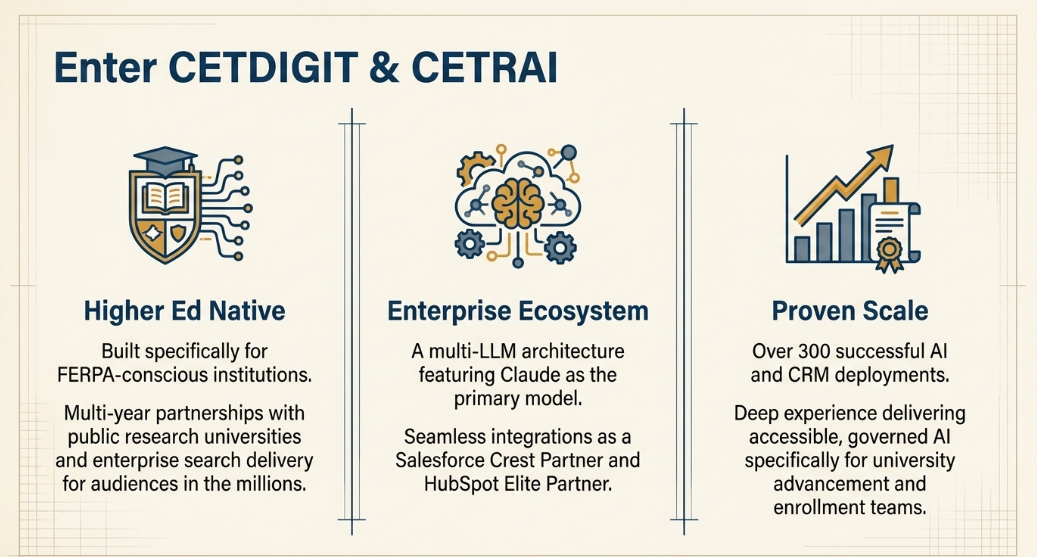
The question worth asking on your own campus
Open your site's search analytics and look at last month's top fifty zero-result queries. Behind each one is a prospective student, a current student, or a parent who asked your institution a direct question and got silence. Enrollment teams work too hard, and recruit against too much demographic headwind, to let the website squander that intent at the last step.
If your university is weighing a search modernization, planning an RFP, or simply wants an honest assessment of how the current site performs against real student questions, CETDIGIT can help. We are an AI solutions builder with more than 300 AI and CRM deployments, a Salesforce Crest Partner and HubSpot Elite Partner, and deep experience delivering accessible, governed AI search in higher education. Schedule a consultation with our team, and we will walk through your query data, your CMS environment, and what a semester-long path to launch would look like.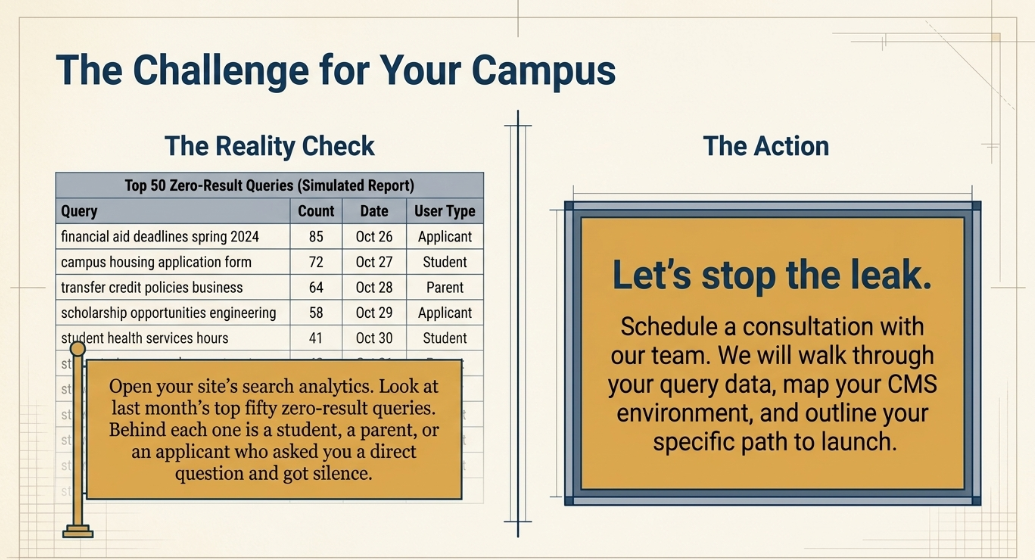
Related Reads
Answering at Scale: How AI Agents Are Quietly Transforming Schools, Universities, and Government Services
Beyond Standard RAG: How Agentic RAG is Transforming Enterprise AI in Salesforce and HubSpot
Your CRM Already Knows the Answer: How AI Integration Turns Salesforce into an Intelligent Operating System


Leave a Comment