


Voice AI is the Activation Edge for inbound revenue events, the real-time execution layer that captures a live phone call into the system of action the instant it happens, instead of letting it collapse into voicemail. It is not a phone tool bolted onto the stack. It is the orchestration surface where a high-intent inbound contact becomes a signal the revenue system can act on, in the minutes before that intent decays.
The Inbound Call Is a Revenue Event, and It's Decaying
Picture a mid-market team with real inbound phone volume. The calls come in, and they hit voicemail or a menu tree. Someone gets to them eventually, an hour later, a day later, sometimes never. From the operator's seat, those calls look like activity that got handled. They were actually revenue events that decayed before anyone acted on them.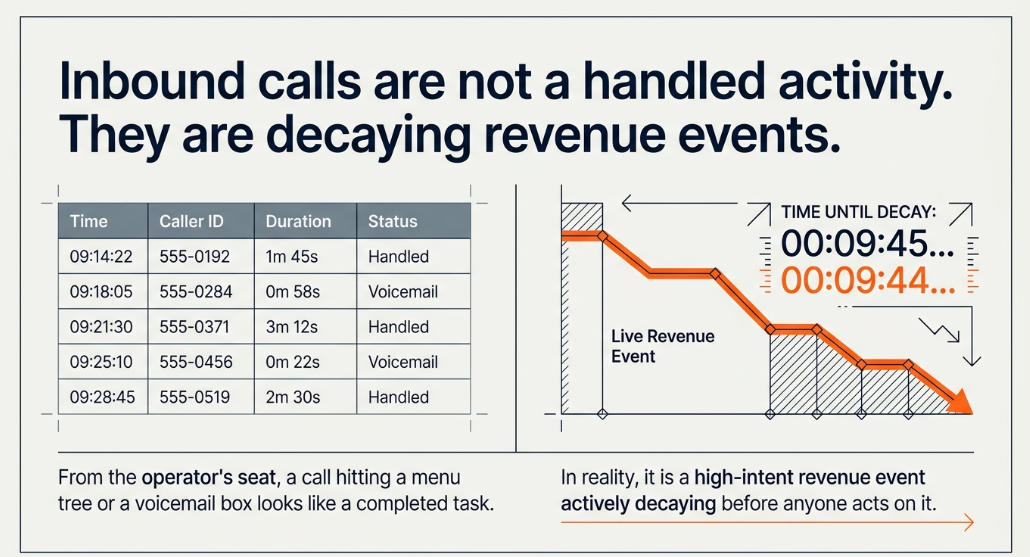
The decay is measurable, and it's fast. The seminal Harvard Business Review audit of 2,241 US firms found inbound queries go cold fast, and most firms answer far too slowly, with an average response time of 42 hours, with 23% of firms never responding at all. The companion MIT lead-response research went finer-grained: the odds of qualifying a lead collapse within minutes of the inquiry, with contact inside five minutes versus thirty, raising the odds of qualifying roughly 21x. A phone call is the most perishable form of inbound there is. It expects an answer now, and the value is gone in minutes.
That decay is an architecture problem, not a staffing one, which is why it belongs inside CETDIGIT's broader AI services architecture rather than in another hire.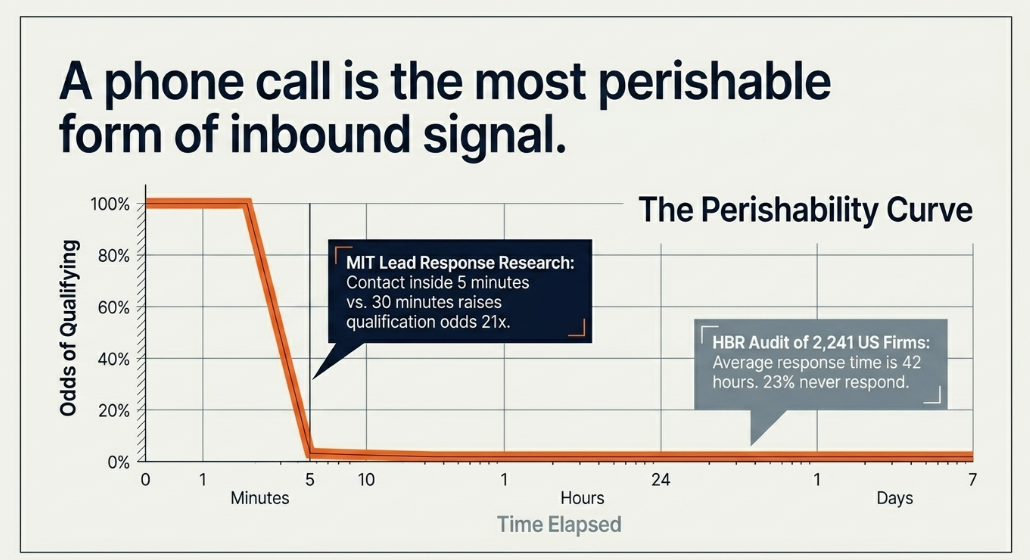
So, What Is Voice AI as the Activation Edge?
Voice AI is the Activation Edge surface for inbound. The Activation Edge is the high-velocity execution layer that acts on live signal, and an inbound call is about the highest-intent signal a revenue system can receive. Positioned correctly, voice AI answers instantly, captures what the caller wants, and writes that into the System of Action: the mechanism that turns a live event into the next orchestrated step, routed and acted on rather than logged and forgotten.
The contrast that matters is with the Cognitive Core, the system of record that holds the account history but does not act in real time. The Core knows. The Activation Edge acts. A voice tool that only records a call and drops a transcript into the record is sitting on the wrong side of that line. The term was first defined as part of the AI revenue engine architecture, where the Activation Edge and Cognitive Core were set out as the two halves of a connected revenue system; this article places voice AI specifically as the Activation Edge surface for the phone.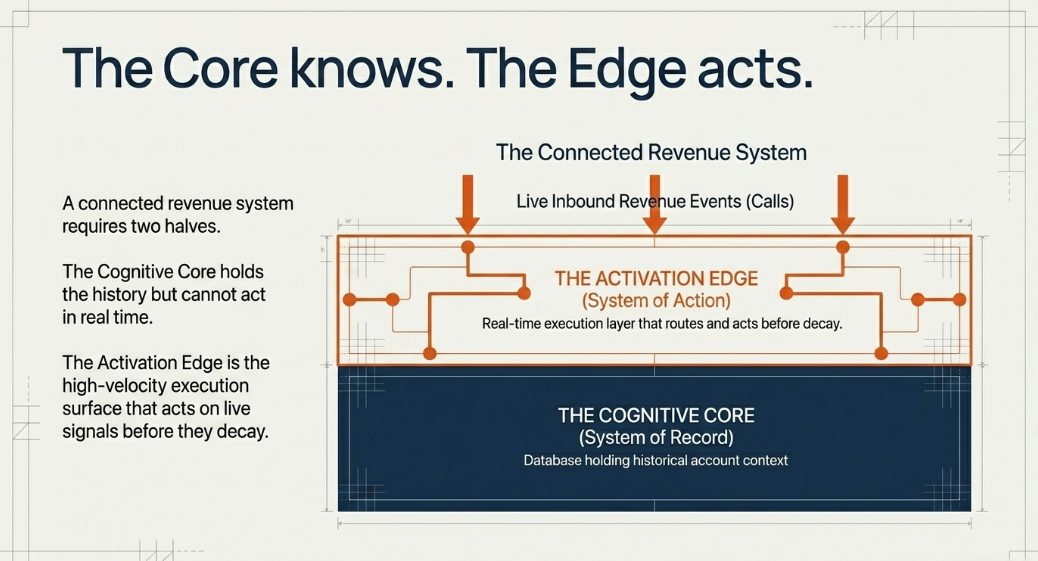
Where Voice Fits in the Revenue Stack
Here's the reframe that decides whether voice AI is worth it: the question isn't which voice product has the best features. It's where voice sits in the architecture. As a standalone tool, voice answers calls in isolation, and the rest of the stack never learns anything from them. As an Activation Edge component, every call becomes a signal that the system acts on.
The evidence that placement beats product is strong. BCG's 2024 global AI survey found that most of AI's value comes from process and orchestration, not the tool. Their 10-20-70 rule puts roughly 70% of AI value in people and process, only 10% in the algorithm. Buying a smarter voice gadget captures the 10%. Wiring voice into the revenue engine the Activation Edge plugs into is how you reach the 70%.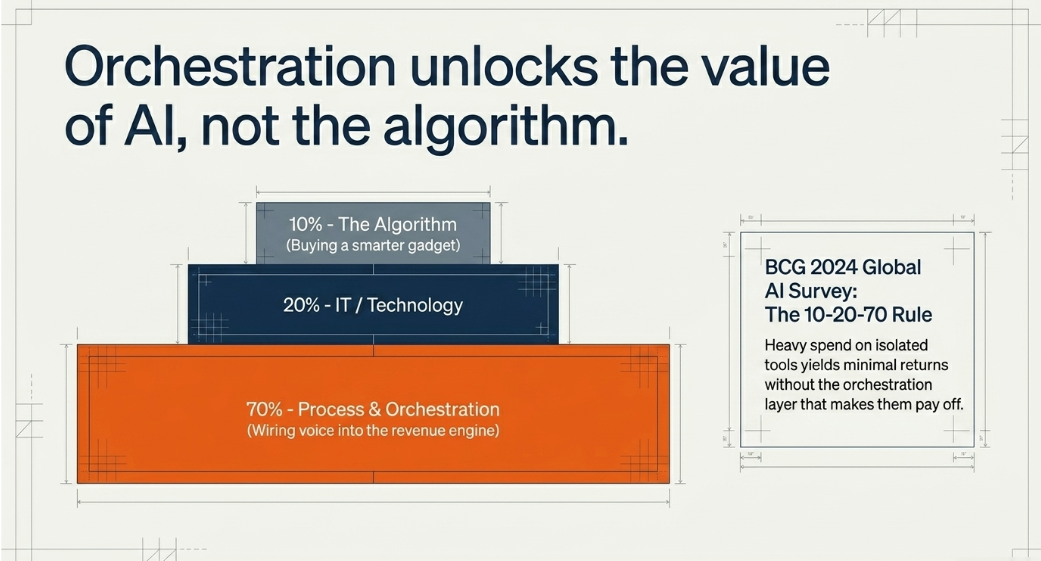
Who This Affects
If you run RevOps, Growth, or engineering for a team with real inbound call volume, this is your problem to architect. You're the one who can see that the phone system and the revenue system are two separate things, and that nothing carries a call across the gap between them.
It matters more now, not less, because of how buyers behave. Gartner's March 2026 survey found 67% of B2B buyers prefer a rep-free experience, and B2B buyers now run most of the purchase digitally and on their own terms. The buyer who does pick up the phone in that world is unusually far along and unusually high-intent. Missing that call isn't a missed call. It's a missed late-stage revenue event.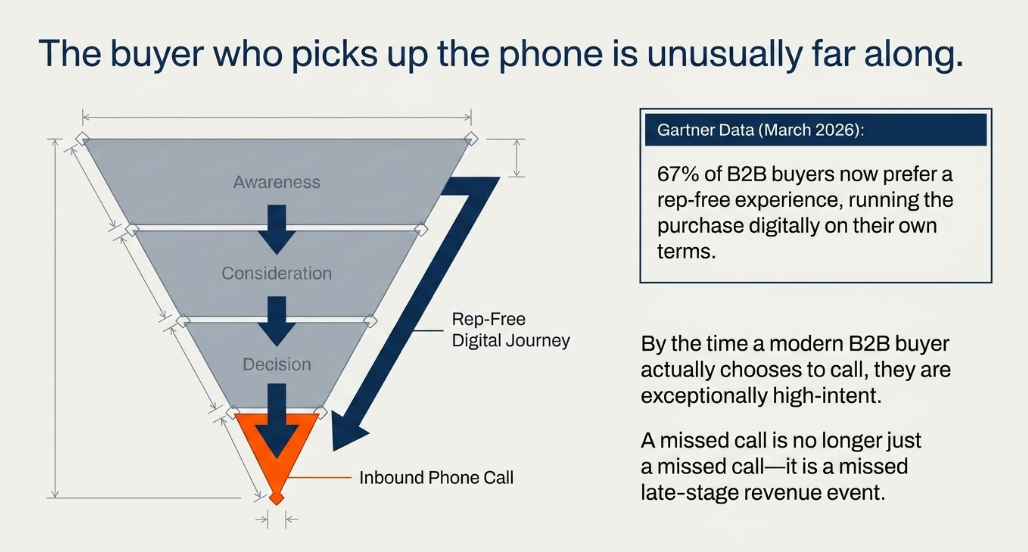
What Context Collapse Looks Like on the Phone
When voice sits outside the architecture, the failure has a name: Context Collapse. The inbound event loses its context and collapses into a dead end. On the phone, it looks like this:
- The call hits voicemail or a menu tree, and the intent evaporates before anyone hears it.
- The call gets answered and logged, but nothing links it to the account record or triggers a next step.
- The caller's reason for calling lives only in someone's memory, never in the system.
This is the Context Collapse that sends inbound calls to voicemail (cross-link URL pending EIC ruling; see Remaining Gaps), the canonical failure mode for voice that isn't wired in. What's missing underneath all of it is a Revenue Intelligence layer: a measurement view that would tell you how many revenue events the phone is losing. Without it, the calls that decay are invisible, so the problem never makes it onto a dashboard.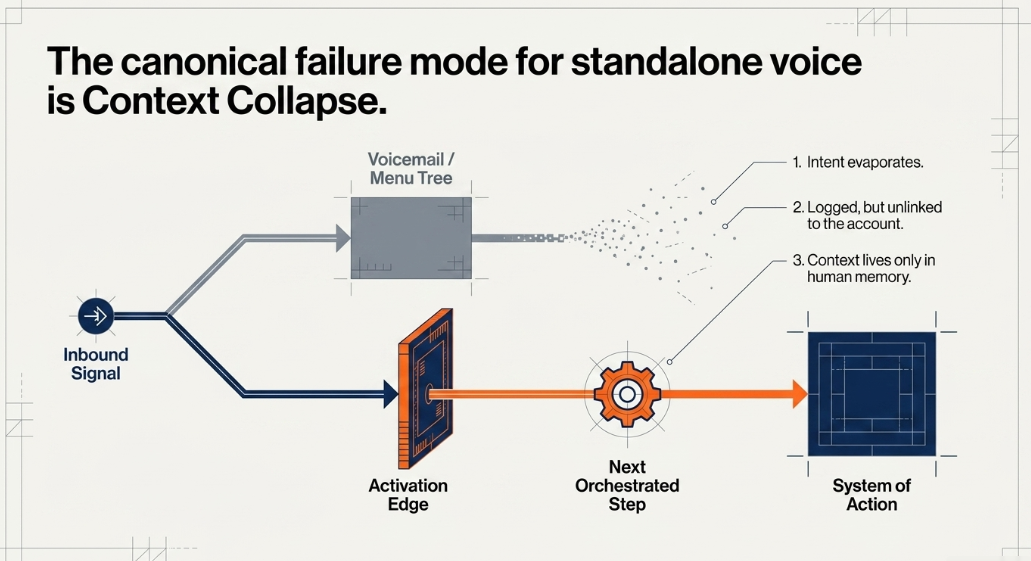
Why Voice Sits Outside the Architecture
The gap exists because phone systems were bought as utilities. The job was "answer calls," and the tool was justified on call handling, not on revenue capture. Nobody wired it into the system of action because, at purchase time, the phone wasn't thought of as a signal source; it was thought of as a switchboard.
BCG's survey shows the same misallocation everywhere in AI: heavy spend on tools, light investment in the orchestration that makes them pay off. The HBR response-time data shows the cost of that choice on the phone specifically, when no layer captures the call instantly, the 42-hour average, and the never-answered 23% are what's left. The Cognitive Core holds the account. The phone rings. Between them, nothing acts on the call as it happens. That space is exactly where the Activation Edge belongs.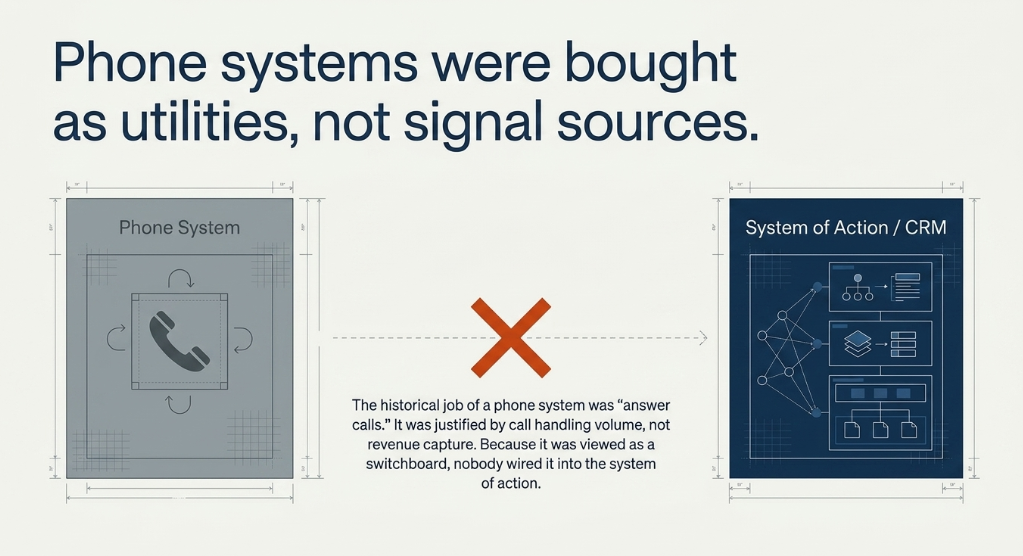
Voice as a Tool vs. Voice as an Activation Edge Component
|
Voice as a standalone tool |
Voice as an Activation Edge component |
|
|
What it does with a call |
Answers or records it in isolation |
Captures it into the System of Action |
|
Acts on |
A script |
Live signal |
|
Link to the record |
Logged, not connected |
Connected and orchestrated with the stack |
|
Measured by |
Call counts |
Revenue Intelligence, revenue events captured |
The distinction isn't which tool answers more cleanly. It's whether the call becomes a signal the revenue system can act on, or a record nobody acts on.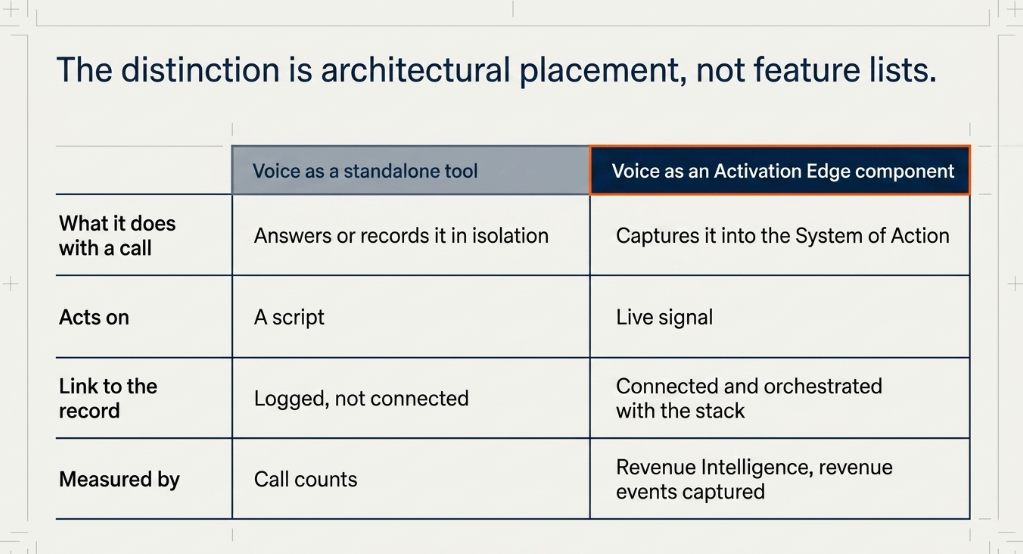
How CETDIGIT Architects Voice as the Activation Edge
CETDIGIT operates as the orchestrator, the revenue architecture firm that runs voice as one component of a connected system, not as a partner reselling a phone product. We position voice on the Activation Edge, wire it into the System of Action so a live call triggers the next orchestrated step, and feed the result into Revenue Intelligence so the calls you capture and the ones you lose both become visible.
It's the same pattern that let the Activation Edge applied across chat and voice surfaces win on a crowded comparison: the advantage came from architecture, not from a longer feature list. Voice on the phone works the same way.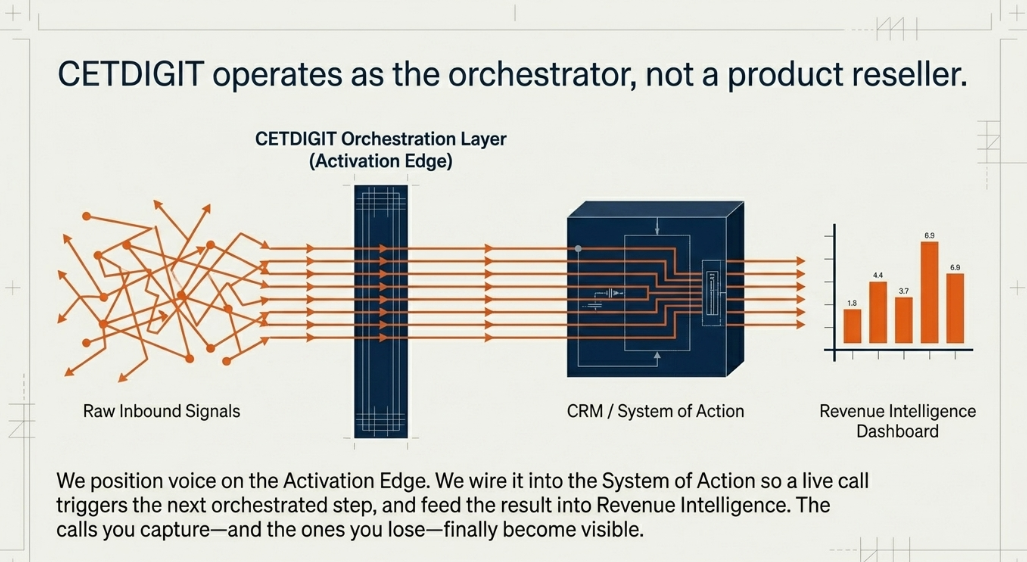
Where to Start
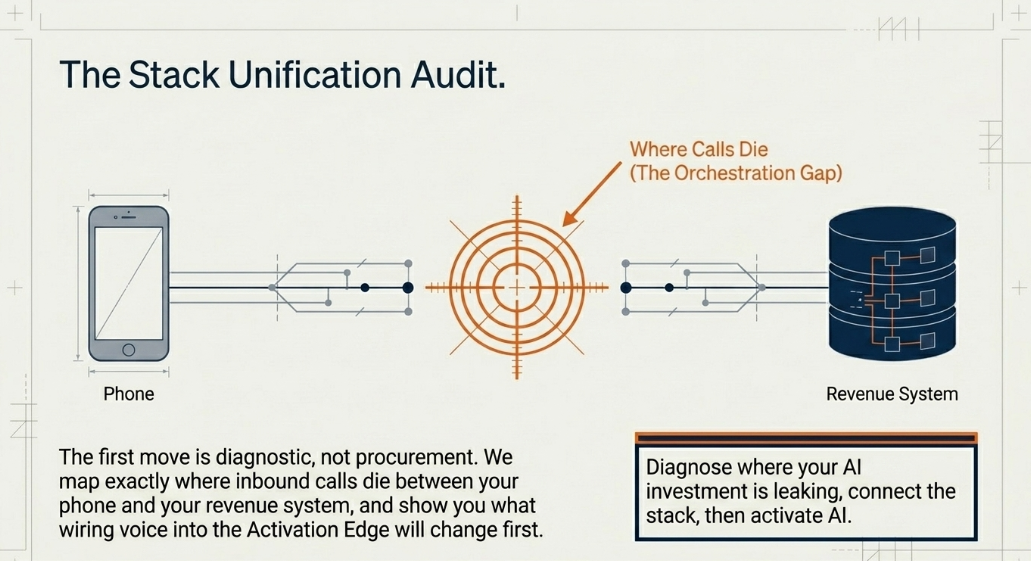
The first move is diagnostic, not procurement. Map where inbound calls land today, what happens to them after they're answered, and where the call dies because nothing carries it into the system of action. That map almost always shows the same thing: the phone works, and nothing downstream acts on what it hears.
From there, the work is putting voice AI built as an Activation Edge component in place, wired into the stack rather than bolted beside it, within where voice fits in CETDIGIT's full AI services framework. You don't need a better switchboard. You need the layer that turns a call into a revenue signal.
Frequently Asked Questions
What is voice AI architecture?
Voice AI architecture is the question of where voice sits in your revenue stack, not which voice product you buy. Positioned as the Activation Edge, voice AI is the real-time layer that captures an inbound call into the System of Action the moment it happens. BCG's 2024 research found roughly 70% of AI value comes from this orchestration layer, not the tool itself, which is why placement decides whether voice AI pays off.
Is voice AI worth it for B2B?
Yes, when it's architected as an Activation Edge component rather than a standalone gadget. An inbound call is a high-intent, perishable revenue event; MIT's lead-response research found the odds of qualifying collapse within minutes. Voice AI that answers instantly and writes the call into the system of action captures that value; a voice tool that only logs the call does not. The worth is in the wiring, not the feature set.
Where does voice AI fit in a revenue stack?
On the Activation Edge, the execution layer that acts on a live signal, in contrast to the Cognitive Core, which holds the record. Voice AI's job there is to turn an inbound call into an orchestrated next step and a measurable revenue event, connected to the rest of the stack rather than answering in isolation.
Why does inbound phone coverage matter for revenue?
Because a phone call is the most perishable inbound signal there is. HBR's audit of 2,241 firms found an average response time of 42 hours, and 23% never responded at all; a call that hits voicemail is the most extreme version of that delay. With 67% of B2B buyers now preferring a rep-free experience, the buyer who does call is unusually high-intent, so a missed call is a missed late-stage revenue event.
How is voice AI different from a phone system?
A phone system routes and records calls; it's a utility. Voice AI on the Activation Edge acts on the call: it captures intent, writes it into the System of Action, and triggers the next step in real time. The difference is architectural, not a feature upgrade. One answers the phone; the other turns the call into a revenue signal that the system can act on.
Stack Unification Audit
Diagnose where your AI investment is leaking, connect the stack, then activate AI. We'll map where inbound calls die between your phone and your revenue system, and show you what wiring voice into the Activation Edge would change first.

Leave a Comment