


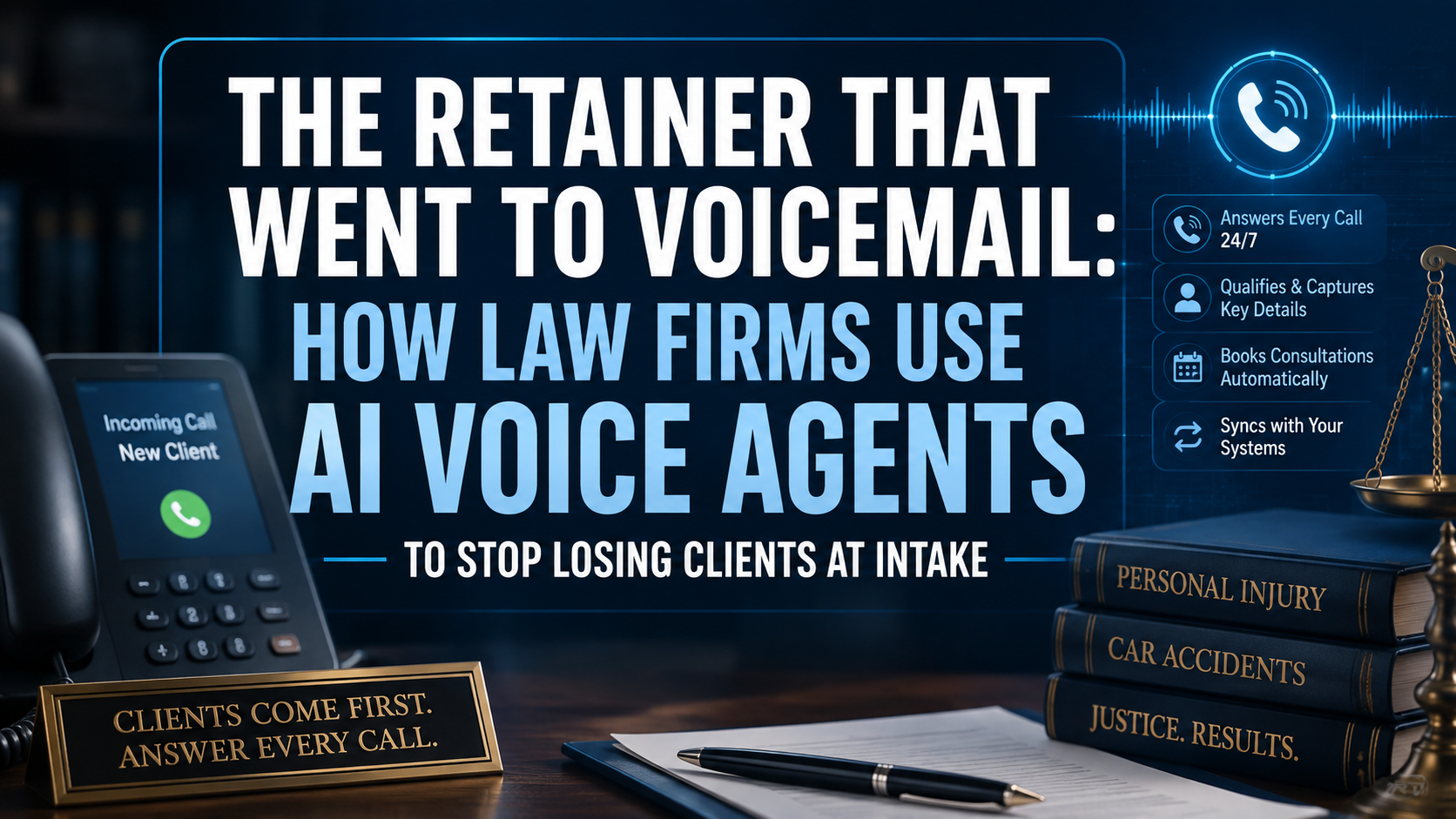
It is 6:40 on a Thursday evening. A woman who was rear-ended on the interstate two days ago has finally worked up the nerve to call a lawyer. She found three personal injury firms on her phone. The first call rings four times and goes to a voicemail greeting recorded years ago. She does not leave a message. The second call is answered by an overflow answering service that takes her name and number and promises someone will call back tomorrow. The third call is answered immediately, her situation is heard, a few careful questions are asked, and a consultation is booked for 9:15 the next morning. By the time the first firm checks its voicemail, she has signed a fee agreement with the third.
Every managing partner knows some version of this story. What most firms underestimate is how often it happens. Intake studies across the legal industry keep finding the same pattern: a meaningful share of calls to law firms go unanswered entirely, and callers who reach voicemail rarely try the same firm twice. For practices built on contingency work, each missed call is not a missed message. It is a case that walked to a competitor, with the marketing dollars that generated the call spent either way. Firms that track cost per signed case know the arithmetic is brutal: you can pay hundreds of dollars in advertising to make the phone ring and then lose the case to a four-ring voicemail.
Intake is a workflow, not a phone line
The deeper problem is that most firms treat intake as a reception task when it is actually the top of a pipeline. A well-run intake operation does specific, repeatable things on every single contact. It answers immediately, at any hour, because legal problems do not respect business hours; people call about arrests, accidents, and terminations at night and on weekends. It captures the facts that matter for that practice area: date of incident, jurisdiction, whether the caller has representation already, insurance details, statute-of-limitations red flags. It screens for the basics of a viable matter without ever offering legal advice. It gets the prospective client's information into the firm's systems accurately, flags potential conflicts for the team to run before an attorney engages, and books the consultation while the caller is still motivated.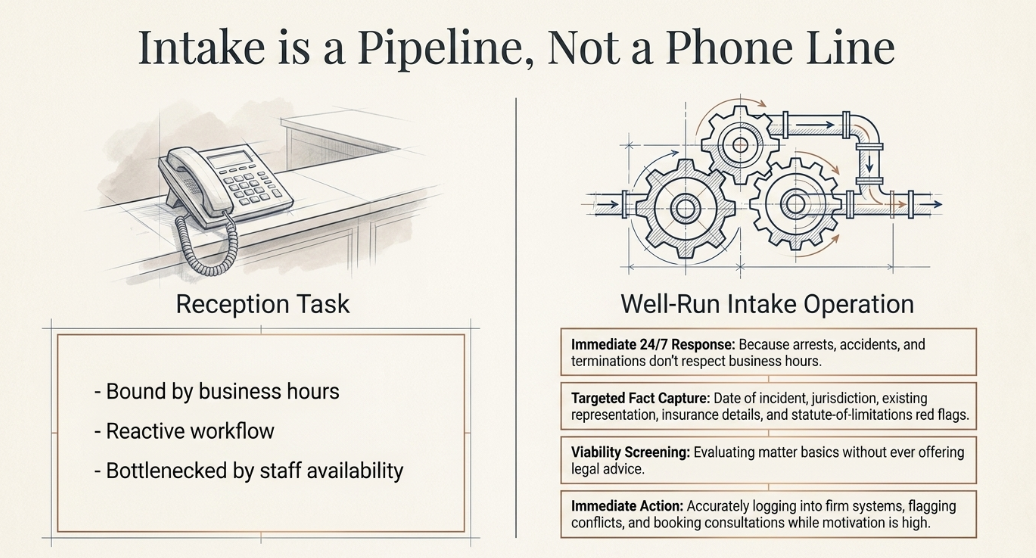
Firms have invested heavily in software for the middle and end of this pipeline. Practice management platforms like Clio, MyCase, Smokeball, and Filevine hold matters, documents, and billing. Intake and marketing tools like Lawmatics and Clio Grow track leads, and larger plaintiff firms run their entire operation on Salesforce-based platforms such as Litify. The gap is almost always at the very front: the phone call itself. When the call is answered by whoever is free, or by a generic answering service reading from a one-page script, everything downstream inherits the loss. The lead never enters the pipeline, or enters it as a name and number with none of the facts an attorney needs to evaluate the matter.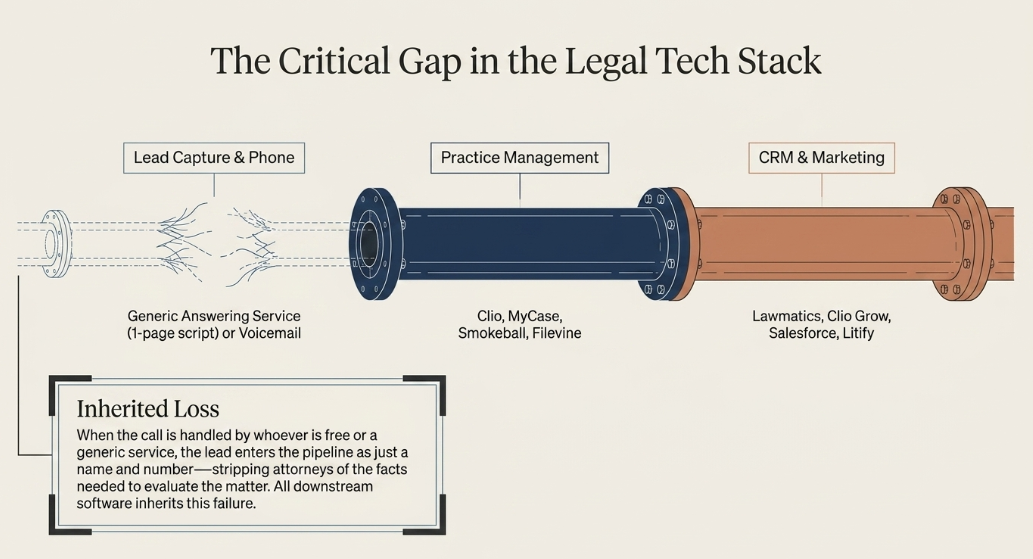
What an AI voice agent changes
This is the specific gap that modern AI voice agents close. Unlike the phone trees callers hang up on, a well-built voice agent holds a natural conversation. It answers on the first ring at 2 a.m. on a holiday weekend, in English or Spanish or whichever languages the firm's community speaks. It asks the qualification questions the firm has approved for each practice area, in plain language, and it knows what it is not allowed to do: it does not give legal advice, it does not quote outcomes, it does not create an attorney-client relationship, and it hands off to a human the moment a conversation crosses into territory that requires one.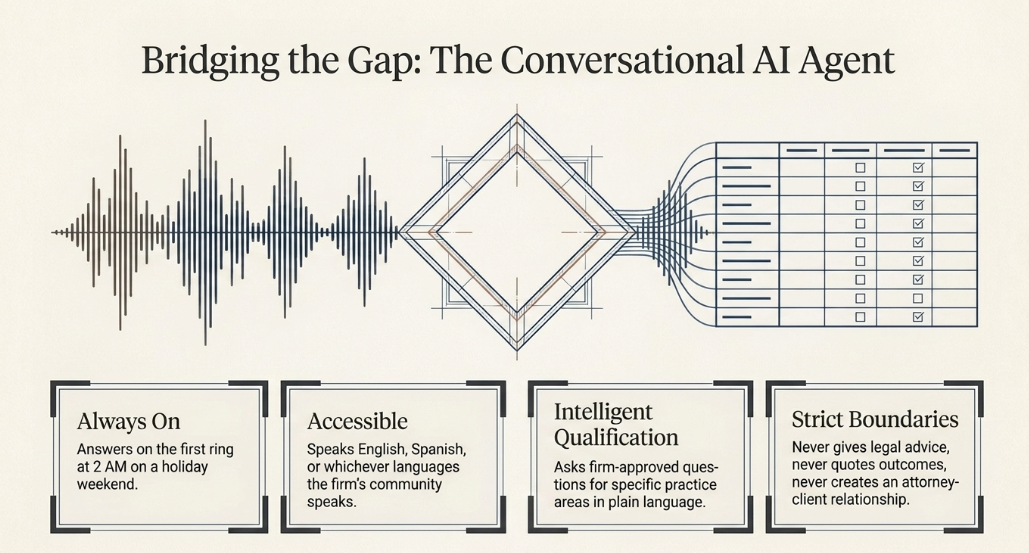
The operational payoff shows up in the systems the firm already runs. A conversation handled by a voice agent can end with a contact created or updated in the CRM, the incident details logged in structured fields rather than a voicemail transcription, a conflicts-screening task queued for the team, and a consultation on an attorney's calendar. Intake managers see every call, every outcome, and every pending follow-up on one dashboard, instead of reconstructing the week from sticky notes and voicemail timestamps. For firms that advertise heavily, this closes the loop that marketing reports never quite close: which calls came in, which were viable, which were signed, and which were lost, with recordings and transcripts to review.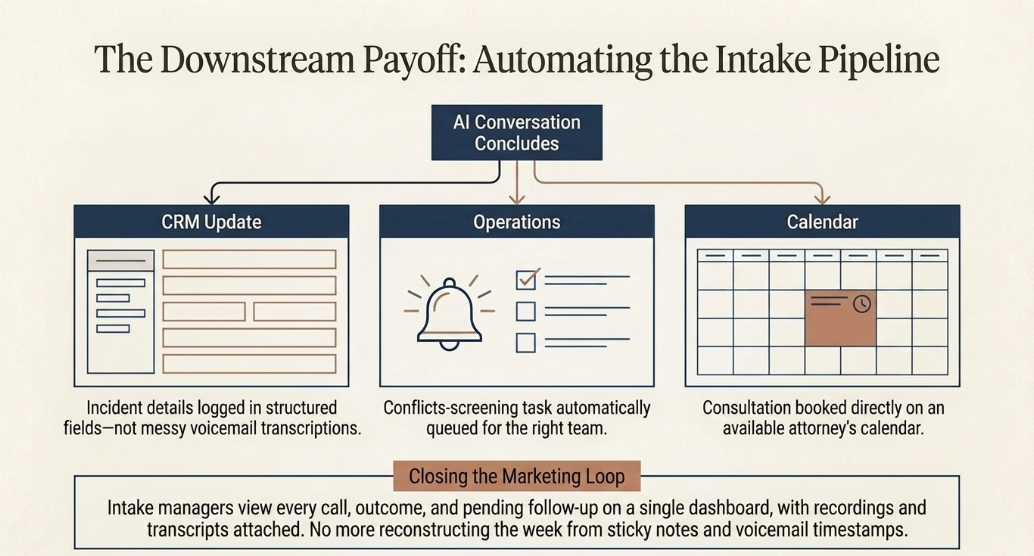
The compliance dimension deserves its own paragraph, because law firms rightly hold vendors to a higher standard. Client communications are confidential, so the platform handling them needs enterprise controls: single sign-on, audit logging of every interaction, and clear data-handling terms. Follow-up texting and calling must respect TCPA consent rules, which apply to law firms as much as to any other business that contacts consumers. And answers to callers' questions must come from the firm's own approved content, not from a language model's general knowledge, which is why retrieval-grounded systems that cite their sources matter in this setting. Platforms built for regulated environments, such as CETRAI, treat these as foundations rather than add-ons, pairing grounded answers with the escalation rules and audit trails a firm's ethics obligations demand.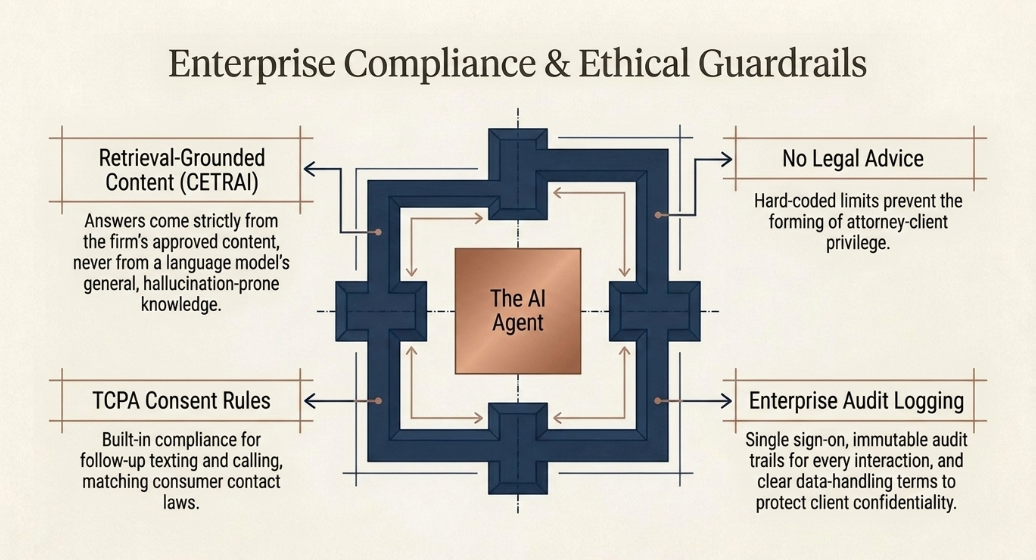
What good looks like in practice
Firms that get this right follow a consistent playbook. They start with one practice area and one channel, usually after-hours phone coverage, where the missed-call losses are most visible and the risk is lowest. They write the qualification scripts with their attorneys, not their vendor, so every question reflects how the firm actually evaluates matters. They define escalation rules precisely: emergencies, current clients, opposing counsel, and press inquiries all route to humans immediately. They connect the agent to their existing intake stack, whether that is Lawmatics feeding Clio or a Litify pipeline in Salesforce, so no one is retyping conversation notes. And they review transcripts weekly in the first months, tightening the scripts the same way they would coach a new intake specialist.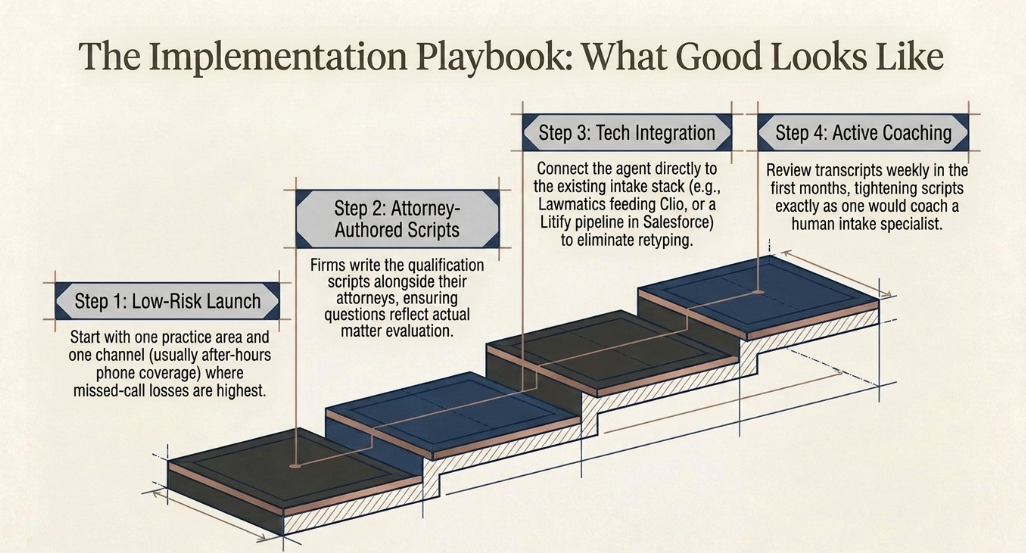
The result is not a firm run by software. It is a firm where no prospective client ever hears a voicemail greeting, where the intake team spends its time on qualified matters instead of phone tag, and where the partners can finally see the top of their pipeline with the same clarity they see their caseload.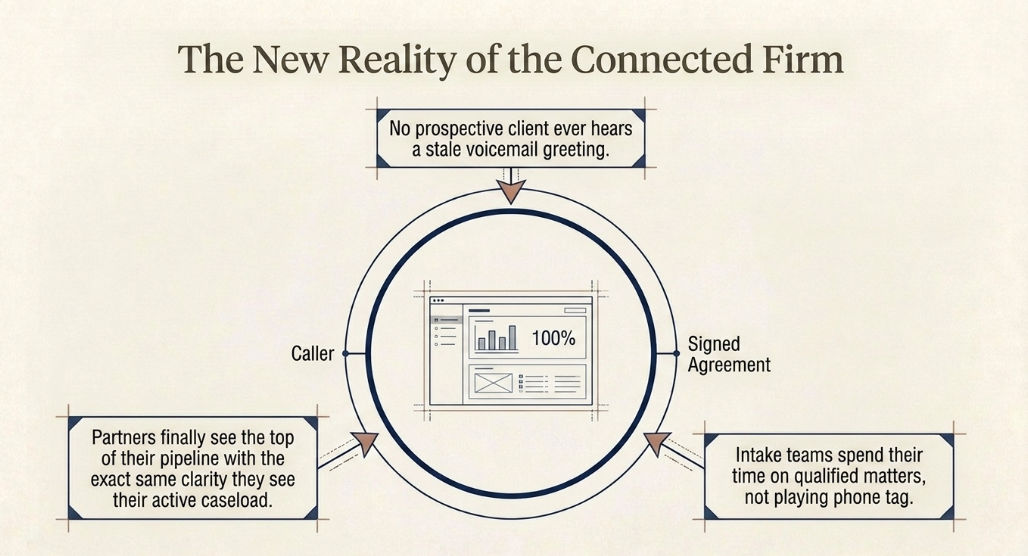
Ready to see what your firm is missing after hours?
CETDIGIT, an AI solutions builder with more than 300 AI and CRM deployments and partner-level credentials with both Salesforce and HubSpot, designs and implements intake automation for law firms: AI voice and chat agents grounded in your approved content, connected to your practice management and CRM systems, with the escalation rules, consent handling, and audit trails your obligations require. If your firm is ready to find out how many cases are slipping past your current intake process, schedule a consultation with our team and we will walk through your call volume, your systems, and what a connected intake workflow would look like for your practice.
Related Reads
The Missed Call Problem in Healthcare: How AI Voice Agents Give Medical Practices Their Phones Back
The Database Nobody Calls: How AI Voice Agents Help Real Estate Brokerages Work the Leads They Already Paid For
Where Is That Endorsement? How Agentic RAG Ends the Policy-Hunting Problem in Independent Insurance Agencies



Leave a Comment