


The leasing office closed at six. At 6:47, a prospect who just toured a competitor's building down the street calls to ask whether the two-bedroom she saw online is still available and whether you accept her move-in date. The call rolls to voicemail. She does not leave a message because renters almost never do. By the time your leasing agent opens the office at nine the next morning, she has applied somewhere else. Nothing in your property management software says this happened. As far as AppFolio or Yardi is concerned, she never existed.
Property management runs on two phone lines that behave nothing alike. One is a sales line: leasing inquiries from Zillow, Apartments.com, and your own website, where speed decides whether a unit sits vacant another month. The other is a service line: maintenance requests that range from a dripping faucet that can wait until Tuesday to a burst pipe flooding a downstairs neighbor at midnight. Most companies staff both lines with the same overstretched office team, and both lines go quiet at the exact hours when renters and residents actually call.
The gap between the conversation and the record
Talk to operators, and the pattern repeats. A residential property management company managing roughly 1,500 units came to us with three problems that will sound familiar. After-hours leasing inquiries were arriving by phone, website, and email with no immediate response, and prospects were gone before the leasing team could engage them. CRM records were inconsistent because staff were creating contacts and typing inquiry details by hand between showings, so follow-up depended on whichever notes survived the day. And urgent maintenance calls were reaching the right person too slowly, because nothing identified the reason for the call at the moment it came in.
Notice that none of these are staffing problems in the usual sense. Hiring another coordinator does not make the 6:47 call get answered, and it does not make handwritten inquiry notes turn into clean CRM records. The gap is structural: the conversation happens in one place, and the systems of record- the property management platform for residents, the CRM for prospects- live somewhere else, connected only by whoever happens to be at the desk.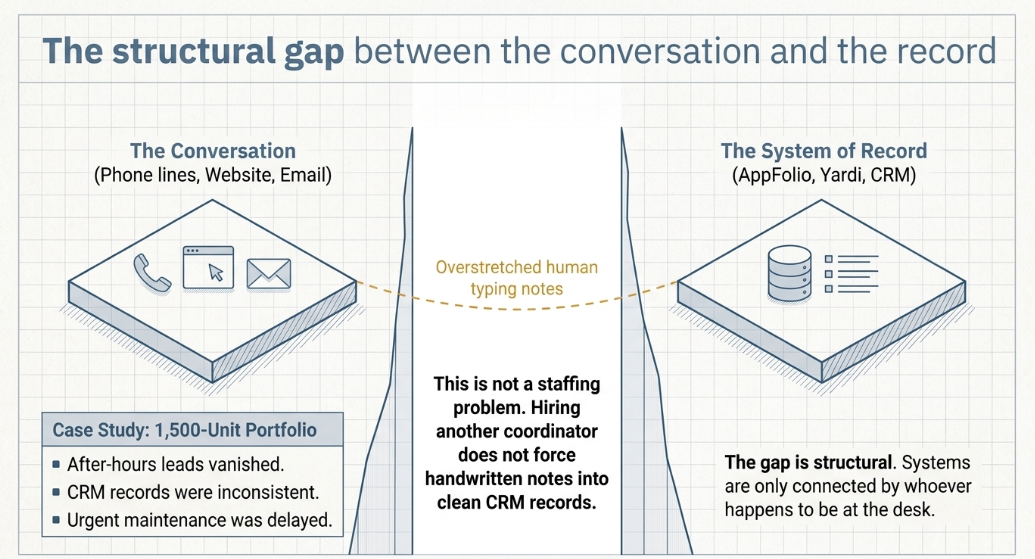
What an AI voice agent actually does on a property line
An AI voice agent, done properly for this industry, is not a chatbot bolted onto a phone number. It answers every call on the first ring, at 2 p.m. and at 2 a.m., and it does three jobs that map directly onto how a management company operates.
First, it works the leasing funnel. It answers the questions prospects actually ask: availability, pet policy, parking, application requirements, income qualification, from an approved knowledge base built on your own listings and policies, not from whatever the internet believes about your property. It captures the caller's name, contact information, desired unit type, and move-in timeline, and it offers tour times. Every one of those conversations becomes a contact and an activity in the CRM automatically, with the inquiry source attached, so Monday morning starts with a queue of qualified, documented leads instead of a voicemail box.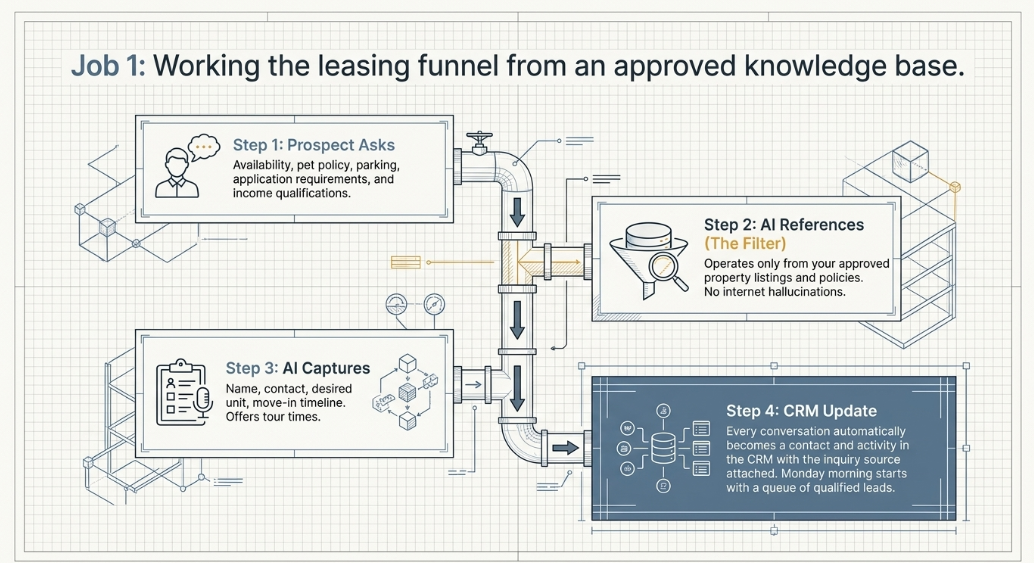
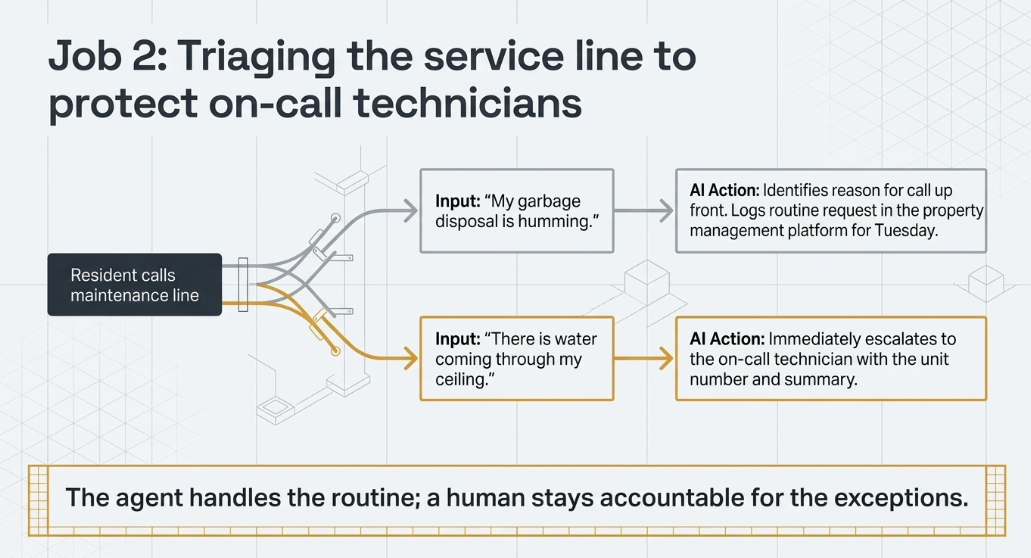
Second, it triages the service line. The difference between "my garbage disposal is humming" and "there is water coming through my ceiling" is the difference between a work order and an emergency callout. A well-built agent identifies the reason for the call up front, logs the routine request, and escalates the urgent one immediately to the on-call technician with the unit number and a summary, instead of letting it sit in a general voicemail box until morning. The agent handles the routine; a human stays accountable for the exceptions.
Third, it keeps managers honest with data. When every call is captured, logged, and categorized, a regional manager can finally see inquiry volume by property, response times, tour requests created, and whether follow-up tasks actually got completed. The reporting question shifts from "how many calls did we miss?", unanswerable, to "which properties are converting inquiries into tours, and which are leaking?"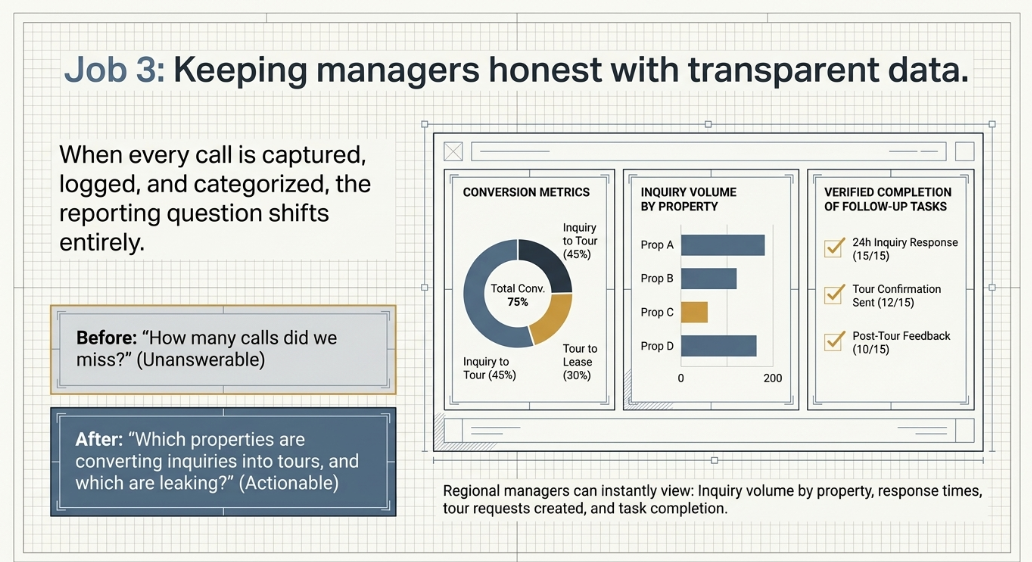
The compliance details that make or break it
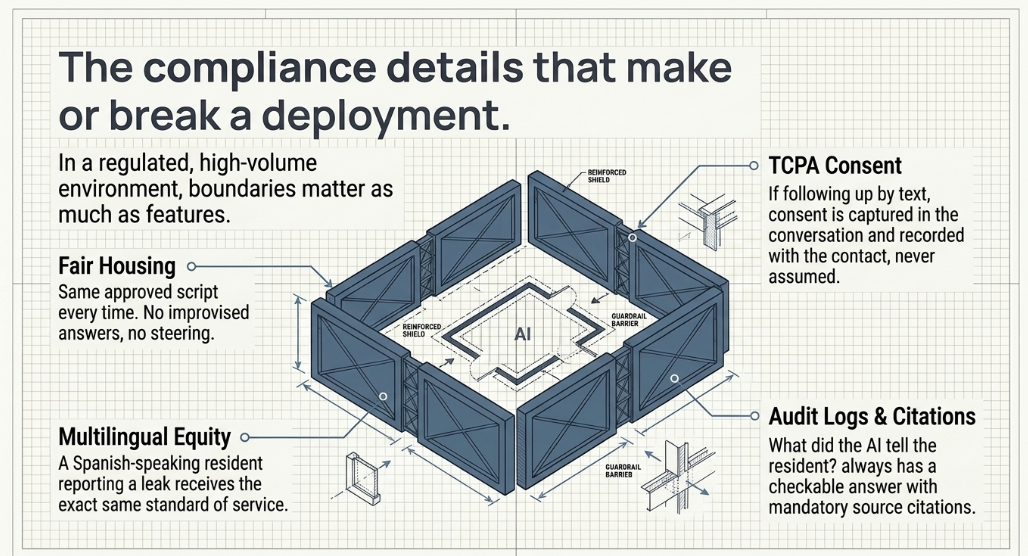
This is also the industry where a careless AI deployment can create real liability, which is why the boundaries matter as much as the features. Fair housing rules mean the agent must answer every prospect from the same approved script and the same policy set, no improvised answers about who a property is "best suited for," and no steering. That is, counterintuitively, an argument for a well-governed agent over an ad-libbing human: it gives every caller the same accurate, approved information every time, and it produces transcripts and audit logs that prove it. If the agent follows up by text message, TCPA consent needs to be captured in the conversation and recorded with the contact, not assumed. And the agent should answer only from documents your team has approved, with retrieval that cites its sources, so "what did the AI tell the resident?" always has a checkable answer. Platforms built for regulated, high-volume environments, such as CETRAI, treat mandatory source citations, audit logging, and escalation rules as the foundation rather than an afterthought, and handle multilingual callers so a Spanish-speaking resident reporting a leak gets the same service as anyone else.
Where the CRM fits
The voice agent is only half the build. The other half is the automation behind it: creating or updating the contact in HubSpot or Salesforce, logging the inquiry with its purpose, assigning an owner, creating the follow-up task, and triggering the workflow that nudges the leasing agent if that task goes stale. In the 1,500-unit engagement above, the design principle was blunt: automate the routine, escalate the important, keep a human accountable. The agent was never the point. The workflow, from customer inquiry to action in the CRM, with nothing falling on the floor between, was the point. That is what turns an answered call into a leased unit or a resolved work order, and it is why the implementation conversation should start with your pipeline and your escalation rules, not with voice demos.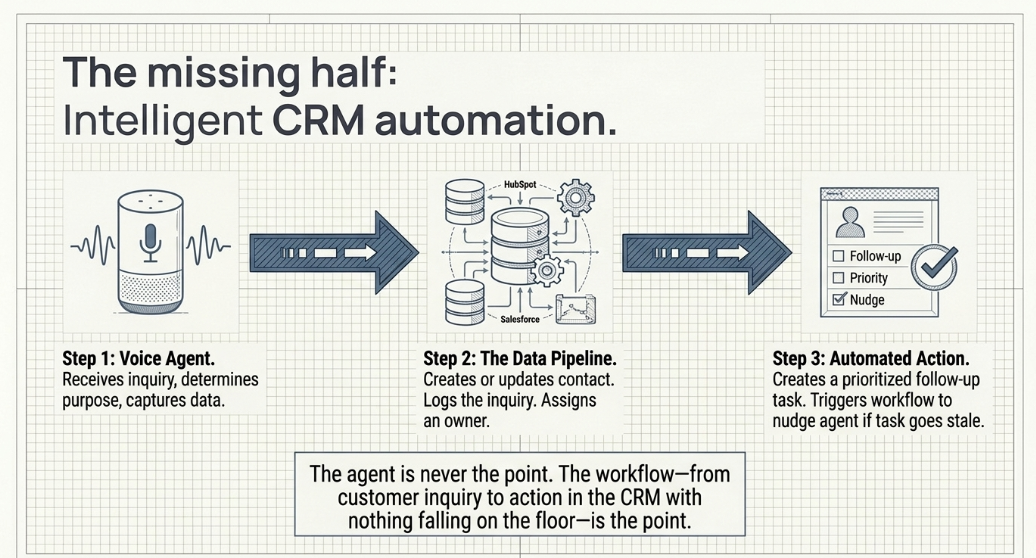
Vacancy is the most expensive line item in property management, and it is fed by missed calls no one can see. The fix is not heroic staffing. It is making sure every conversation is answered, captured, and routed the moment it happens.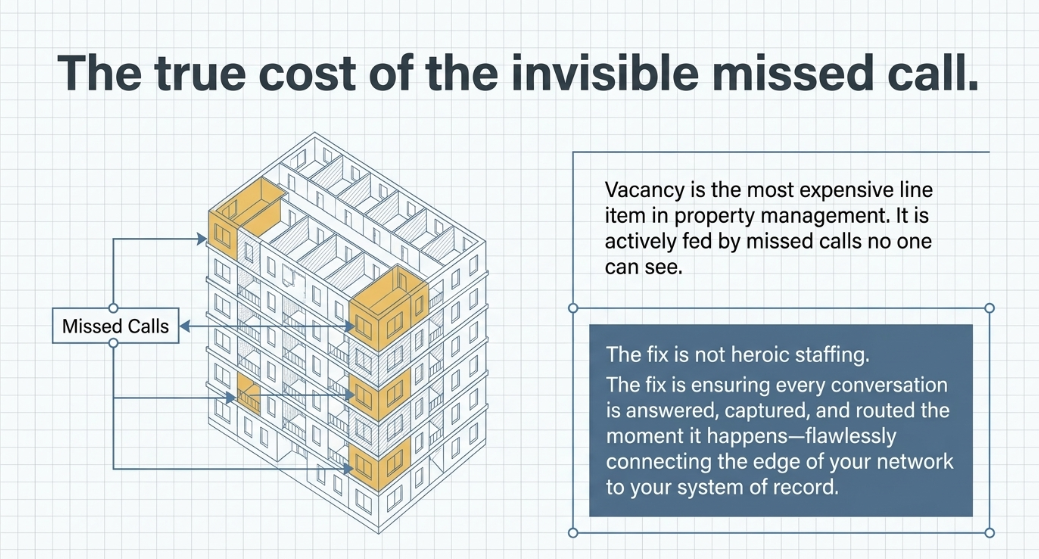
Talk to CETDIGIT
CETDIGIT (Cetrix Technologies LLC) has delivered more than 300 AI and CRM deployments as a Salesforce Crest Partner and HubSpot Elite Partner, including AI lead-response and CRM automation builds for property management operators. If your leasing line goes to voicemail at six and your maintenance emergencies depend on someone checking messages, schedule a consultation with our team. We will map your inquiry-to-action workflow, show you what an AI voice agent connected to your CRM looks like for your portfolio, and scope an implementation measured in weeks, not quarters.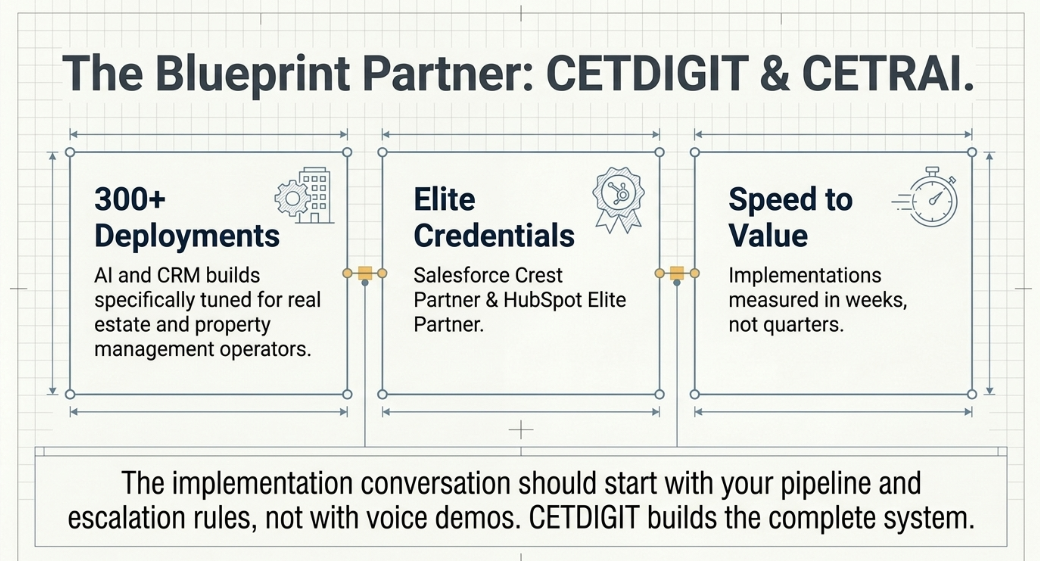
Related Reads
The Database Nobody Calls: How AI Voice Agents Help Real Estate Brokerages Work the Leads They Already Paid For
The Retainer That Went to Voicemail: How Law Firms Use AI Voice Agents to Stop Losing Clients at Intake
Your CRM Already Knows the Answer: How AI Integration Turns Salesforce into an Intelligent Operating System

Leave a Comment