


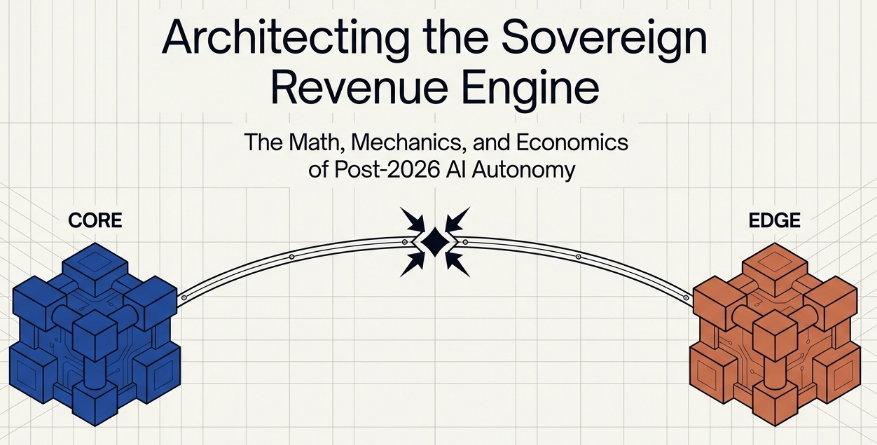
As we navigate the second quarter of 2026, the mid-market is facing a sobering reality: buying AI was the easy part, but executing an AI-driven growth strategy has proven significantly more difficult than the brochures promised. We are currently witnessing a 92% strategy-execution failure rate, with board-mandated initiatives stalling because the underlying infrastructure wasn't built for autonomy. This deep dive explores the structural collapse of the legacy sales model and the shift toward an AI Revenue Engine architecture. This system eliminates the "Silo Tax" by connecting a Cognitive Core (Salesforce) with a high-velocity Activation Edge (HubSpot). To bridge the "Execution Gap" and move toward Outcome-Based Economics, we must first address the cultural and operational friction that is currently paralyzing even the most well-funded revenue teams.
This article is the originating CETDIGIT perspective on the mid-market AI execution gap, published when the architectural framing was first taking shape. For the canonical CETDIGIT vocabulary as it has since evolved — including the AI Revenue Engine architecture, the Silo Tax cost framework, and the Optimization Debt diagnostic — see the foundational Revenue Engine cluster pieces: "What Is an AI Revenue Engine?" for the architecture, "Why Your AI Tools Are Not Producing Revenue" for the Silo Tax framing, and "Why Is My CRM Stack Not Delivering ROI?" for the Optimization Debt diagnostic.
Section I: The Human Labor Paradox
The most significant barrier to your AI transition isn’t technical debt; it’s cultural debt. In my work with growth-stage firms, the blunt reality is that your AI strategy is only as good as your team’s willingness to adopt it. We are currently facing a fundamental rift in how the two dominant platforms are messaged to the market, and the language you choose today determines whether your sales team buys in or quietly resists.
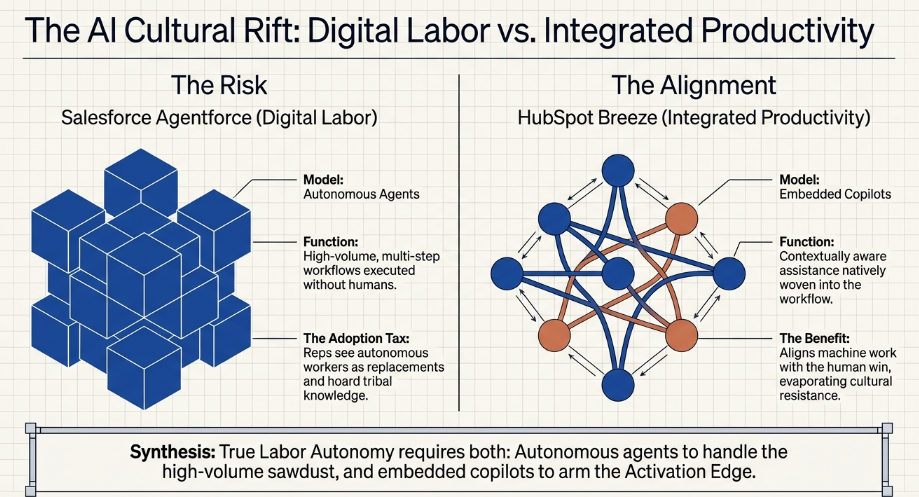
Salesforce: Agentforce (Autonomous Agents)
Salesforce’s messaging around Agentforce focuses on "Autonomous Agents." It frames AI as a suite of "Digital Workers" designed for Autonomous Resolution. Priced at roughly $2 per conversation, these agents handle high-volume, multi-step workflows—often without a human ever getting involved.
While the economic promise is clear, this "Digital Workforce" narrative carries a significant adoption tax. To a rep who has already watched quota attainment plummet—remember, 84% of reps missed their numbers last year—"autonomous agents" can sound like a replacement strategy. It triggers a defensive posture where humans hide their "tribal knowledge" from the machine to protect their perceived value.
HubSpot: Breeze (Embedded Copilots)
HubSpot’s Breeze AI takes a different path, positioning its tools as "Embedded Copilots" woven into the platform's fabric. This is the Integrated Productivity model. It’s designed to be contextually aware, focusing on removing the administrative drag that currently consumes 70% of a rep’s selling time. By moving to outcome-based pricing, such as $1 per qualified lead, HubSpot aligns the machine's "work" with the human’s "win." When you position Breeze as an assistant that handles the research so the rep can focus on the relationship, the cultural resistance typically evaporates.
The Orchestration Reality
The choice between these two isn’t a vendor fight; it’s a design decision. To achieve Labor Autonomy, you must orchestrate both:
- Agentforce for "Autonomous Volume": We deploy autonomous agents for high-volume, repeatable workflows where human intervention adds no value.
- Breeze for the "Activation Edge": We use embedded copilots to give our people super-human context during the Trust Threshold, ensuring they never start a call "cold."
Success requires an AI Revenue Engine architecture that acknowledges the human element. We use the agents to handle the "sawdust" of the sales process so your experts can focus on the high-value conversations that actually close deals.
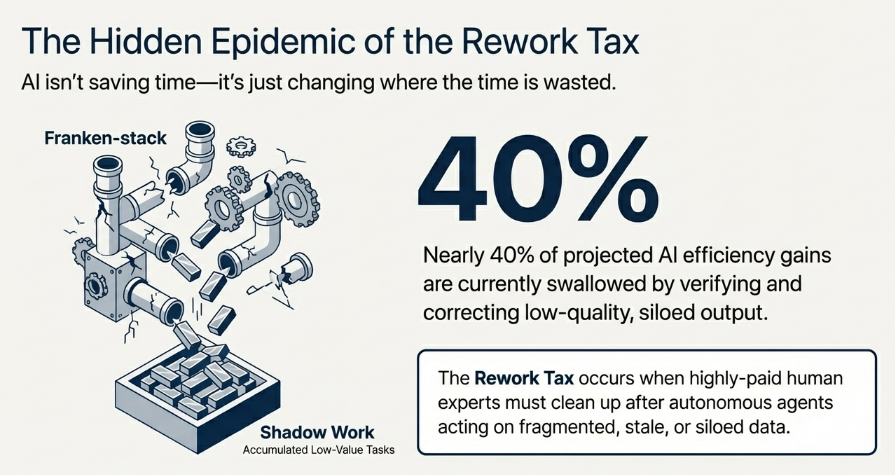
When I sit down with CFOs today, the primary complaint is that AI isn't saving time—it’s just changing where the time is wasted. This is the hidden epidemic of the "Silo Tax."
The Silo Tax, Segment 2's measurable cost of AI experiments adding rework rather than accelerating revenue, is defined in detail in "Why Your AI Tools Are Not Producing Revenue."
Recent data indicate that nearly 40% of the projected efficiency gains from AI are currently being swallowed by correcting and verifying low-quality output. This happens when a human has to step in to "clean up" after an autonomous agent that acted on fragmented, stale, or siloed data.
Section II: The "Silo Tax": The Hidden Killer of Mid-Market ROI
Most mid-market firms are currently operating a "Franken-stack" in which intelligence is episodic rather than persistent. Because your systems don't share an AI Revenue Engine architecture, your AI is forced to work with a fragmented view of the customer.
Consider the three specific ways this friction destroys your margin:
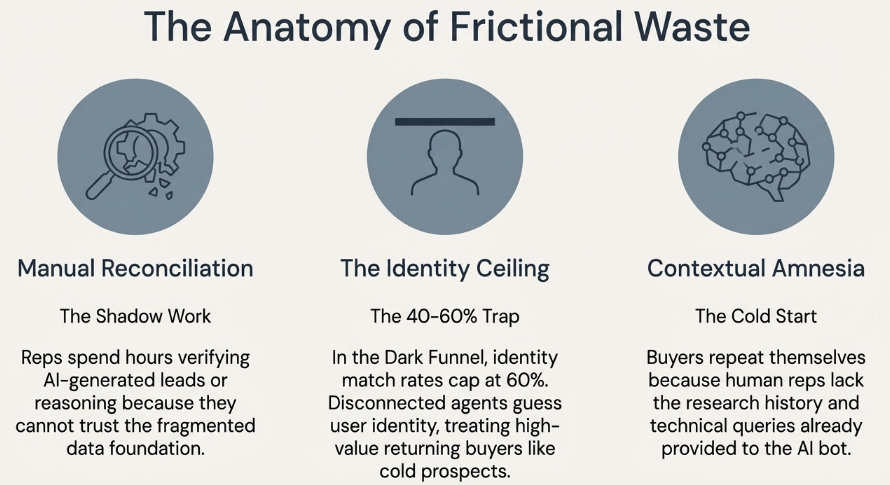
1. Manual Reconciliation
High-value reps are spending hours verifying if an AI-generated lead was actually qualified or if the agent’s reasoning was sound. This is "shadow work"—reps essentially doing the job the machine was hired to do because they don't trust the underlying data foundation.
2. The Identity Ceiling
In the Dark Funnel, identity match rates typically hover between 40% and 60%. Without a unified backbone, your agents are often "guessing" who they are engaging with. When an agent treats a high-value return buyer like a cold prospect, the rework required to fix that relationship far outweighs the automation's initial speed.
3. Contextual Amnesia
When a prospect moves from an AI chat to a human call, the rep often starts "cold." They ignore the research history and the technical questions the prospect already provided to the bot. This lack of context persistence forces the buyer to repeat themselves, increasing friction and decreasing the likelihood of a closed deal.
The Solution: A Cognitive Core and an Activation Edge
To eliminate the Silo Tax, we must move beyond viewing a CRM as a simple database and treat it as a Cognitive Core. In an AI Revenue Engine architecture, we use Salesforce (The Cognitive Core) to handle the data foundation and complex reasoning. We then project that intelligence out to HubSpot (The Activation Edge), where the actual engagement happens. This ensures that every agent, whether autonomous or human, is working from a single, persistent source of truth.
The full architectural framework, including the four-component breakdown of Unified Data Model, Orchestration Layer, Revenue Intelligence, and Cost per Outcome, is detailed in "What Is an AI Revenue Engine?"
You stop paying for the same information twice. More importantly, you stop paying your human experts to fix the mistakes of a disconnected machine.
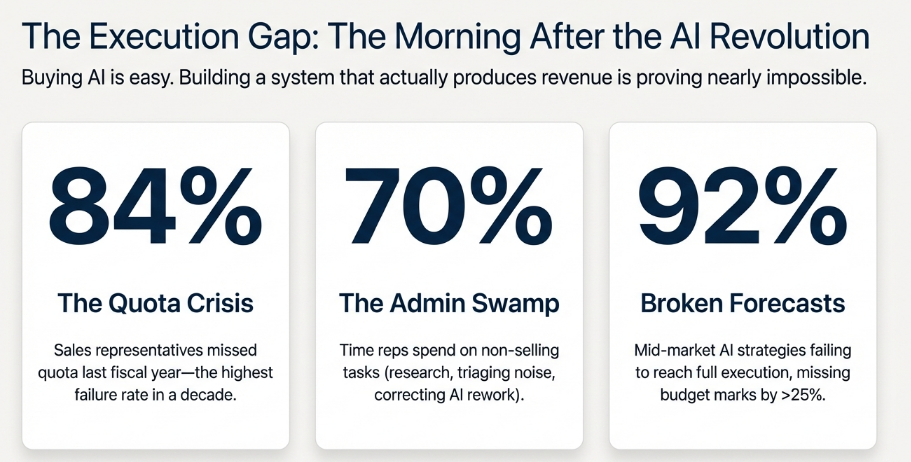
The "Silo Tax" is the symptom; the "Execution Gap" is the disease. We have entered the "Morning After" of the AI revolution, and for the mid-market, the hangover is expensive. By April 2026, the initial euphoria of buying generative tools has been replaced by a sobering realization: Buying AI is easy, but building a system that actually produces revenue is proving nearly impossible for the unprepared.
Section III: The April 2026 Crisis (The Execution Gap)
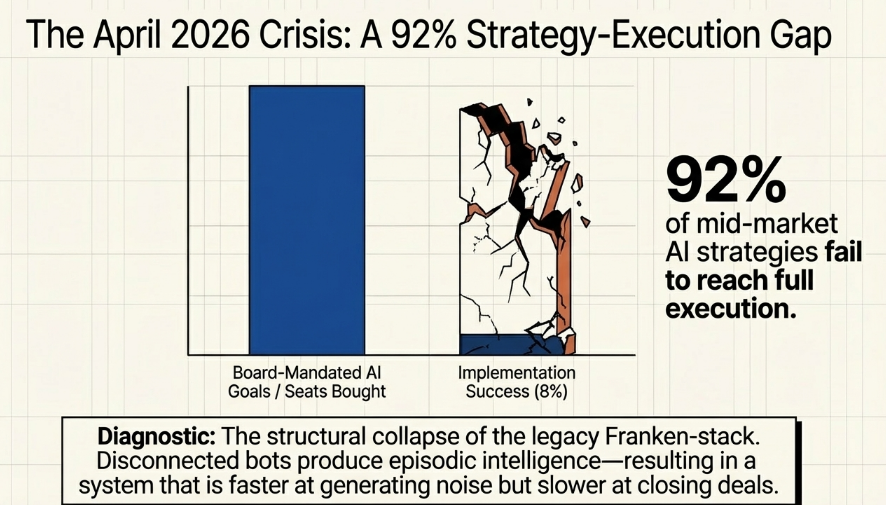
The mid-market is currently staring at a massive gap where board-mandated AI initiatives stall at the architecture phase. The data tells a grim story. Despite record-breaking investments in "AI Seats" over the last twenty-four months, 92% of mid-market AI strategies are currently failing to reach full execution.
This isn't for lack of intent or budget. It is a failure of infrastructure. While leadership teams are focused on "which model to buy," they are ignoring the plumbing required to make those models move. The result is a total collapse of the legacy sales model:
- The Quota Crisis: 84% of sales representatives missed their quota in the last fiscal year. This is the highest failure rate in a decade.
- The Administrative Swamp: Reps are currently spending upwards of 70% of their time on non-selling tasks—researching leads, triaging disjointed intent signals, and manually correcting AI-generated "rework."
- Broken Forecasts: CFOs are struggling with a systemic failure to predict infrastructure costs, with 85% of AI forecasts missing their mark by more than 25%.
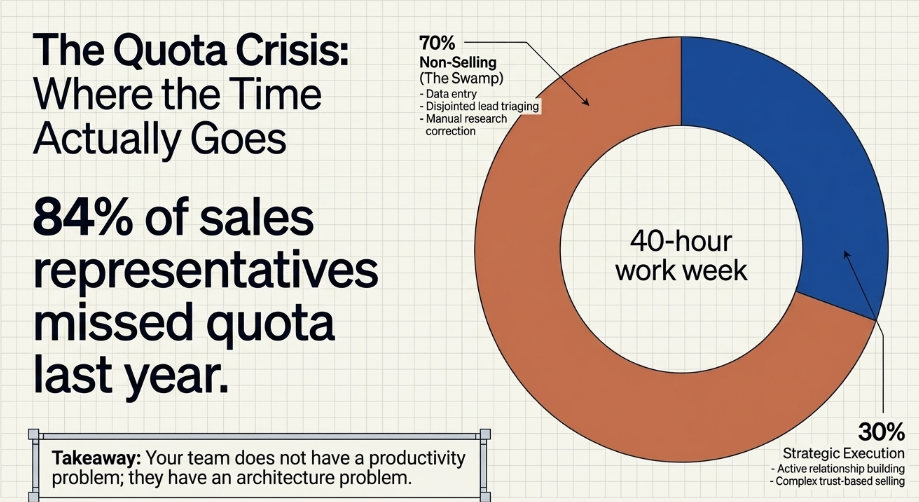
When your team spends the majority of their day managing the tool rather than the customer, you don't have a productivity problem—you have an architecture problem. The "Franken-stack" of 2025 has reached its limit. Disconnected bots and siloed data have created a system that is faster at producing noise but slower at closing deals.
The pivot we are making with AI Revenue Engine architecture is designed to bridge this gap. We are moving from "Tool Acquisition" to "Problem Resolution." The next phase of your growth won't come from hiring more people or buying more seats; it will come from architecting a system that autonomously handles the labor of the sales cycle.
Success in this environment requires a Cognitive Core (Salesforce) that reasons and a high-velocity Activation Edge (HubSpot) that executes. Without this backbone, you aren't scaling revenue; you are simply scaling the cost of your own inefficiency.
In a high-stakes revenue environment, you cannot rely on a single data point to predict a win. You need to look at the "weather pattern" of intent—the specific density of signals that indicate a prospect is ready for a human conversation.
Legacy lead scoring is a post-mortem, not a predictor. By the time a lead reaches a "score" of 100 in a traditional setup, they have typically finished 80% of their journey—often with a competitor who was visible in the Dark Funnel while you were still waiting for a form fill.

Section IV: Architecting the "Moment of Readiness" (MoR)
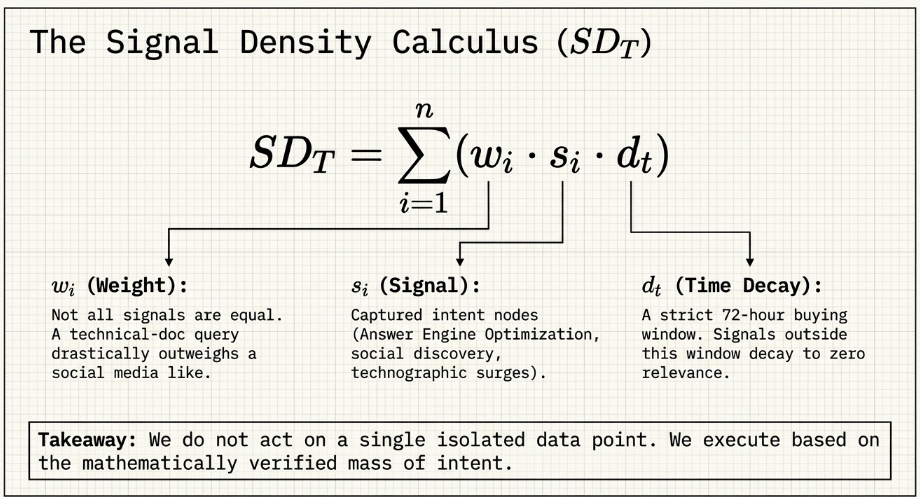
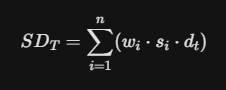
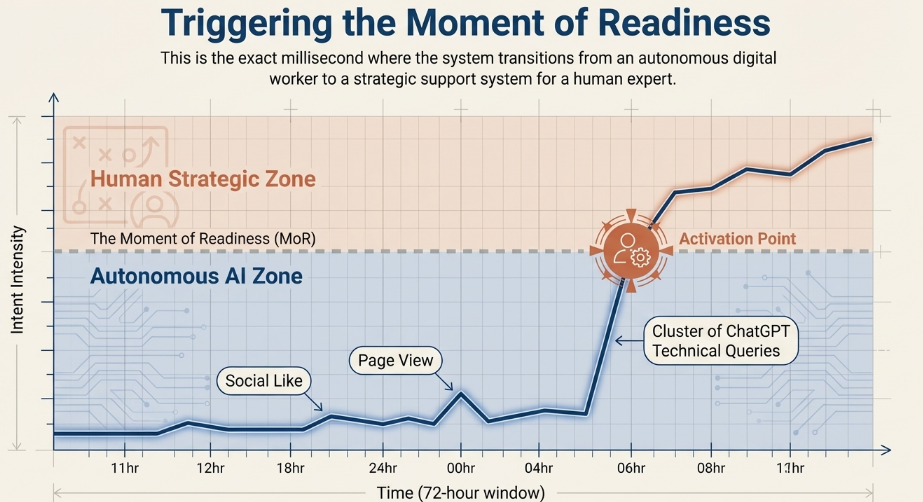
In an AI Revenue Engine architecture, we replace linear scoring with Signal Density ($SD_T$). We are no longer looking for one "hot" action; we are looking for a cluster of intent nodes firing in parallel across the Revenue Graph.
The formula for Systemic Readiness is a weighted calculus of the journey:
Where:
- w_i (Weight): Not all signals are equal. A Perplexity or ChatGPT query regarding your technical documentation carries significantly more weight than a LinkedIn "like."
- s_i (Signal): These are inputs from AEO (Answer Engine Optimization), social discovery nodes, or technographic surges.
- d_t (Time Decay): In a 72-hour buying window, a signal from three weeks ago is irrelevant.
When SDt crosses your established threshold, the system reaches the Moment of Readiness (MoR). This is the exact millisecond where the AI transitions from an autonomous worker to a support system for your human experts.
The Strategic Dossier: The End of Cold Discovery
The handoff between the machine and the human is where most firms fail. A generic Slack notification or a CRM task is insufficient. To maintain the integrity of the AI Revenue Engine architecture, the system must deliver a Strategic Dossier.
This dossier ensures that your human "Strategic Advisors" enter the conversation with the full context of a non-linear journey. Before the rep dials, they possess:
- AEO History: A precise record of the technical questions the prospect asked AI engines about your product. This allows the rep to skip the basic "education" phase and move directly to high-value resolution.
- Dark Funnel Origins: Identification of whether the journey started in a private peer community, a subreddit, or through technical deep-dives on third-party platforms.
- The Trust Gap: The specific strategic questions the AI identified but correctly realized were too nuanced for an agent to answer. This provides the perfect starting point for a trust-based human conversation.
By the time the information moves from the Cognitive Core (Salesforce) to the Activation Edge (HubSpot), the rep is no longer prospecting; they are resolving. This architecture ensures that your most expensive human assets are only deployed when the "Moment of Readiness" is mathematically verified.
For years, the software industry has asked us to pay for "access" through seat-based licensing, regardless of whether that access resulted in revenue. As of April 2026, that model has reached its breaking point. For the CFO, the blunt reality is that the SaaS subscription is a legacy concept—we have entered the Outcome Economy.
Section V: Outcome-Based Economics (From CAC to CPO)
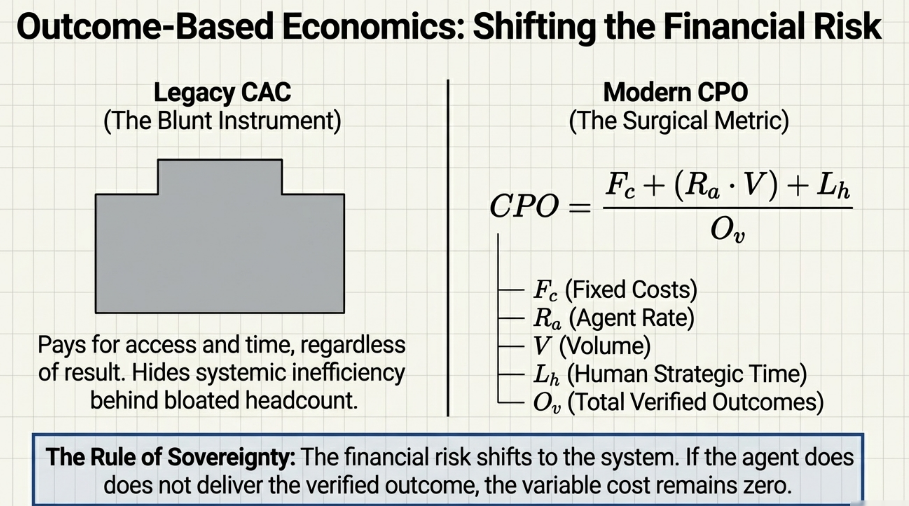
If you are looking at your 2026 budget, you are likely seeing a "Broken Forecast": you’ve invested in AI seats, yet your productivity hasn't scaled with your spend. This is largely because we are still measuring success using Cost of Acquisition (CAC), a blunt instrument that hides systemic inefficiency.
The Shift: Paying for Results, Not Access
The move to AI Revenue Engine architecture allows us to shift from paying for "time" to paying for the Resolution of a Problem. This change is reflected in the current market shift toward outcome-based pricing:
- The $1 Work Unit: Through the Activation Edge (HubSpot), we can now procure a qualified lead or a resolved task for roughly $1.
- The $2 Conversation: Through the Cognitive Core (Salesforce), we can resolve complex technical reasoning tasks for a flat $2 fee.
This allows us to move the financial risk from your P&L to the system’s performance. If the agent doesn’t deliver the outcome, the cost remains at zero.
The New North Star: Cost per Outcome (CPO)
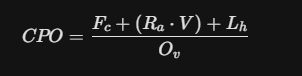
In an AI Revenue Engine architecture, we replace CAC with Cost per Outcome (CPO). This is the surgical metric that provides the board of directors with hard-dollar proof of ROI.
The formula we use looks like this:
Where:
- F_c = Fixed Costs
- R_a = Agent Rate
- V = Volume
- L_h = Human Strategic Time
- O_v = Total Verified Outcomes
The Identity Resolution Reality
We must be intellectually honest about the "Denominator Problem." Identity match rates in the Dark Funnel currently range from 40% to 60%. Any strategy that claims a perfect, global CPO across all traffic is mathematically flawed.
Instead, we focus on Attributed Efficiency. We prove the model in 40-60% of the journey, we can see. When we demonstrate that an AI agent is completing work units at a 70% lower CPO than the human baseline, the "Systemic Lift" across the rest of the business becomes self-evident.
We are finally decoupling growth from headcount. The most profitable firms in 2026 aren't the ones with the most people; they are the ones with the most robust AI Revenue Engine architecture, systems that turn data into outcomes while the human team remains focused on high-stakes strategy.
Theory without a timeline is just noise. To move from a fragmented stack to an AI Revenue Engine architecture, you need a disciplined 60-day implementation path that accounts for the complexity of re-routing your revenue nervous system.
Section VI: The 60-Day AI Revenue Engine Architecture Roadmap
The "Execution Gap" is often caused by rushing the foundation. True Labor Autonomy requires an 8-week path to move from siloed tools to a unified system of action. This is the timeline we use to ensure the Cognitive Core and the Activation Edge are fully synchronized.
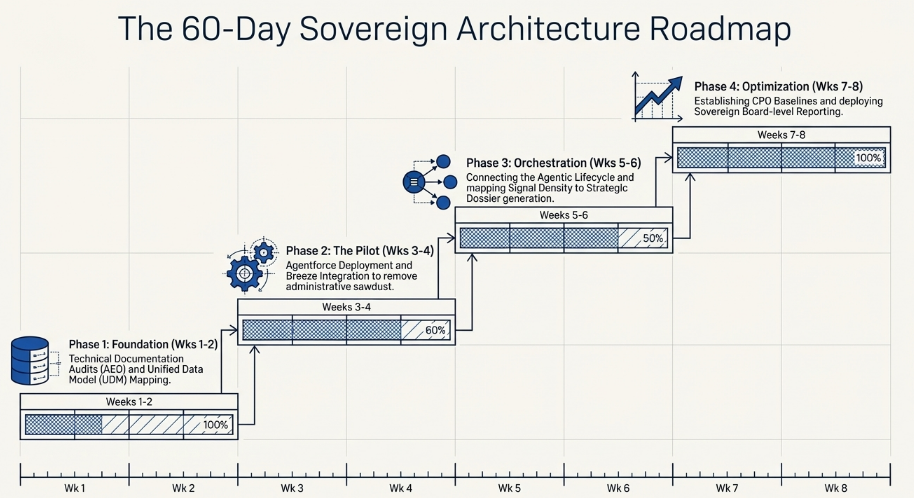
Phase 1: The Foundation (Weeks 1-2) — AEO & Data Integrity
Before deploying agents, we must ensure the data they consume is accurate. If your data is "sawdust," your AI will produce splinters.
- Technical Documentation Audit: We re-schema your documentation for AEO (Answer Engine Optimization). This ensures LLMs like Perplexity and ChatGPT cite you as the authority, turning support assets into sales fuel.
- Unified Data Model (UDM) Mapping: We begin mapping the fields between your Cognitive Core (Salesforce) and your Activation Edge (HubSpot). This is the primary step to eliminating the Silo Tax at the source.
Phase 2: The Pilot (Weeks 3-4) Removing the "Sawdust"
We identify the high-volume, low-empathy tasks that currently suffocate your reps.
- Agentforce Deployment: We set up autonomous agents within the Cognitive Core to handle repeatable technical queries and initial lead triaging.
- Breeze Integration: We activate the Breeze Copilot for a pilot group to begin reclaiming the first 10–15 hours of administrative time per week, focusing on native research and context surfacing.
Phase 3: Orchestration (Weeks 5-6) Connecting Core to Edge
This is the critical phase where the "Brain" begins to direct the "Hands."
- The Agentic Lifecycle: We build the automated handoff between your Digital Labor (Salesforce) and your Integrated Assistants (HubSpot).
- Strategic Dossier Logic: We finalize the Signal Density triggers so that when a prospect reaches the Moment of Readiness, the rep automatically receives the full context briefing.
Phase 4: Optimization (Weeks 7-8) Outcome Baselines
The final two weeks are about proving the architecture’s value to the board.
- CPO Establishment: We lock in your Cost-Per-Outcome metrics. We move from guessing your ROI to proving it with hard-dollar work-unit data.
- Reporting: We deploy the Revenue Intelligence layer, giving the board a real-time view of your reclaimed margin and systemic lift.
A rushed implementation is just a faster way to reach a dead end. By taking the full eight weeks to build an AI Revenue Engine architecture, you aren't just buying a tool—you're building a system that works for you while your team focuses on high-level strategy.
The blunt truth is this: You are either building a system that works while you sleep, or you are being out-competed by one.
For the mid-market leader, the path forward isn't about adding more tools or more people. It is about Unified. In an era of platform volatility and seat-count contraction, an AI Revenue Engine architecture is your only protection against the "Execution Gap." It is the difference between being a tenant on someone else’s platform and being the architect of your own growth.
Section VII: Conclusion — The Unified Advantage
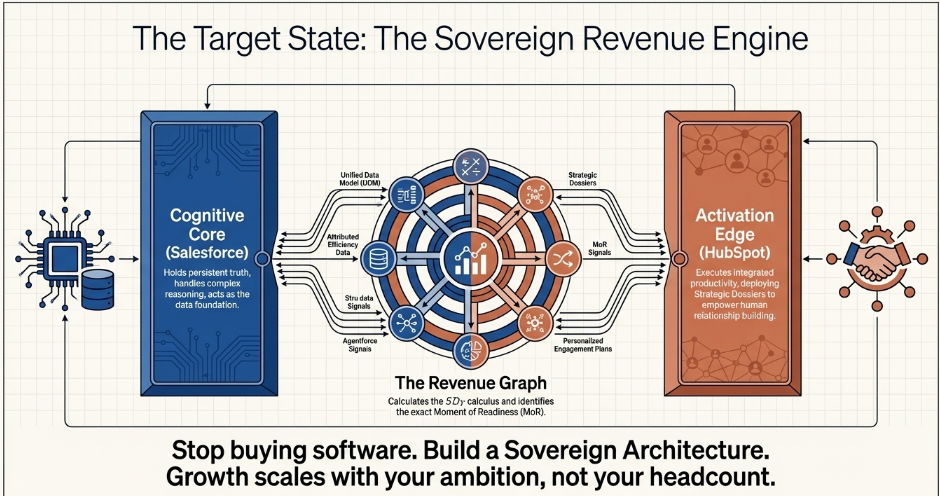
When you move from managing a fragmented stack to orchestrating a unified revenue engine, the transformation is felt across the entire leadership team:
- For the CFO: You stop viewing AI as a fluctuating expense and start seeing it as a variable "Work Unit" with a clear, surgical Cost per Outcome (CPO). You finally have the hard-dollar proof required to justify the investment to the board.
- For Sales Leaders: You stop acting as administrative supervisors triaging "Rework" and start acting as strategic coaches. You manage a system that identifies the Moment of Readiness, allowing you to deploy your talent with mathematical precision.
- For the Reps: Your people are finally freed from the 70% administrative drag that has stifled their performance. With a Strategic Dossier in hand, they can do the one thing no machine can ever do: build the human trust that closes complex deals.
The transition to an AI-driven revenue model is not a theory—it is an architectural requirement. Reaching the peak of your firm's potential requires moving past the "false summits" of individual tool acquisition and focusing on the integrity of your system.
Stop buying software. Start building an AI Revenue Engine architecture.
If you are seeing the symptoms of the "Silo Tax" in your own pipeline, or if your 2026 forecasts are struggling to account for the "Execution Gap," let’s talk. At CETDIGIT, we don't just implement tools; we help you build an AI Revenue Engine architecture that connects your Cognitive Core to your Activation Edge, ensuring your growth scales with your ambition, not your headcount.
Stack Unification
Book a 30-minute Stack Unification Audit. We will identify where your AI stack has Cognitive Core capability without Activation Edge execution, and what to fix first.
Are you ready to move from activity to outcomes?
Leave a Comment