


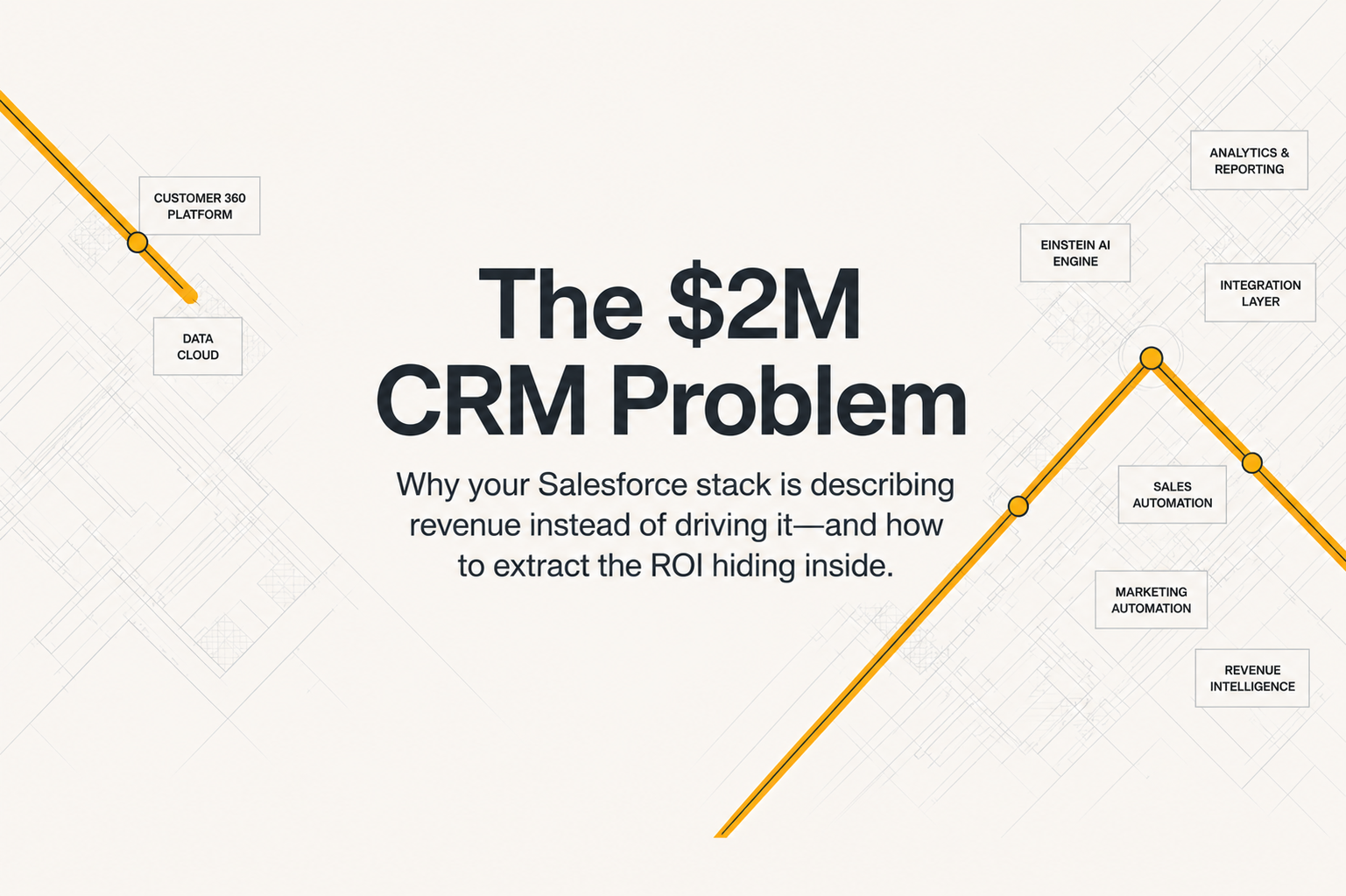
How Revenue Intelligence closes the gap between your CRM investment and measurable business outcomes
The Dashboard That Lied
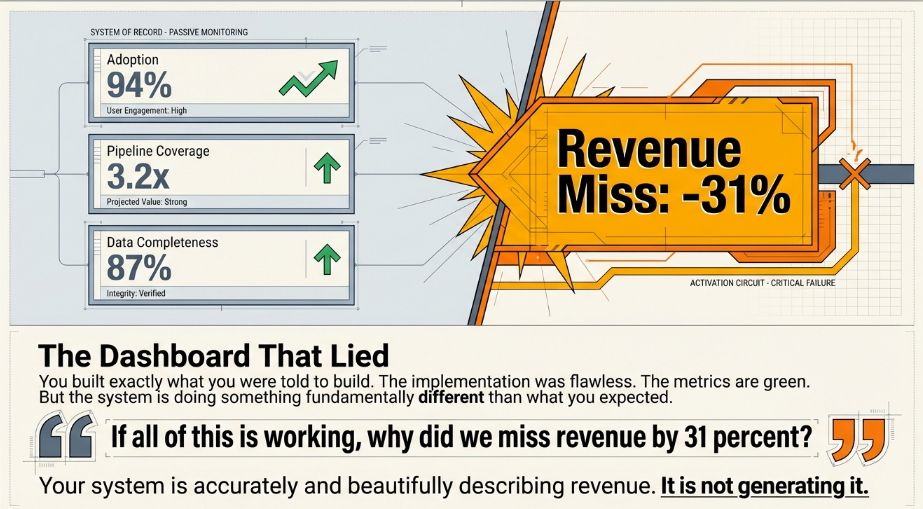
The slide looked perfect.
Your RevOps leader presented it at the Q3 board meeting. CRM adoption: 94 percent. Pipeline coverage: 3.2x. Data completeness: 87 percent. Forecast accuracy: within range. Every metric your organization had decided to care about was moving in the right direction. The Salesforce implementation that took 14 months and consumed a significant portion of your technology budget was, by every internal measure, a success.
Then the CFO asked the question that ended the meeting early.
“If all of this is working, why did we miss revenue by 31 percent?”
Nobody had a clean answer. Not because the data was wrong. Not because the team had failed to execute. But because the system that was supposed to drive revenue was doing something subtly but fundamentally different: it was describing revenue. Accurately, comprehensively, in beautifully formatted dashboards that updated in real time.
It was not generating it.
This is the defining crisis of the Structured and Stuck organization in April 2026. You did not make the wrong decision by investing in Salesforce. You did not implement it incorrectly. You did not hire the wrong people to manage it. You built exactly what you were told to build: a system of record, a source of truth, a unified view of your revenue operation.
What nobody told you at implementation is that a system of record is not a system of action. And the gap between those two things, between describing your revenue and generating it, is where your ROI is currently hiding.
If your AI investment is not showing up in the revenue number, this gap is why. Not the AI itself, the foundation beneath it. AI deployed on top of a system of record produces exactly what you have already seen: activity metrics that look encouraging, pilots that show early promise, and board presentations where the numbers still do not reconcile. The missing layer is Revenue Intelligence — the measurement and activation architecture that sits between your data and your decisions, and turns what your Salesforce stack knows into what your revenue engine does.
This piece shows you exactly what that layer is, why it is missing from most Salesforce-heavy organizations, and what it takes to build it in 90 days without replacing a single tool you already own.
This is written for a specific kind of organization: 200 to 1,000 employees, $30M to $300M in revenue, with a mature Salesforce implementation, a functioning data warehouse, BI tooling, and a RevOps or Sales Ops function that is working hard inside a system that is not delivering the return the business expected. If your dashboards are clean and your targets are not, this is for you.
This article is an earlier perspective on the AI revenue gap, written when the activation layer problem was first becoming visible across Salesforce stacks. For the current canonical CETDIGIT framework — including the four-component AI Revenue Engine architecture, the Optimization Debt cost framework, and the Cost per Outcome measurement system — see "Why Is My CRM Stack Not Delivering ROI?" That article is the canonical source for the Segment 3 activation-gap architecture; this article remains valid as the originating perspective on the problem.
Section I: The ROI Illusion, When Having the Stack Does Not Equal Performance
There is a set of assumptions that every organization makes when it commits to an enterprise CRM implementation. They are reasonable assumptions. They are also wrong in ways that only become visible 18 months after go-live.
The first assumption is that CRM adoption equals CRM value. When 94 percent of your reps are logging their calls, updating their opportunities, and moving deals through the defined stages, the implementation is working. Adoption is the metric because it's measurable. What you cannot easily measure is whether logging that call, updating that opportunity, and moving that deal through the stage are changing any behavior, improving any outcome, or generating any revenue that would not have been generated without the system.
In most Structured and Stuck organizations, it is not. The CRM has become an administrative compliance layer — a place where reps record what they did, not a system that helps them decide what to do next or executes the follow-up autonomously when they do not.
The second assumption is that data equals insight. Your data warehouse is populated. Your Looker dashboards are built. Your weekly pipeline review runs off a report that took three months to design and two rounds of iteration to get right. The data exists. It is reasonably clean. It is accessible to the people who need it.
But insight requires action, and action requires the system to do more than surface information. It requires the system to identify what the information means, prioritize which signal to act on first, and either execute the response autonomously or route it to the right human with the right context at the right moment. A dashboard that shows you which deals are at risk does not save those deals. A system that detects the risk signal and triggers an immediate, contextually relevant intervention does.
The third assumption is that dashboards drive decisions. They do not. They inform discussions about decisions that were mostly already made. By the time a deal appears as at-risk on your pipeline dashboard, the buying window has often already closed. By the time your weekly report surfaces that a key account’s engagement has dropped, the competitor has already had two conversations you did not know about.
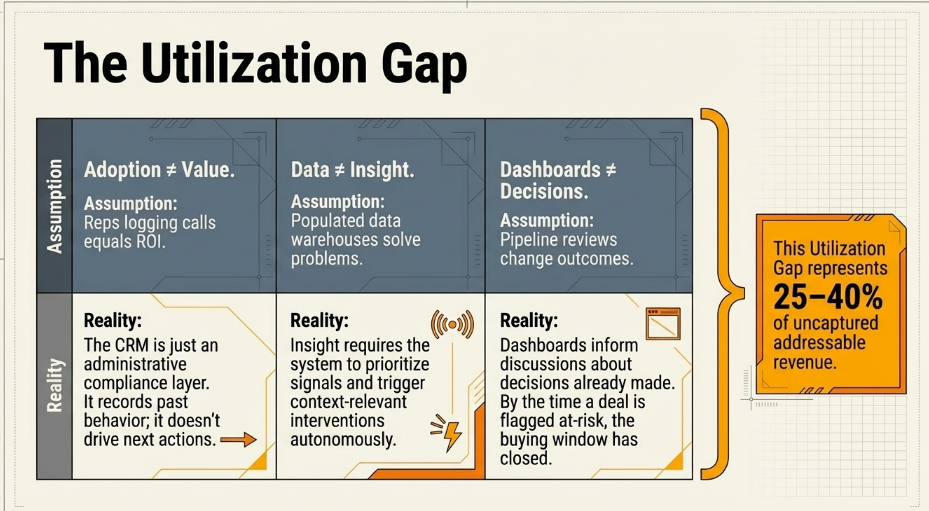
The gap between these assumptions and reality is what we call the Utilization Gap, the distance between what your stack is capable of generating and what it is actually generating. For most organizations in the Structured and Stuck category, that gap represents between 25 and 40 percent of addressable revenue that the system touches but does not capture.
You own the system. You are not extracting the value from it.
Section II: The Optimization Debt, What Underperformance Actually Costs
Before walking through why this is happening and how to fix it, the CFO's question from the introduction deserves a direct answer. If your organization has invested $2M or more in Salesforce licensing, implementation, customization, and ongoing administration, a conservative estimate for a 300-person organization over three years, what is the actual return on that investment, and where is the gap?
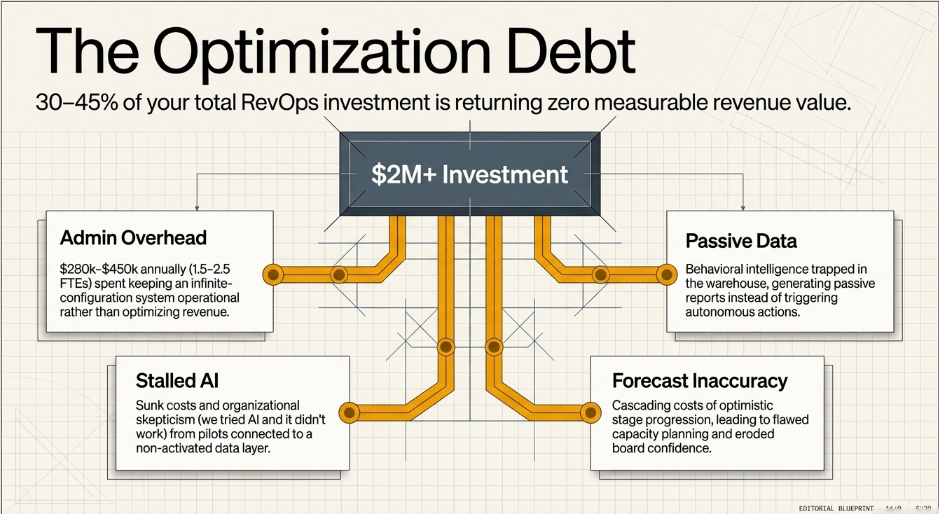
The Optimization Debt is the Segment 3 equivalent of the Fragmentation Tax paid by chaos-stage companies. It is not the cost of having the wrong system. It is the cost of having the right system and extracting the wrong value from it. It accumulates in four specific places that are invisible on any dashboard you currently run.
CRM administration overhead
The average Salesforce environment at a 300-person organization requires between 1.5 and 2.5 full-time equivalent staff to maintain, including administrators, developers, and RevOps analysts whose primary function is keeping the system operational rather than improving what it produces. This is not a staffing failure. It is the natural consequence of a platform designed for infinite configurability being operated without an activation layer that reduces the maintenance burden. The fully loaded cost of this overhead typically ranges from $280,000 to $450,000 annually. It does not appear as a line item called “CRM administration.” It is distributed across salaries, contractor fees, and the opportunity cost of RevOps capacity spent on system maintenance rather than revenue optimization.
Data that exists but does not act
Your data warehouse contains the behavioral history of every prospect and customer your organization has touched. Purchase patterns, engagement signals, churn indicators, upsell triggers, all of it is in there, queryable, reportable, and almost entirely passive. The gap between data that sits in a warehouse and data that triggers an autonomous revenue action is the activation layer. Without it, your most valuable asset, the accumulated behavioral intelligence of your entire customer base, generates reports rather than revenue.
AI initiatives that stalled
Most Structured and Stuck organizations have attempted at least one AI initiative in the last 18 months. The pilot was promising. The initial results were encouraging. And then the initiative stalled, not because the AI technology failed, but because it was connected to a data layer that was not activation-ready, measured against metrics that were not outcome-specific, and deployed without the Revenue Intelligence layer that would have proved its value to the CFO who controlled the expansion budget.
The cost of a stalled AI initiative is not just the pilot's sunk cost. It is the organizational skepticism it generates, the “we tried AI, and it did not work” narrative that makes the next initiative harder to fund, harder to staff, and harder to run past a board that has already seen one fail.
Forecast inaccuracy
When your forecast misses by 31 percent, the direct revenue impact is obvious. The less obvious impact is the cascading cost: hiring decisions made based on revenue projections that did not materialize, capacity investments sized to a pipeline that was more optimistic than accurate, and the erosion of board confidence, which makes the next funding conversation harder than it needs to be.
The Optimization Debt, when totaled across these four categories, typically represents 30 to 45 percent of your total technology and RevOps investment and returns zero measurable revenue. That is where the ROI is hiding. Not in a new tool. Not in a replacement platform. In the activation layer, which converts your existing system from a system of record into a system of action.
Section III: Why Your AI Investment Isn’t Showing Up in Revenue
Here is the conversation happening in most Structured and Stuck organizations right now.
The VP of Sales wants to know why the AI pilot that cost $180,000 and consumed six months of RevOps capacity has not moved the forecast number. The CRM Manager knows the answer but cannot say it directly in the meeting: the AI was connected to the wrong data, measured against the wrong outcomes, and deployed into a system that was not designed to act on its findings.
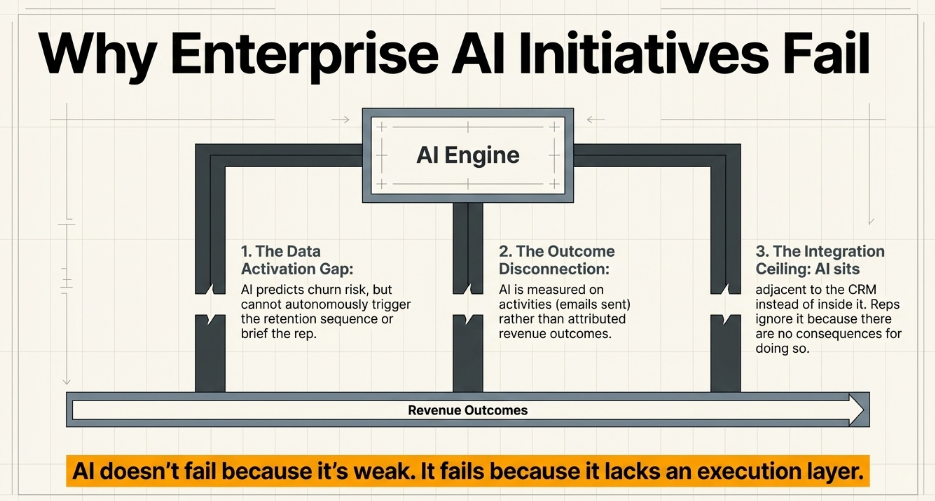
AI fails in structured organizations, not because the technology is inadequate. It fails due to three specific architectural gaps that are almost never addressed at deployment time.
The data activation gap
Your data warehouse contains the information the AI needs to make accurate predictions and trigger relevant actions. But data in a warehouse is not the same as data in an activation layer. A model that predicts churn risk is valuable. A model that predicts churn risk and automatically triggers a targeted retention sequence, routes the account to the right human with a pre-built context brief, and logs the intervention in the CRM without requiring manual input, that is an activation layer. Most AI deployments in Structured and Stuck organizations cover the first half, not the second.
The outcome disconnection
AI initiatives in mature organizations are almost universally measured against activity metrics: emails sent, calls logged, sequences activated, leads scored. These metrics are measurable and reportable, but completely inadequate as evidence of revenue impact. When the CFO asks whether the AI investment is working, “we increased outreach volume by 34 percent” is not an answer. “We reduced cost per qualified opportunity by 41 percent and improved forecast accuracy from 69 percent to 88 percent” is an answer. The difference between those two responses is the Revenue Intelligence layer, the measurement architecture that connects AI activity to revenue outcomes in a way that is attributable, defensible, and board-ready.
The integration ceiling
Most AI tools deployed in Structured and Stuck organizations sit adjacent to the CRM rather than inside it. They ingest CRM data, generate recommendations, and surface insights in a separate interface that reps are supposed to check alongside their existing workflow. They do not. Reps use the CRM because it is where their manager checks their activity. They do not use the AI tool because there is no consequence for ignoring it. The integration ceiling, the point at which an AI tool’s value is limited by its disconnection from the system of record, is where most enterprise AI pilots go to die.
AI does not fail because it is weak. It fails because it is not connected to your revenue system in a way that generates measurable, attributable, board-ready outcomes.
Section IV: What Your Salesforce Stack Is Missing: The Revenue Intelligence Layer
Here is the board dynamic that every RevOps leader in a Structured-and-Stuck organization recognizes.
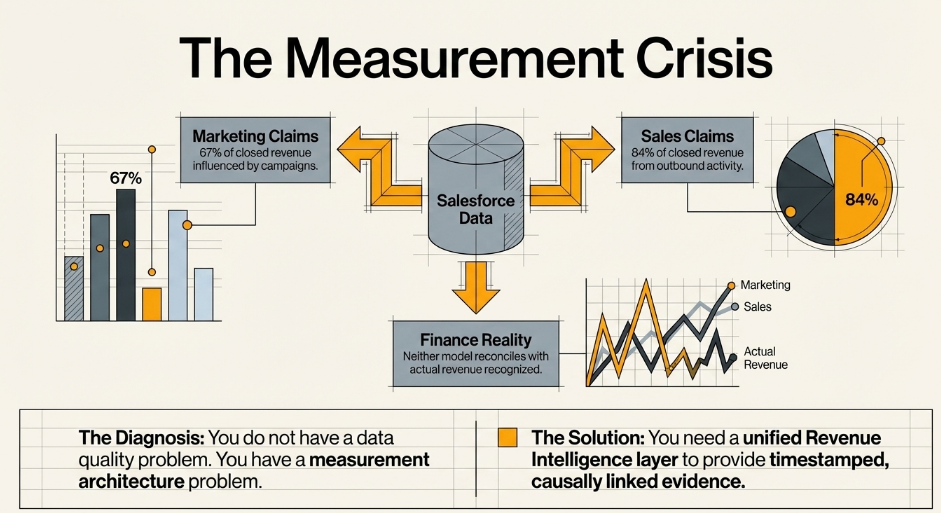
Marketing presents attribution data showing that its campaigns influenced 67 percent of last quarter's closed revenue. Sales presents pipeline data showing that 84 percent of closed revenue came from outbound activity. Finance presents a model showing that neither number reconciles with the actual revenue recognized. All three are using data from the same Salesforce environment. All three are telling different stories with it.
This is not a data quality problem. The data is reasonably clean. It is a measurement architecture problem, the absence of a unified Revenue Intelligence layer that translates activity data into revenue attribution in a way that all three functions agree on and can act on.
Revenue Intelligence is not a dashboard. It is not a BI tool. It is the measurement layer that sits between your data and your decisions, the system that answers “what is actually driving revenue” with attributed, time-stamped, causally linked evidence rather than correlational reporting that each function interprets in its own favor.
In a mature Sovereign Architecture, Revenue Intelligence operates across three dimensions that the Structured and Stuck organization currently lacks.
Multi-touch attribution that drives action.
The goal of attribution is not to settle the argument between marketing and sales about who gets credit. The goal is to identify which nodes in the Revenue Graph generate the highest return per dollar invested and to shift investment toward them in real time. When a specific content asset is generating 3.4x the pipeline per dollar of production cost compared to your next best asset, Revenue Intelligence surfaces that signal and triggers a production decision, not a quarterly review discussion, but an immediate reallocation.
AI versus human performance benchmarking.
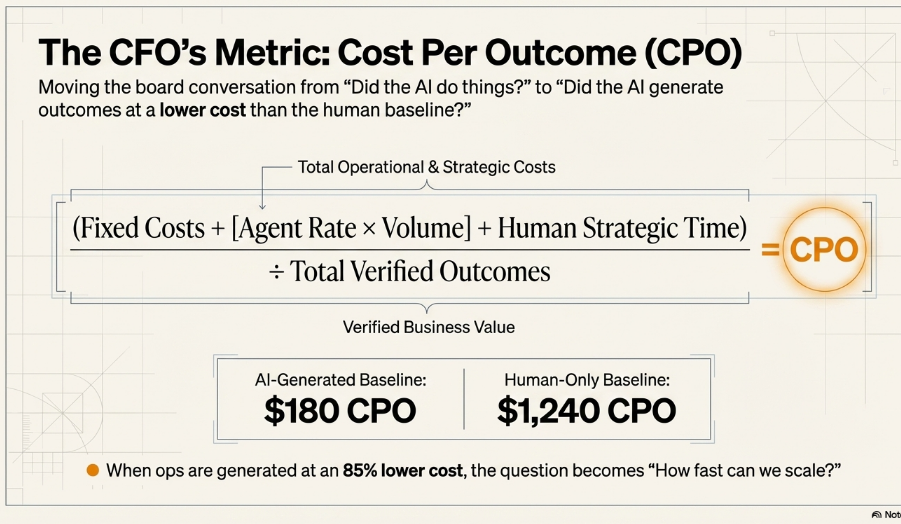
The Cost per Outcome formula, Fixed Costs plus Agent Rate times Volume plus Human Strategic Time, divided by Total Verified Outcomes, gives the CFO the metric that settles the AI investment question once and for all. Not “did the AI do things” but “did the AI generate outcomes at a lower cost than the human baseline, and by how much.” When the answer is “AI agents are generating qualified opportunities at 70 percent lower CPO than the human-only baseline,” the conversation shifts from “should we continue the AI investment” to “how fast can we scale it.”
Forecast architecture that the board trusts.
A forecast built on Signal Density, the weighted, time-decayed accumulation of intent signals across every touchpoint in the Revenue Graph, is fundamentally more accurate than a forecast built on rep-reported pipeline stages. It is not immune to error. It is immune to the specific errors that come from optimistic stage progression and reps who move deals forward to avoid a difficult pipeline review conversation. When your forecast accuracy improves from 69 percent to 88 percent, the board stops discounting your numbers. That is a strategic asset that compounds every quarter.
If you cannot measure it, your system is not working. It is just operating.
You do not have a visibility problem. You have an execution problem. And the path from visibility to execution runs through the architecture in the next section.
Section V: From System of Record to System of Action
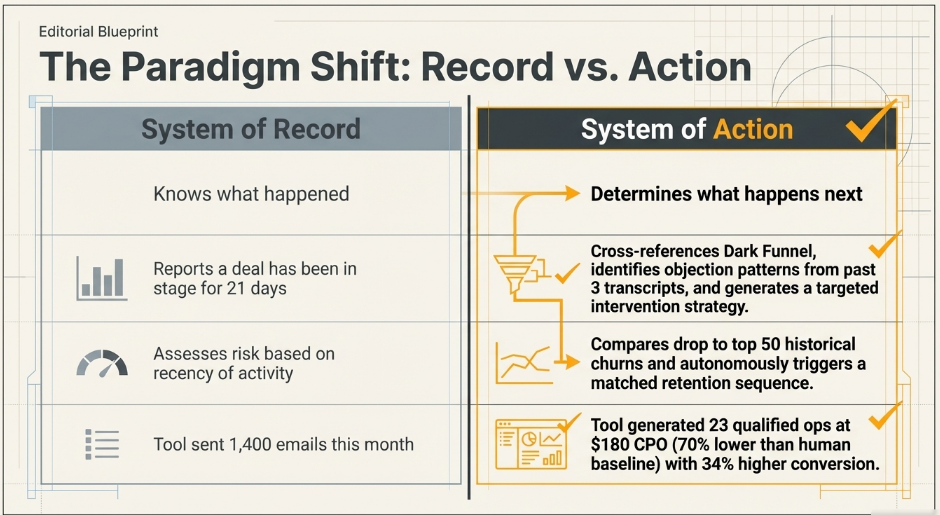
Here is the difference in plain terms: a system of record knows what happened. A system of action determines what happens next.
Your current Salesforce environment was built as a system of record. Every design decision — the object model, the workflow rules, the reporting structure, the integration architecture — was optimized for one outcome: capturing what happened accurately and making it retrievable. This was the right design goal for 2019. It is an incomplete design goal for 2026.
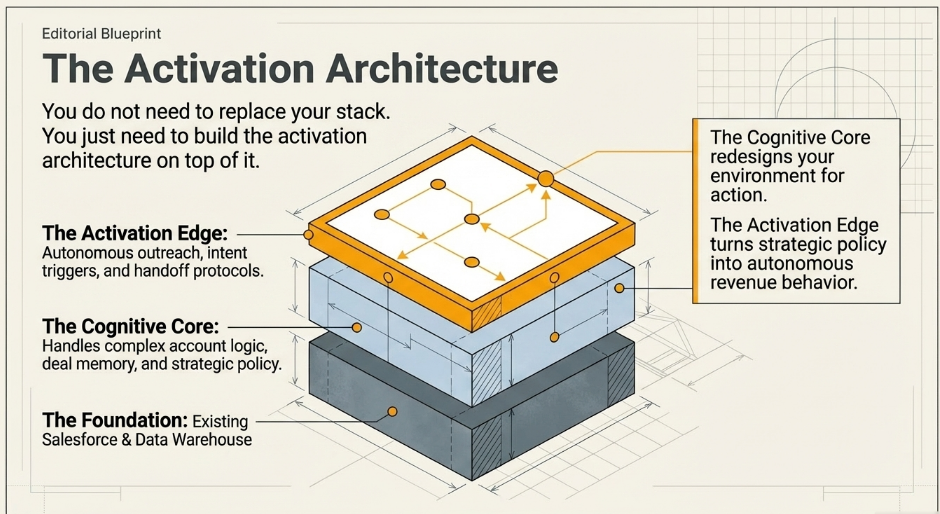
A system of action is built on the same foundation — the same CRM, the same data warehouse, the same BI layer — but with an activation architecture layered on top that converts captured information into autonomous revenue behavior.
The contrast is concrete.
A system of record knows that a deal has been in the same stage for 21 days. A system of action detects that signal, cross-references it against the account’s Dark Funnel activity, identifies the specific objection pattern from the last three call transcripts, generates a targeted intervention strategy, and either executes it autonomously or routes it to the right rep with a complete context brief — all before the deal appears as at-risk on any dashboard.
A system of record knows that a high-value customer’s engagement frequency has dropped. A system of action detects the drop, compares it against the churn signal patterns from your 50 most recent churned accounts, assigns a health score that reflects actual risk rather than activity recency, and triggers a retention sequence that matches the intervention that succeeded in the 12 most similar historical cases.
A system of record reports that your AI prospecting tool sent 1,400 emails last month. A system of action reports that your AI prospecting tool generated 23 qualified opportunities at an average CPO of $180, compared to a human-only baseline of $1,240 per opportunity, with a pipeline conversion rate 34 percent higher than the human-sourced baseline.
The Cognitive Core — your Salesforce environment, redesigned for action rather than record — is the center of this architecture. It handles complex account logic, multi-stakeholder relationship mapping, long-cycle deal memory, and the strategic policy decisions that define how every other part of the system behaves.
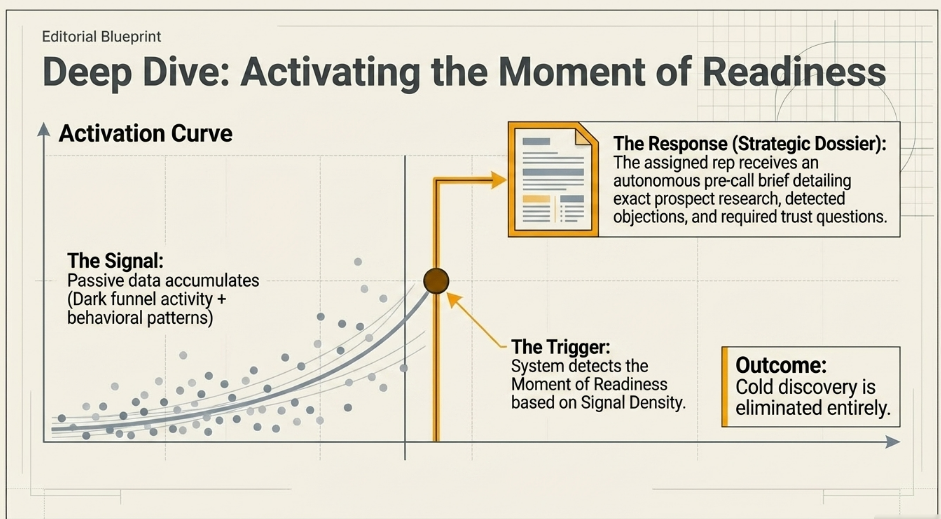
The Activation Edge — the execution layer connected to the Cognitive Core — is where those policy decisions become autonomous revenue behavior. Outreach sequences that trigger on intent signals rather than manual enrollment. Content delivery that responds to Dark Funnel research patterns rather than scheduled cadences. Handoff protocols that route the right deal to the right human at the mathematically verified Moment of Readiness, with a Strategic Dossier that eliminates cold discovery entirely.
Your system should not describe revenue. It should generate it.
Section VI: Activate What You Already Own
The most important positioning distinction for the Structured and Stuck organization is also the one most often lost in technology conversations: you do not need to replace your stack. You need to activate it.
This is not a semantic distinction. It is a strategic and political one. The RevOps leader or CRM Manager reading this has professional credibility invested in the current architecture. They championed the Salesforce implementation. They designed the data model. They built the dashboards. The conversation that opens with “your current system is the problem” closes the door before it opens.
The conversation that is both more accurate and more productive is this: the stack was the right decision. The implementation was executed correctly. The data model is sound. What is missing is the activation layer that nobody builds at implementation time — because it requires 18 months of live behavioral data, a mature signal detection architecture, and an AI orchestration layer that sits on top of the existing system rather than replacing any part of it.
AI is not the starting point of that activation sequence. But it is what makes activation scalable at enterprise volume. Without AI, activation is a manual process that creates an additional administrative burden for the same RevOps team already at capacity. With AI, activation is an autonomous layer that executes against the data continuously, without requiring human monitoring of every signal and human judgment on every response. The sequence matters precisely because deploying AI without the measurement and data activation layers beneath it produces the same stalled pilot your organization has already experienced. You are not ready for AI at scale. You are ready for the foundation that makes AI at scale produce outcomes rather than activity.
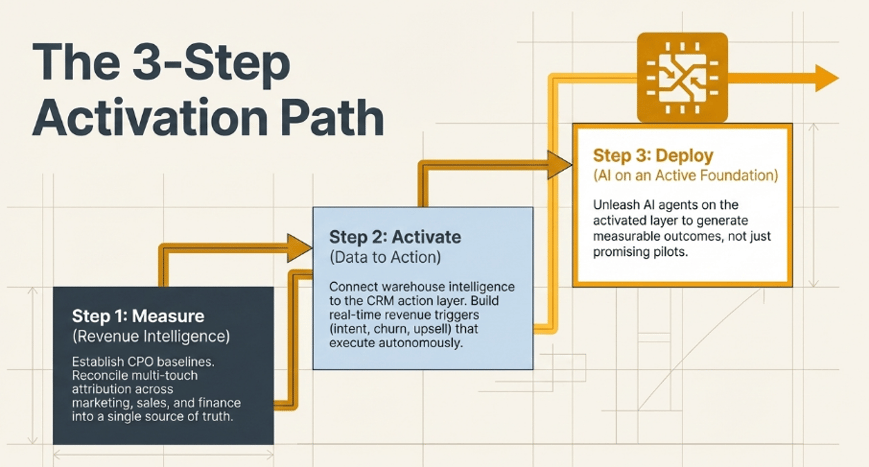
The activation path follows three sequential steps, each building on the foundation established by the previous one.
Step one: measure what actually matters
Before any new capability is deployed, the Revenue Intelligence layer is built. This means establishing the CPO baseline — the current cost per qualified opportunity, per closed deal, per retained customer — against which every subsequent improvement will be measured. It means building the multi-touch attribution model that reconciles the marketing, sales, and finance versions of revenue contribution into a single source of truth. And it means defining the AI-versus-human performance benchmark that will prove the value of every activation initiative to the CFO who controls the expansion budget.
Step two: activate the data you already have.
Your data warehouse contains the behavioral intelligence of every prospect and customer your organization has engaged. The activation step connects that intelligence to the CRM’s action layer — building the signal detection architecture that converts passive data into real-time revenue triggers. Intent signals from the Dark Funnel. Churn indicators from engagement pattern analysis. Upsell triggers from product usage data. Each signal is connected to an autonomous response that executes without requiring a human to notice the pattern and decide to act.
Step three: deploy AI on the activated foundation.
With the Revenue Intelligence layer established and the data activation architecture in place, AI deployment yields measurable outcomes rather than promises. The AI agent is not working from a passive data warehouse. It operates from a real-time activation layer that provides the context to act correctly, is connected to a measurement architecture that demonstrates it is acting effectively, and is integrated into the CRM in a way that makes its output visible and attributable to every stakeholder who needs to see it.
You do not need more tools. You need your current tools to work.
Section VII: The 90-Day Activation Roadmap
For the Structured and Stuck organization, the path to value extraction is a 90-day activation sequence designed to work with the existing architecture rather than replace it — built for a RevOps team that is already fully committed to maintaining the current system and cannot absorb a parallel implementation without additional capacity.
Days 1 through 30 — Revenue Intelligence foundation
The measurement architecture is established before any new capability is deployed. CPO baselines are calculated across every revenue motion — inbound, outbound, partner, and expansion. The multi-touch attribution model is built and reconciled across marketing, sales, and finance. The AI-versus-human performance benchmark is defined and agreed upon by all stakeholders who will later evaluate the results.
By Day 30, the organization has a shared measurement framework that all three functions accept. The argument over who gets credit for closed revenue has been replaced by a unified model that accurately attributes contributions and drives resource allocation decisions rather than political conversations.
Days 31 through 60 — Data activation
The signal detection architecture is built on top of the existing data warehouse. Intent signals, churn indicators, upsell triggers, and Dark Funnel behavioral patterns are connected to the CRM’s action layer. The Moment of Readiness detection goes live — identifying the specific point in each buyer’s journey at which the signal density crosses the threshold warranting an immediate, autonomous response.
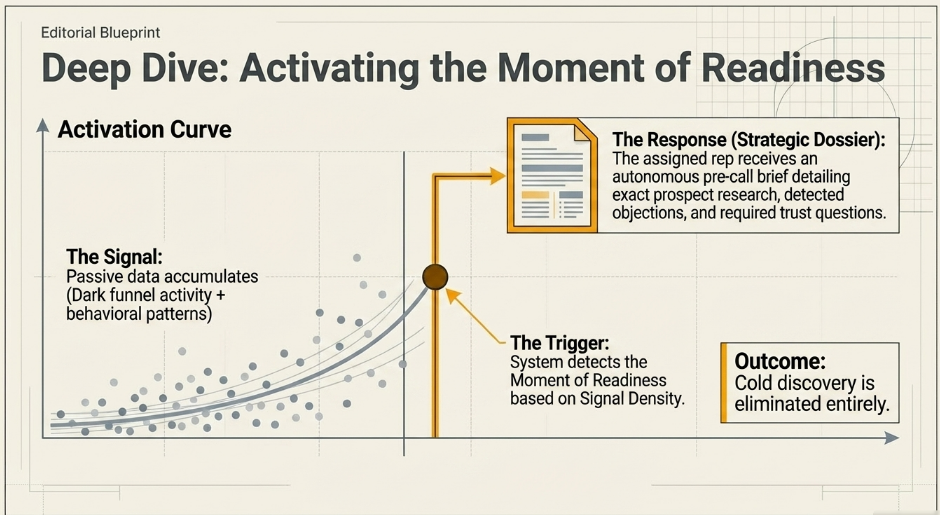
The Strategic Dossier protocol is activated. When a deal crosses the Moment of Readiness threshold, the assigned rep receives a complete pre-call brief: the exact research the prospect has been conducting, the specific objection patterns detected in previous interactions, and the trust questions the AI has identified as requiring human resolution. Cold discovery is eliminated. The rep enters every conversation already knowing what the buyer needs to hear.
Days 61 through 90 — AI deployment and optimization
With the Revenue Intelligence layer established and the data activation architecture in place, AI agents are deployed against the activated data foundation. Prospecting agents work from real-time intent signals rather than static lists. Retention agents respond to churn indicators before they appear on a dashboard. Expansion agents identify upsell triggers from product usage patterns and route them to the right account manager with a ready-built business case.
By Day 90, the CPO comparison is ready to present to the board. Not “here is what the AI did.” Here is what the AI generated, at what cost, compared to the human-only baseline, with full attribution to every touchpoint in the Revenue Graph that contributed to the outcome.
Conclusion: You Do Not Have a Stack Problem. You Have a Performance Problem.
The CFO’s question from the opening of this piece — “if all of this is working, why did we miss revenue by 31 percent?” — has a precise answer.
Your stack is working. It captures data accurately, maintains high adoption rates, and produces clean reports. What it is not doing is converting that captured data into autonomous revenue behavior — because a system of record, however sophisticated, does not do that without an activation layer built on top of it.
Your AI investment is not showing up in the revenue number for the same reason. Not because the AI is inadequate. Because it was deployed on top of a system that was never designed to act on what the AI finds. Revenue Intelligence is the layer that changes this — the measurement and activation architecture that connects your AI to your revenue outcomes in a way that is attributable, scalable, and defensible to a board that has stopped accepting activity metrics as proof.
The companies that will pull away from the Structured and Stuck category in the next 12 months are not the ones that replace their CRM. They are the ones who activate it — who build the Revenue Intelligence layer, connect the data to autonomous action, and deploy AI on a foundation that generates measurable outcomes rather than promises.
The ROI your board is looking for is not in a new platform. It is in the 30 to 45 percent of your current investment that is currently generating reports rather than revenue. The activation layer is what captures it. And the proof that it is working is not a dashboard — it is a CPO number that dropped, a forecast accuracy that improved, and a board conversation that shifted from “why are we missing targets” to “how fast can we scale what is working.”
You are not missing tools. You are missing outcomes. And the path from where you are to where you need to be runs through the system you already own.
CETDIGIT's AI Revenue Engine architecture defines this activation layer as a System of Action sitting on top of the Salesforce Cognitive Core — see the architectural breakdown in that article for the full four-component framework.
Stack Unification Audit
Book a 30-minute Stack Unification Audit. We will identify where your Salesforce stack is collecting data but not activating it, and what to fix first.

Leave a Comment