



Direct answer. A custom agent in HubSpot has no fixed credits-per-run number. HubSpot's own rate sheet bills custom agents at one credit per action unit, and one run can use several. The useful answer is Cost per Outcome: what one decision costs to produce, in credits you can read, against what it returned. The count follows from three choices made before the run: what the agent reads, what it writes, and how often it runs.
A Thursday budget call with no number in it
Picture a distributor with four branches and a few hundred repeat-order accounts. On Thursday afternoon, the budget call reaches the AI line. Someone has proposed a custom agent in HubSpot that would look at the repeat-order accounts once a week and say which ones need a call before the reorder goes to a competitor. The operations manager asks the obvious question: how many credits does one run use?
Nobody in the room can answer it. The sales director guesses. The person who sat through the vendor demo remembers a figure but not the date it was quoted. The finance lead asks whether the number changes if the agent looks at all four branches or just one, and that is where the call stalls, because nobody has written down what the run is allowed to read.
This is not a failure of homework. It is the right question asked in the wrong order. The credit count is not a property of the agent. It follows from decisions nobody in the room has made yet: what the run reads, what it writes, and how often it runs. Until those three are written down, any number offered is a guess, and a guess is exactly what the operations manager will be asked to defend at the next budget review.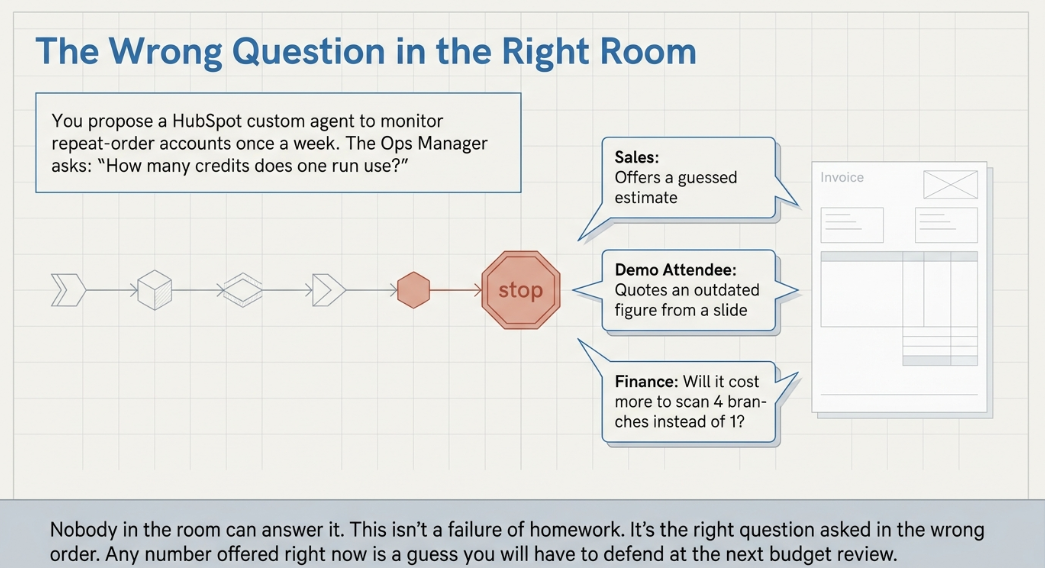
The problem: credits are billed per action, not per run
A custom agent's credit count per run is the sum of the actions it takes in that run, not a fixed price for the run itself. HubSpot's own rate sheet, published in its Products and Services Catalog, bills custom agents at one credit per action unit, and HubSpot's agent-builder documentation says the cost varies with the complexity of the work. A run that reads a handful of records and stops uses fewer action units than a run that reads widely, checks the web, and writes back to every account it touched.
That is why the question in the budget call has no single answer, and why chasing one is the wrong job. The measure that holds up is Cost per Outcome: what one decision costs to produce, in credits you can read, against what it returned. It moves the question from “what does a run cost?” to “what does this decision cost, and was it worth it?” That second question is one a distributor can answer before the first run and check after it.
Cost per Outcome does three things for the person in the budget meeting. It ties the credit count to a named decision, so the number has a reason behind it. It makes the count something you set rather than something you discover on the credit balance. And it gives the finance lead a second column: what the decision returned, so the credits are never read on their own.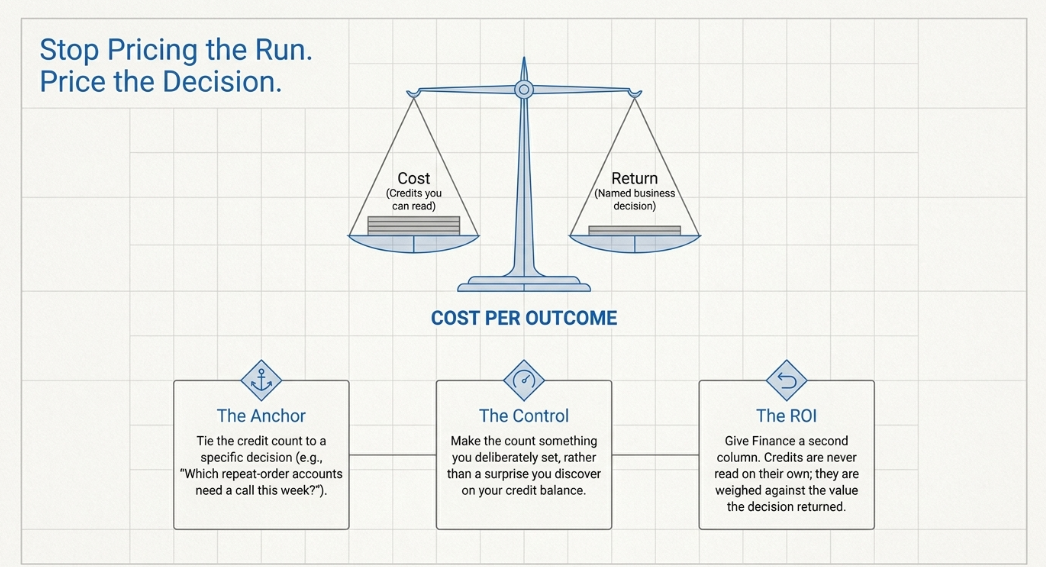
HubSpot does not publish a fixed credits-per-run figure for custom agents. It publishes the per-unit rate and gives builders a way to estimate their own run before it spends anything. The practical work, then, is not finding the number somebody else got. It is setting up your own run so that its number is small, known, and tied to one decision.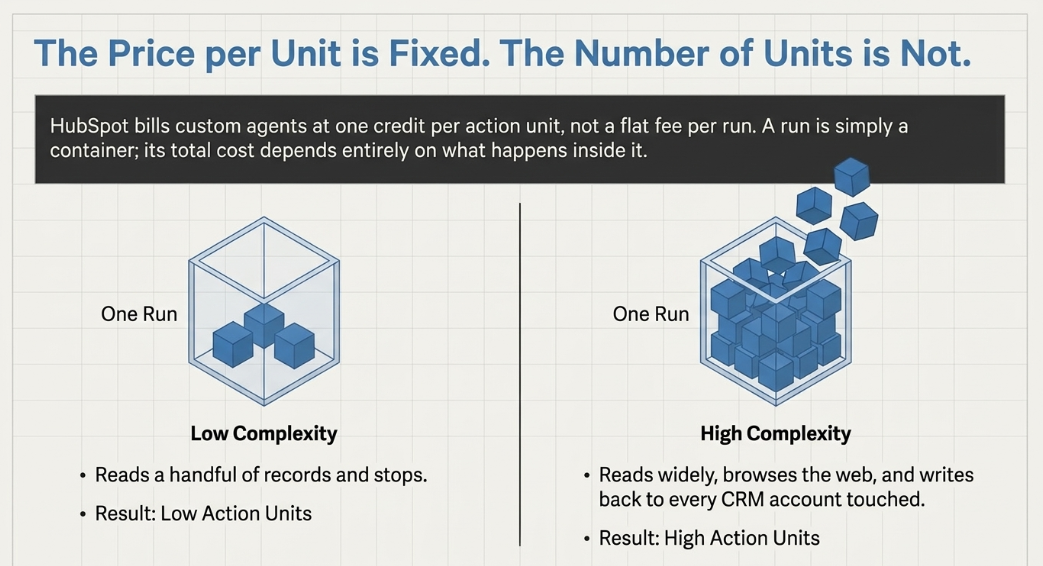
Who this affects
This question lands hardest on the person who owns the budget line for AI at a mid-market distributor on HubSpot. That is usually the owner, the head of operations, or the RevOps or sales operations lead: the person who will be asked in a budget meeting what the agent costs and will be expected to have a number ready. They have usually tried some AI already, often help with writing emails or preparing for meetings, and are now weighing a custom agent that would do something closer to the business, such as watching repeat-order accounts across branches for the ones going quiet. They are not short of interest. They are short of a figure they can stand behind. The branch managers, the inside sales reps, and whoever owns the ERP all shape what the agent can read, but the credit question sits with the budget holder.
Symptoms: how to tell the credit question is still open
The credit question is still open when the agent has been described, but its reading, writing, and schedule have not. Run this list against your own situation; each yes is a gap to close before the first run.
- Nobody can say which HubSpot records the agent will read on each run.
- Nobody has decided whether the agent may write anything back to the CRM.
- The proposed schedule is described as “regularly” rather than as a number of runs per week or month.
- The credits figure in circulation came from a demo, a slide, or a partner's page, and nobody knows its date.
- No one has tested the agent and read the estimate HubSpot shows for the run.
- No monthly run limit has been set, so the first sign of cost would be the credit balance.
- The finance lead is being asked to approve credits without a named decision the run is meant to produce.
Root causes: what actually sets the count
The per-run count is set by HubSpot's billing unit and by three choices the builder makes before the run. None of them is a matter of doing the work well or badly. They are design decisions, and they get made whether or not anyone writes them down.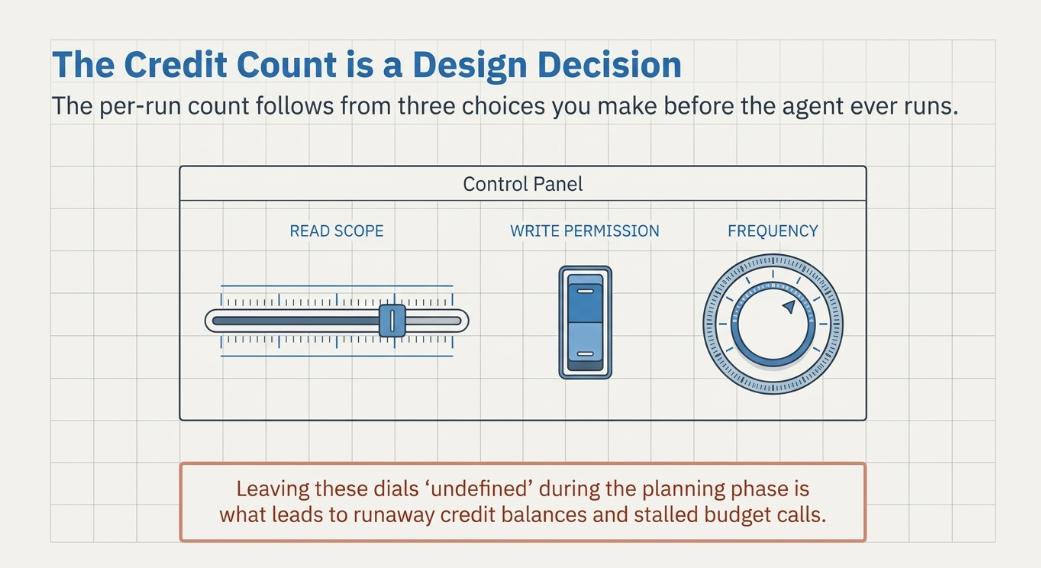
HubSpot bills the action, not the run
HubSpot's rate sheet sets the unit at one credit per action unit for custom agents, with a note that custom agents run prompts on your behalf and that the work varies in complexity. A run is therefore a container of action units, and its total depends on what happens inside it. This is the root of the budget-call problem: the price per unit is fixed, the number of units is not.
Choice one: what the run reads
What an agent reads is a builder setting, not a given. HubSpot's agent-builder documentation lists reading your HubSpot CRM records as a default action that the builder configures per agent, alongside browsing the web. An agent told to read every company in four branches does more work than one told to read the repeat-order accounts in one branch that have not ordered recently. Leaving web browsing off for a first run removes a whole category of steps and keeps the agent on the record your people already trust.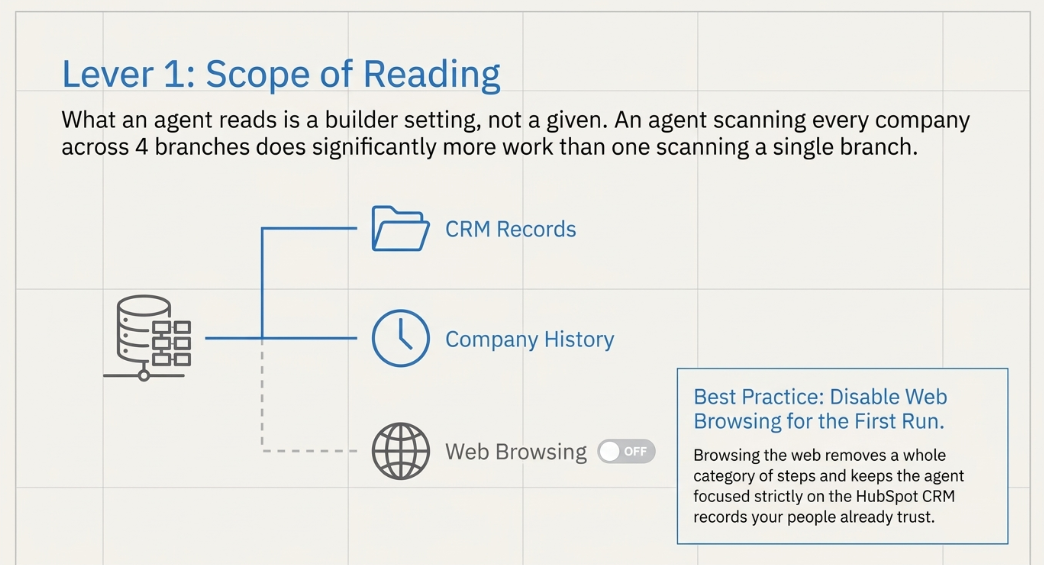
Choice two: what the run writes
Writing back to the CRM is a separate switch from reading it. HubSpot documents writing to your HubSpot CRM records as its own default action, configurable per agent, and an agent cannot write unless that action is turned on. Every write is another step in the run. A read-only first run, which reports and changes nothing, is the simplest version to estimate and the easiest to judge.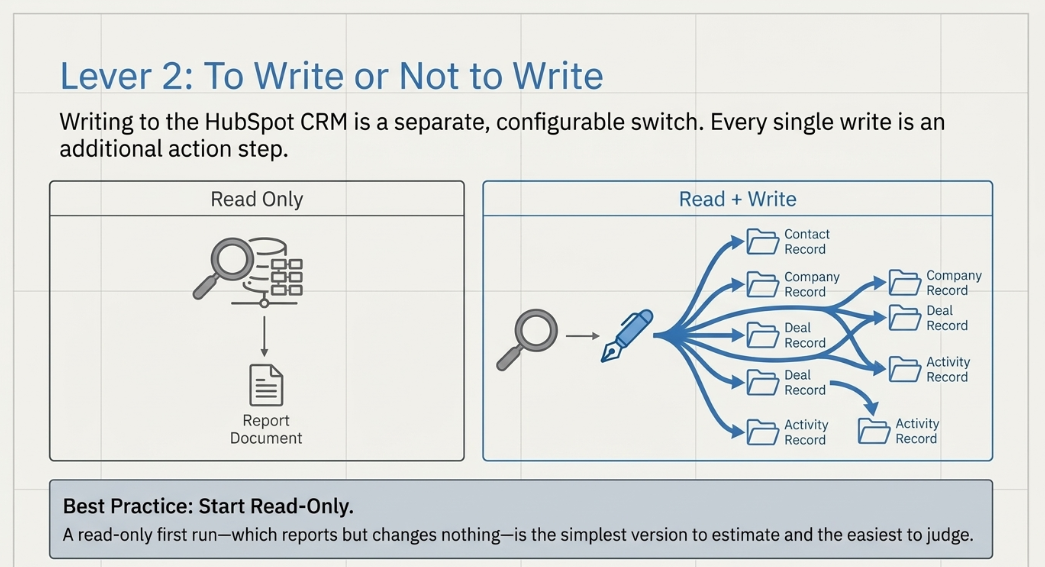
Choice three: how often it runs
Frequency multiplies everything above. HubSpot's credits documentation says the plan sets a monthly allotment, credits reset each month, and unused credits do not roll over. An agent that runs every day spends that allotment on a different curve from one that runs on Monday mornings, even if each run is identical. HubSpot lets builders set a monthly run limit, so the schedule becomes a ceiling you choose rather than a figure you find on the bill.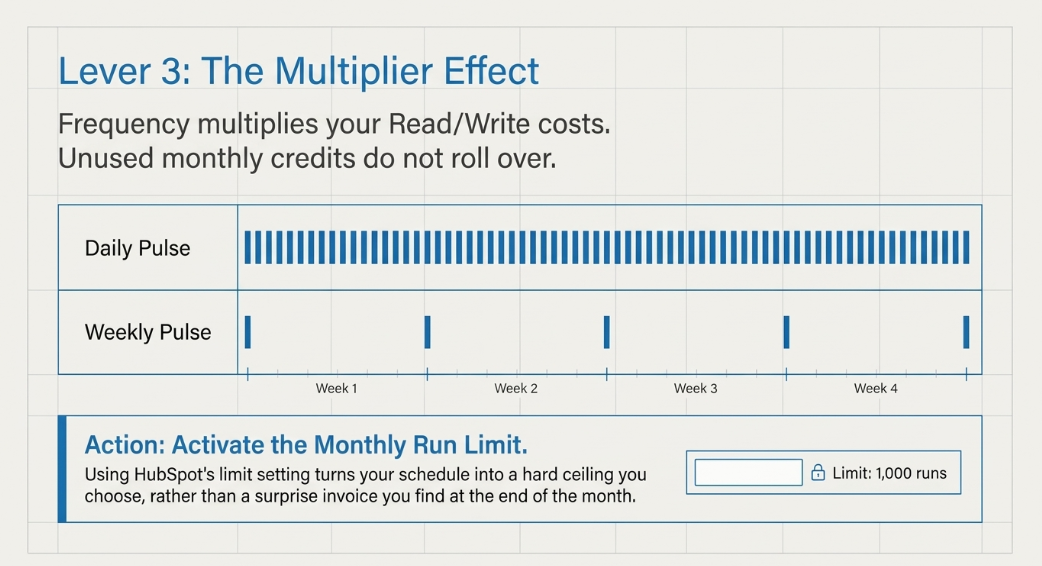
Why no fixed number exists, and why old ones go stale
HubSpot does not publish a credits-per-run total for custom agents; it publishes the per-unit rate and points builders to their own estimate. Prices also move. In HubSpot's own user community, builders reported a cut to custom-agent credit costs at the end of October 2026, so any per-run figure quoted before then needs re-checking before it goes near a budget. Our earlier piece on what does one AI agent in HubSpot cost to run for a distributor made the case for pricing one decision rather than an agent; the per-run count is how that one decision gets its number.
Decision table: what to do in your situation
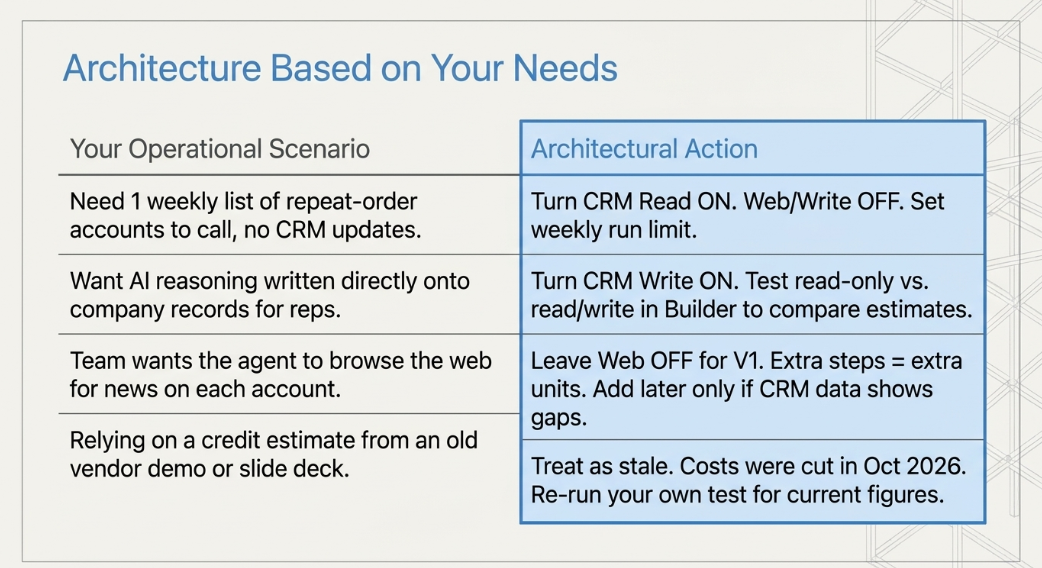
The right first move depends on what the agent is being asked to do and what you already have in hand. Find the row that matches your situation.
|
If your situation is |
Do this |
|
You want one weekly list of repeat-order accounts that need a call, and nothing written back. |
Turn on reading CRM records only. Leave writing and web browsing off. Test a run, read the estimated credits in run history, and set a monthly run limit that matches a weekly schedule. |
|
You want the agent's reason written onto the company record so reps see it where they already work. |
Turn on writing to CRM records as well. Test the read-only version and the read-and-write version separately and compare the two estimates before choosing. |
|
Someone wants the agent to browse the web for news on each account. |
Leave it off for the first run. Each extra step adds action units, and the CRM is the record your people already trust. Add it later only if the first run shows a gap. |
|
A credits-per-run figure is circulating from a demo, slide or older page. |
Treat it as stale until it is re-run. Builders reported a cut to custom-agent credit costs at the end of October 2026; your own test run is the only current figure. |
|
You are comparing a custom agent with HubSpot's Customer Agent. |
Compare each against the decision it serves, not against each other. HubSpot bills the Customer Agent per resolved conversation and custom agents per action unit. |
The CETDIGIT perspective: one decision, priced the way HubSpot prices it
CETDIGIT builds one decision at a time and names its credit cost the way HubSpot bills it: from an estimate on the client's own data, never from a guessed average. For a distributor, that decision is usually which repeat-order accounts need attention this week, and why. HubSpot's own study points to analyzing campaigns, prioritizing pipeline, and analyzing customer feedback as the higher-impact cases, and a weekly account-attention list sits squarely in prioritizing pipeline. HubSpot's UNBOUND 2026 study found the most common AI use cases are the low-impact ones: producing content, sending emails, preparing for meetings. The decision worth paying credits for is rarely the one people try first.
The agent reads the CRM and nothing else: company relationships, closed-won history, recent activity, and open pipeline. Days 1 to 3 are a read-only review of the data as it is, ending in one of three answers: ready, ready with small additions, or not yet. That review is the first deliverable, not a prerequisite, and it is where the reading choice gets written down.
The agent runs alongside your team first. Its first run writes recommendations; it does not act on them. Its output is five fields and a written reason on the company record, and a person decides what happens next. The agent reasons, the workflow enforces, a person makes the call, in that order. Because reading, writing, and scheduling are fixed before the first run, the estimate HubSpot shows in run history is an estimate for this decision, not for an agent in general.
As HubSpot co-founder Dharmesh Shah put it, name your number before you start. We name one metric before the run and read it at 30 days: recurring accounts flagged that nobody was already working. That is the “against what it returned” half of Cost per Outcome, and it is the subject of our piece on how a distributor should judge an AI agent after 30 days [per rev b]. How the work is staged from first review to first run is set out in the broader AI services approach.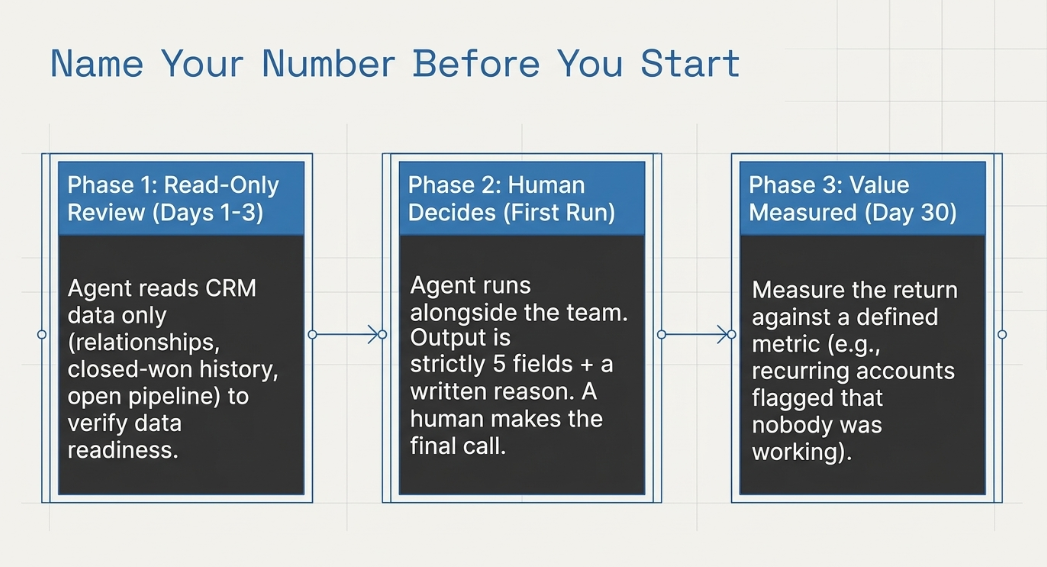
Recommended path: get the per-run number before the run
The per-run number is something you can ask for and check before the agent spends a credit. Write down the three choices: what the run reads, whether it writes, and how many times a month it runs. Build the agent with those settings in Agent Builder, test a run, and read the estimated credits HubSpot shows in run history. Set a monthly run limit that matches the schedule you wrote down. Then bring the estimate, the schedule, and the one decision it serves to the budget call, so the question gets an answer instead of a guess. If you want that work framed against revenue rather than against the credit balance, the AI Revenue Engine page sets out how CETDIGIT ties one decision's cost to what it returns.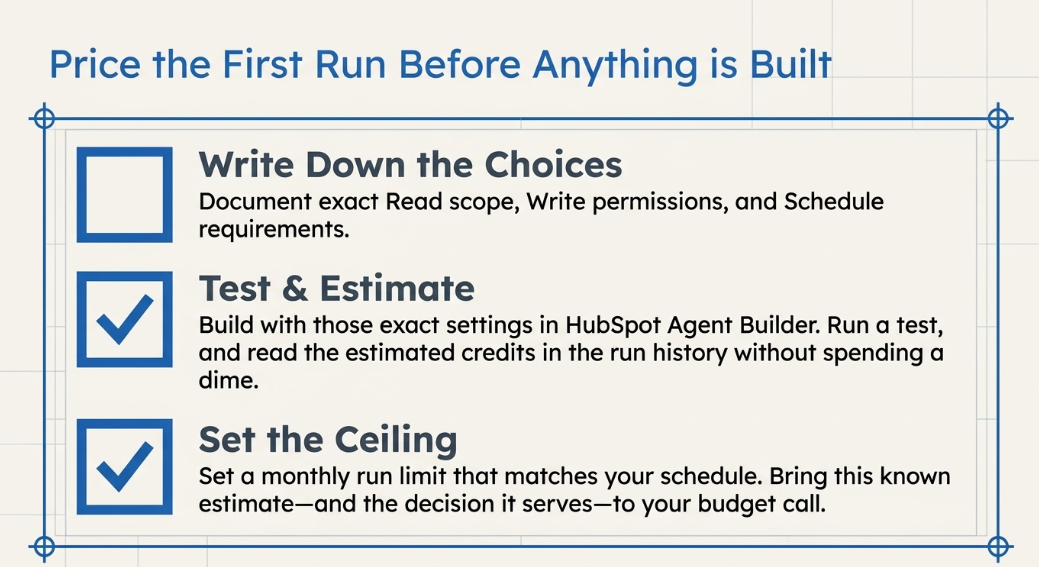
FAQ
These are the questions distributors ask most about custom-agent credits, answered from HubSpot's own documentation.
How many HubSpot credits does a custom agent use per run?
HubSpot's own rate sheet bills custom agents at one credit per action unit, so a run uses as many credits as the action units it performs. There is no fixed per-run figure. A run that only reads a few CRM records uses fewer units than one that reads widely, browses the web, and writes back. The number for your agent comes from testing it in Agent Builder and reading the estimate HubSpot shows in run history.
Does HubSpot publish a fixed credits-per-run number for custom agents?
No. HubSpot publishes the per-unit rate and a way to estimate your own runs. In its documentation on testing and controlling agent credit usage, HubSpot gives an example in which a limit of 1,000 runs corresponds to an estimated range of roughly 9,000 to 138,000 credits, which shows how widely runs vary. Your own estimate, from your own settings, is the figure worth taking to a budget meeting.
Can I see what a run will cost before it spends credits?
Yes. HubSpot's documentation on agent credit usage says Agent Builder lets you test a run before publishing without spending credits, and shows an estimated credits figure in the run history. Test the agent with the exact reading, writing, and schedule you plan to use, because changing any of them changes the estimate.
Can I cap what a custom agent spends each month?
Yes, through a run limit. HubSpot's documentation describes a monthly run-limit setting for agents, and its credits documentation says the plan sets a monthly allotment that resets each month without rolling over. Setting the run limit to match your intended schedule turns the schedule into a ceiling you chose, rather than a figure you discover on the credit balance.
Does HubSpot's Customer Agent use the same rate as a custom agent?
No. HubSpot's rate sheet bills the pre-built Customer Agent per resolved conversation, a different basis from the per-action-unit rate for custom agents. The two are not directly comparable: one prices an outcome HubSpot defines, the other prices the work your own agent does. Compare each against the decision it serves rather than against each other.
Which HubSpot plan do I need to build a custom agent?
HubSpot's agent-builder documentation lists Agent Builder for Professional or Enterprise. Credits for running the agent come from your plan's monthly allotment, as HubSpot's credits documentation describes. Check your portal's plan and credit balance before estimating, since the allotment, not the per-run count alone, sets how many runs a month you can afford.
Which AI uses are worth the credits at a distributor?
HubSpot's own study points to analyzing campaigns, prioritizing pipeline, and analyzing customer feedback as the higher-impact cases, and found the most common uses are lower-impact ones such as producing content, sending emails, and preparing for meetings. For a distributor, a weekly read of which repeat-order accounts need attention is a prioritize-pipeline case. The AI Revenue Engine page explains how CETDIGIT ties one such decision to revenue.
Price the first run before anything is built
For a distributor that wants the first run's reading, writing, schedule, and credit estimate written down before anything is built: [per rev b]



Leave a Comment