


It is 7:40 on a Tuesday morning in early August, and the phones in the district enrollment office have not stopped since the doors opened. A mother on line one wants to know which documents she needs to register a kindergartner. Line two is a father asking, in Spanish, whether his family's new apartment is zoned for the middle school across the highway. Line three is a grandmother trying to find the bus stop assignment that was supposed to arrive by email. The two staff members working the counter are also processing a stack of residency affidavits, and every call they answer means a family standing in front of them waits longer. By 8:15, the voicemail box is full. Nobody knows how many families gave up and hung up, because nothing in the office counts the calls that never got through.
If you work in a district central office, none of this is news. It is what enrollment season, the first week of school, or a snow-day morning looks like. What is worth examining is why it still looks this way, and what districts are starting to do about it.
The questions are predictable. The volume is not.
Sit with a front-office team for a day and tally the calls, and a pattern emerges quickly. Most inbound volume falls into a small set of categories: registration requirements and deadlines, zoning and boundary questions, bus routes, bell schedules, meal applications, immunization requirements, absence reporting, and parent portal access. These are questions with documented answers, living in board-approved policies, on the district website, in the student handbook, and in systems the district already runs — PowerSchool, Infinite Campus, or Skyward on the student information side, ParentSquare and Remind on the communication side.
The problem is not that the district lacks answers. It is that the answers are reachable only through a person already doing three other jobs, and demand arrives in spikes no staffing plan can absorb. An office staffed correctly for October is understaffed fivefold for the first week of August, so the spike becomes hold music, full voicemail boxes, and families driving in to ask a ninety-second question.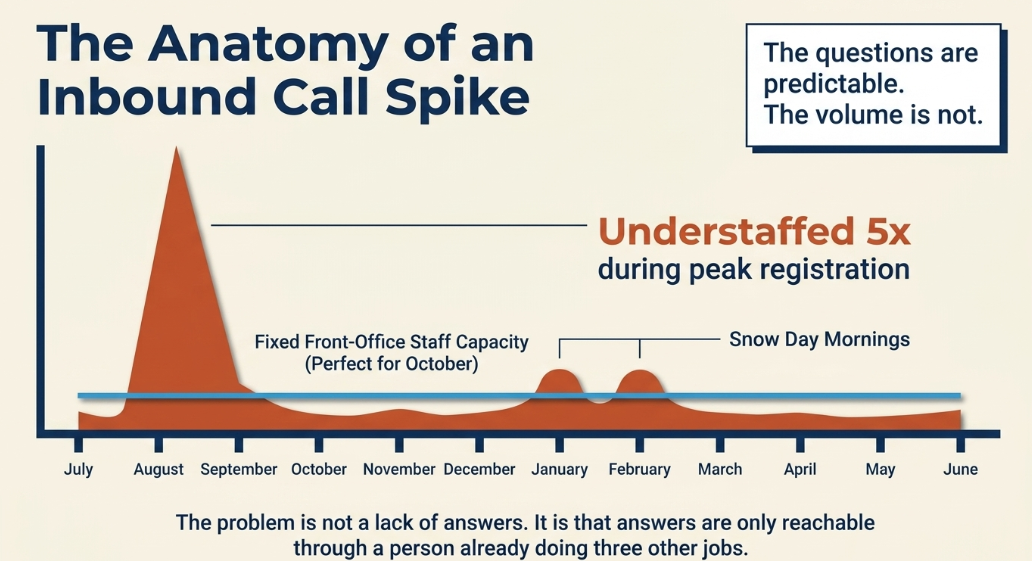
There is an equity dimension here that district leaders feel acutely. The families most likely to give up on a busy phone line are often the ones with the least flexibility: parents working hourly jobs who cannot call back at 2 p.m., households where English is not the first language, families new to the district who do not know which school to call. When the phone system fails, it does not fail evenly.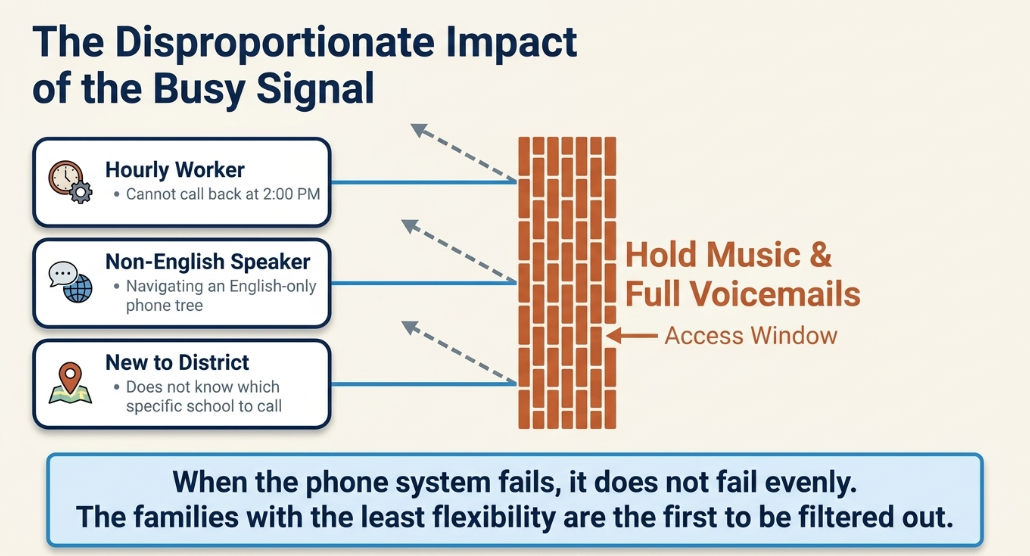
What an AI voice agent actually does in a district
The current generation of AI voice and chat agents is built for exactly this shape of problem: high volume, repetitive questions, documented answers, and callers who deserve a real response rather than a phone tree. Instead of "press three for transportation," a parent asks a question in their own words, in their own language, and the agent answers it in conversation, the way a well-trained front-office colleague would.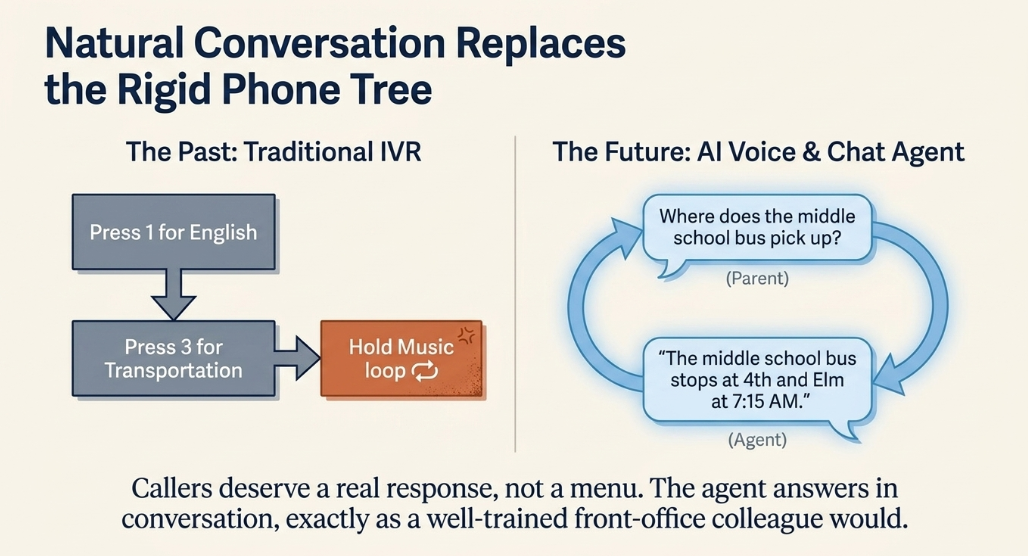
The mechanics matter, because school districts cannot afford an AI that improvises. A properly deployed agent uses retrieval-augmented generation, meaning it answers only from the district's own approved sources: the enrollment page, board policy, the transportation handbook, the calendar. With mandatory source citations, every answer traces back to the document it came from — the agent states the registration deadline because the published enrollment page says so, not because a language model guessed. If the answer is not in the district's material, the agent says so and routes the caller to a person, taking a message instead of letting the call die in a voicemail box.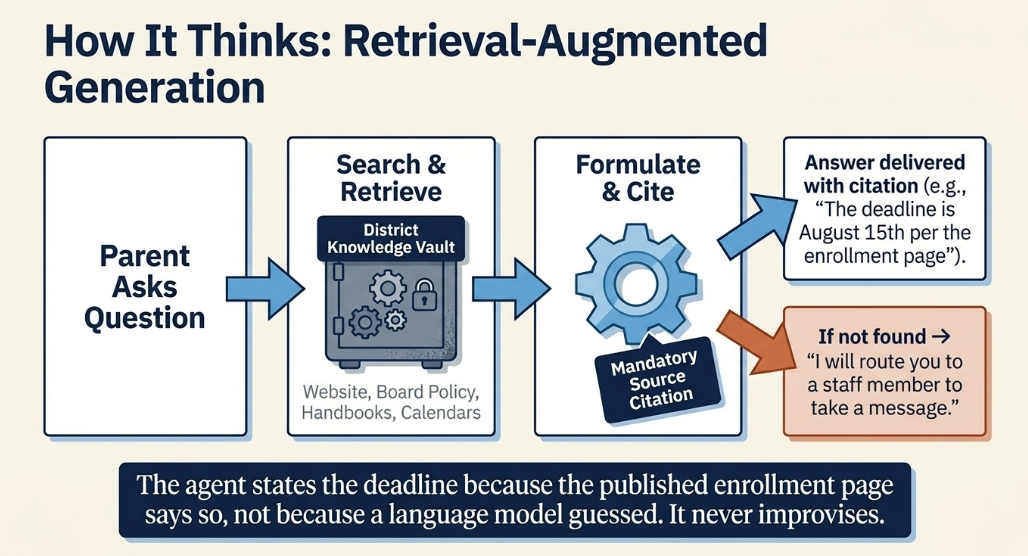
Language access stops being a scheduling problem. The same agent that answers in English answers in Spanish, Vietnamese, Arabic, or Haitian Creole, at 7:40 a.m. or 9 p.m., without the district needing to find bilingual staff for every shift. For districts with large newcomer populations, this alone changes who can get a question answered.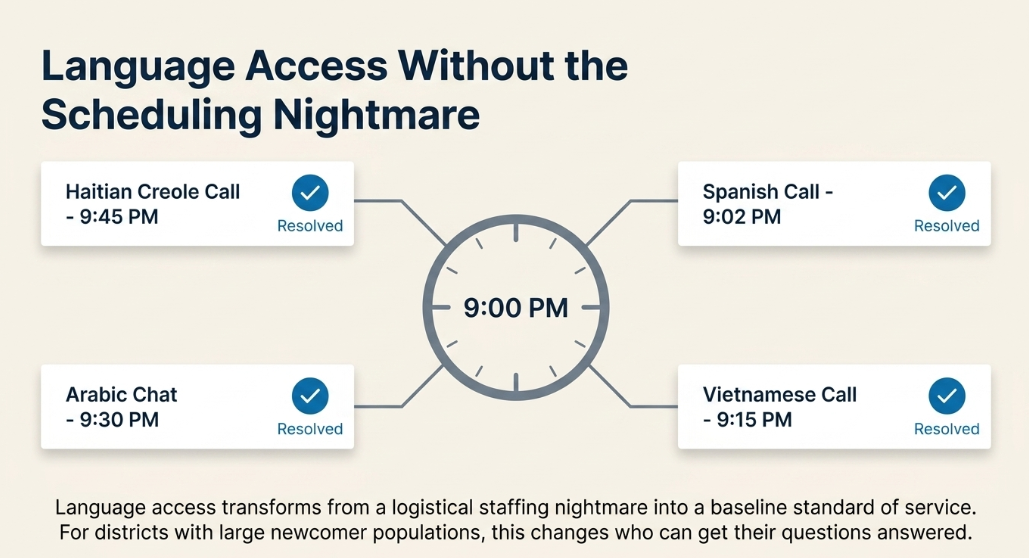
And because the agent handles the repetitive eighty percent, the humans get the calls that actually need them: the McKinney-Vento situation, the custody documentation question, the upset parent who needs to be heard by a person. Front-office staff stop being switchboard operators and go back to being the problem-solvers districts hired them to be.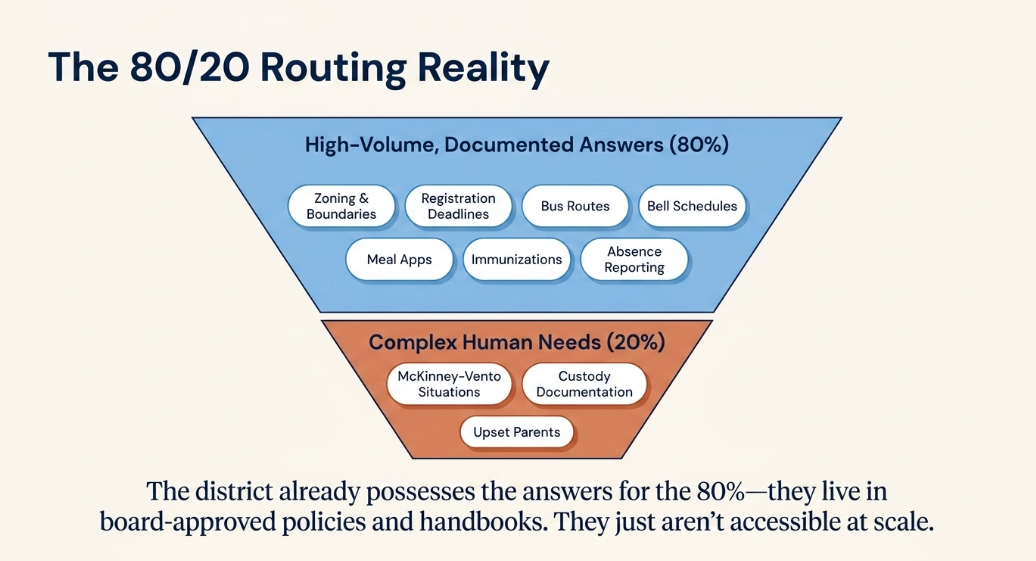
FERPA draws the line, and the line is workable
The first question every superintendent and technology director asks is the right one: what about student data? The workable answer is that the boundary between general and student-specific information must be explicit in the system's design. "What documents do I need to enroll?" touches no student record. "What is my daughter's bus stop?" does, and that requires authenticated access through the existing parent portal or a warm handoff to staff. A district-grade deployment respects that line, supports single sign-on against the district's identity provider, and logs every interaction for audit. Accessibility applies too: a chat agent on a district website must meet WCAG 2.1 AA like the rest of the site. These criteria belong in any evaluation checklist, alongside the vendor's willingness to sign a student-data privacy agreement consistent with FERPA and state student-privacy laws.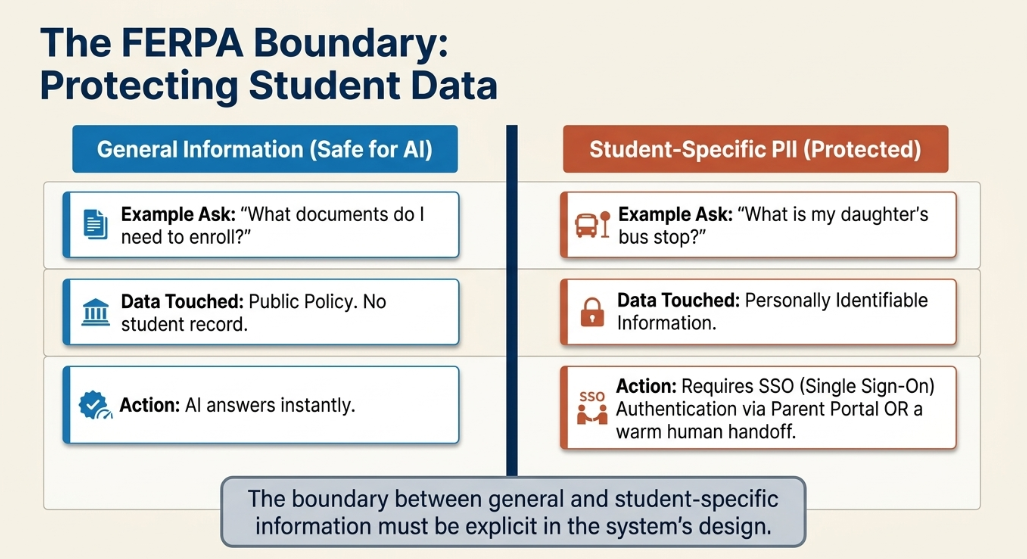
Platforms built for regulated, high-volume public environments, such as CETRAI, treat these constraints as the foundation rather than an afterthought: grounded answers with citations, FERPA-conscious boundaries between public and student-specific information, SSO, audit logging, and accessibility compliance. When evaluating any platform, districts should ask to see those capabilities demonstrated, not just listed.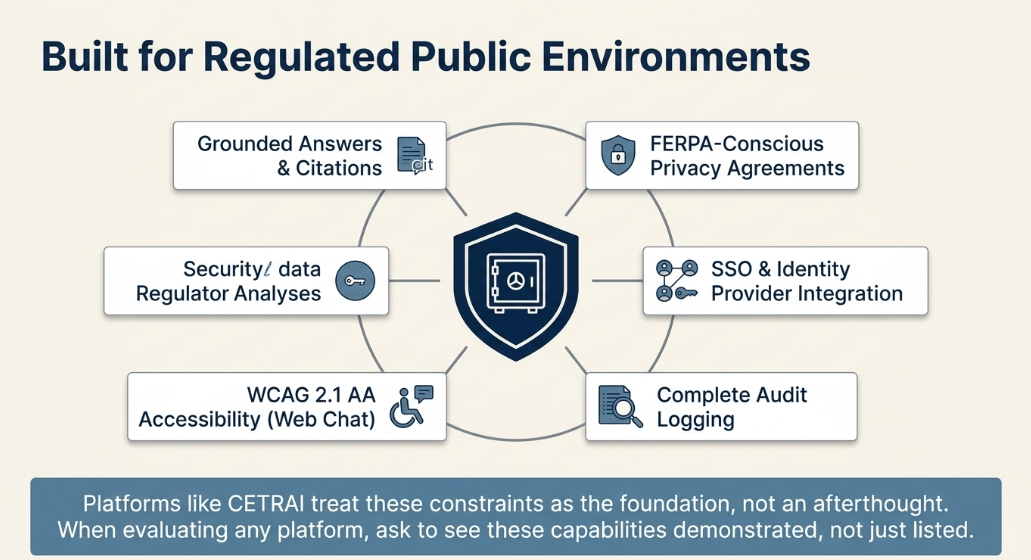
Where districts see the payoff first
Districts that deploy conversational agents typically see the effect first in three places. Enrollment conversion improves, because a family that hits a question at 8 p.m. gets unstuck the same evening instead of abandoning the process. Front-office overtime and stress drop during peak weeks. And for the first time, the district gets data about demand itself: what families are actually asking, in which languages, at which hours. If four hundred families asked about the boundary change in one week, the communications office knows its next mailer wrote itself.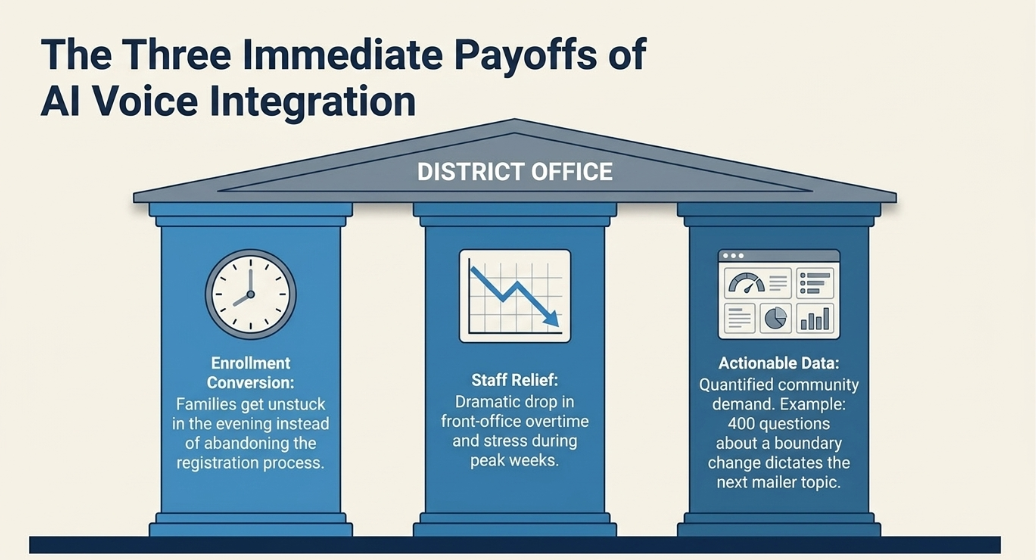
In our work implementing CRM and enrollment automation for public school districts, the pattern is consistent: the technology is the smaller half of the project. The larger half is curating the knowledge sources, agreeing on escalation rules, and connecting the agent to the systems the district already runs, so a message taken at night becomes a task in front of the right staff member in the morning. That is integration work, and it is where an implementation partner earns its keep.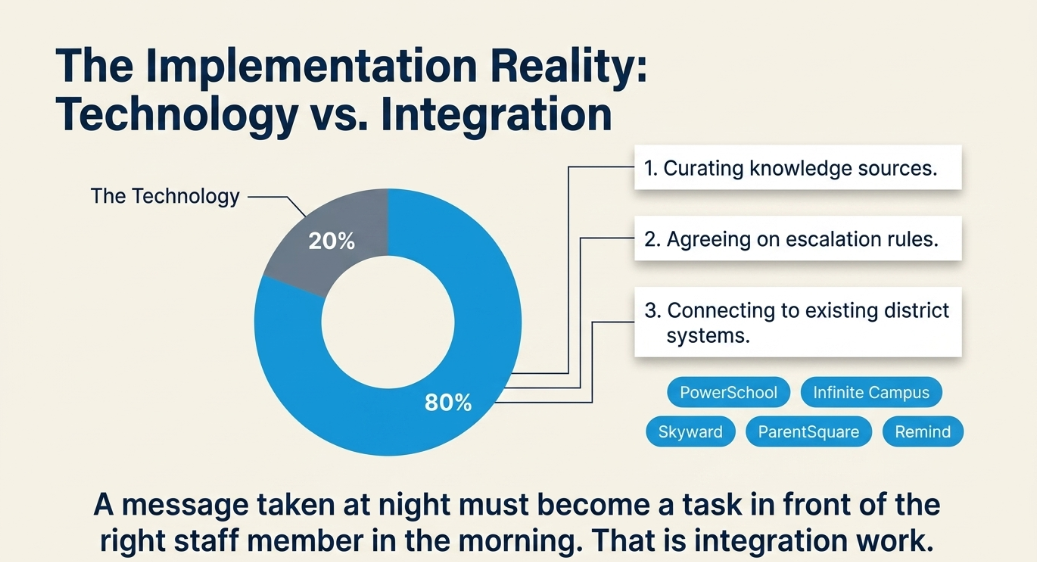
Start before the next spike, not during it
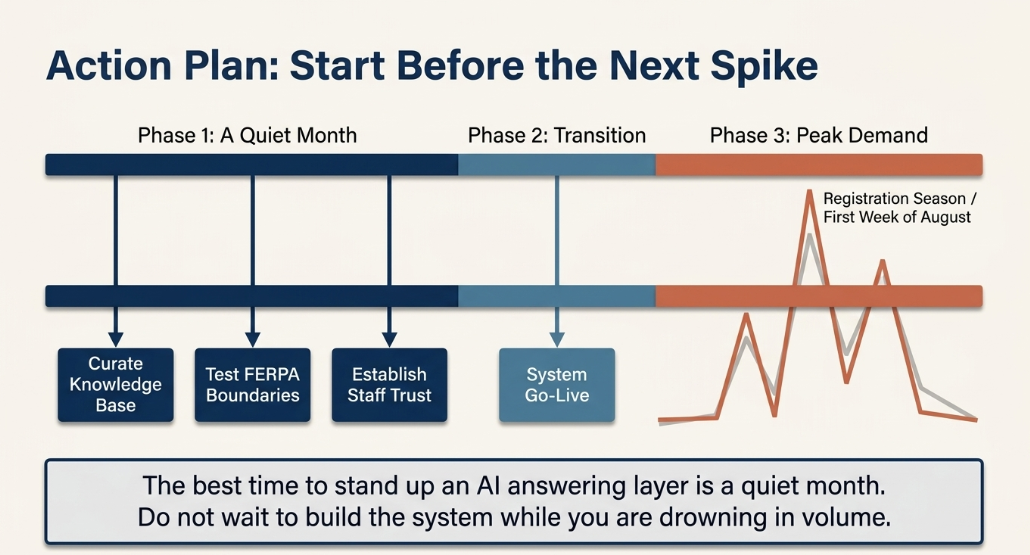
The best time to stand up an AI answering layer is a quiet month, so the knowledge base is curated, the FERPA boundaries are tested, and the staff trusts the escalation rules before registration season hits. CETDIGIT has delivered more than 300 AI and CRM deployments, holds Salesforce Crest and HubSpot Elite partner status, and has worked inside public school district operations, so we know both the technology and the approval processes districts live with. If your front office dreads the first week of August, schedule a consultation with our education team, and we will walk through what a district-grade deployment looks like, from knowledge-base curation to go-live, and what it would cost for a district your size.
Related Reads
The Invisible Enrollment Leak: How AI-Powered Website Search Helps Universities Stop Losing Prospective Students
The Missed Call Problem in Healthcare: How AI Voice Agents Give Medical Practices Their Phones Back
Answering at Scale: How AI Agents Are Quietly Transforming Schools, Universities, and Government Services


Leave a Comment