


Somewhere in your organization, a finance leader has asked a perfectly reasonable question: what will this AI agent cost us next year? And somewhere nearby, a vendor or an internal champion has answered with a range wide enough to drive a truck through. That is not evasion. It is what happens when the unit of purchase changes. For two decades, CRM software was priced by the seat, and a budget was a headcount multiplied by a list price. AI agents are priced by what they do, and nobody can multiply what they do until they have watched one work.
This article is for the executive who has to approve that budget. It does not argue for or against any platform. It explains how the two largest CRM vendors now charge for agents, shows the arithmetic you can do on a whiteboard, and lists what to settle before a contract is signed. Prices below were current as of November 2026, and both vendors revise them, so confirm against the live rate cards.
Two ways of charging for the same idea
Salesforce prices Agentforce activity in Flex Credits. Its pricing page lists 100,000 credits at $500, and its rate card, updated November 3, 2026, assigns 20 credits to a standard or custom action in production and 30 to a voice action. At the listed price, that works out to roughly ten cents per action and fifteen cents per voice action. Sandbox usage is discounted on the rate card, and unused credits do not roll over. Overages are billed monthly in arrears at the contracted rate.
HubSpot has moved toward paying for results. Since April 14, 2026, its Customer Agent has been priced at $0.50 per resolved conversation, down from $1.00 per conversation, and its Prospecting Agent at $1.00 per lead recommended for outreach, both settled in HubSpot Credits. In October 2026, the company added spend controls, including an account-level limit that defaults to as much as 50 percent above the monthly credit allotment, plus caps by feature and action.
One model charges for effort, the other for outcomes. Neither is inherently better. They fail in different ways, and that is the point of understanding them.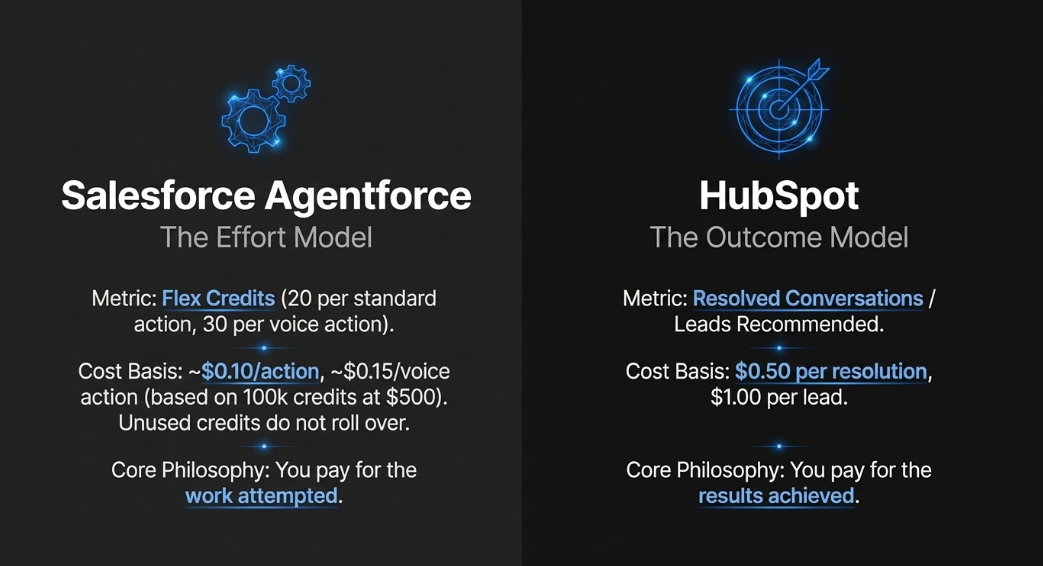
What the arithmetic looks like
Consider a service team that expects 5,000 conversations a month. This is our own illustration, not a quote from either vendor. On an action-based model, suppose a typical conversation requires four actions: look up the account, check entitlement, update the case, and send the reply. That is 80 credits, or about forty cents, and 5,000 conversations cost roughly $2,000 a month. If the design is clumsy and the same conversation takes eight actions, the bill doubles to $4,000 with no change in customer volume.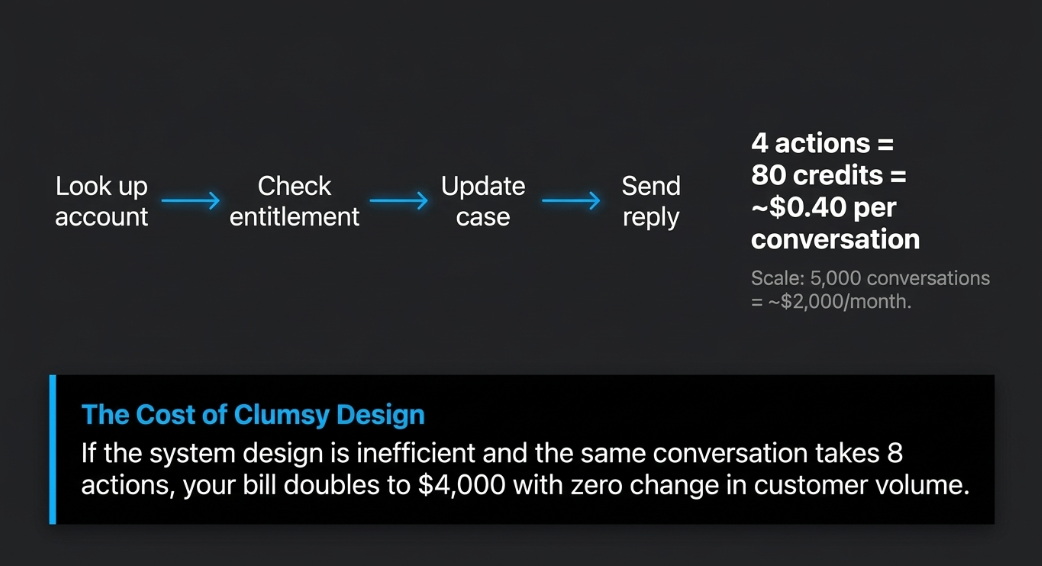
On an outcome-based model, suppose the agent resolves 60 percent of those conversations. Three thousand resolutions at fifty cents come to $1,500. If resolution climbs to 80 percent, the bill rises to $2,000, which is a bill growing because the agent is working better. That is a more comfortable conversation to have with a finance team, provided you know how the vendor defines a resolution.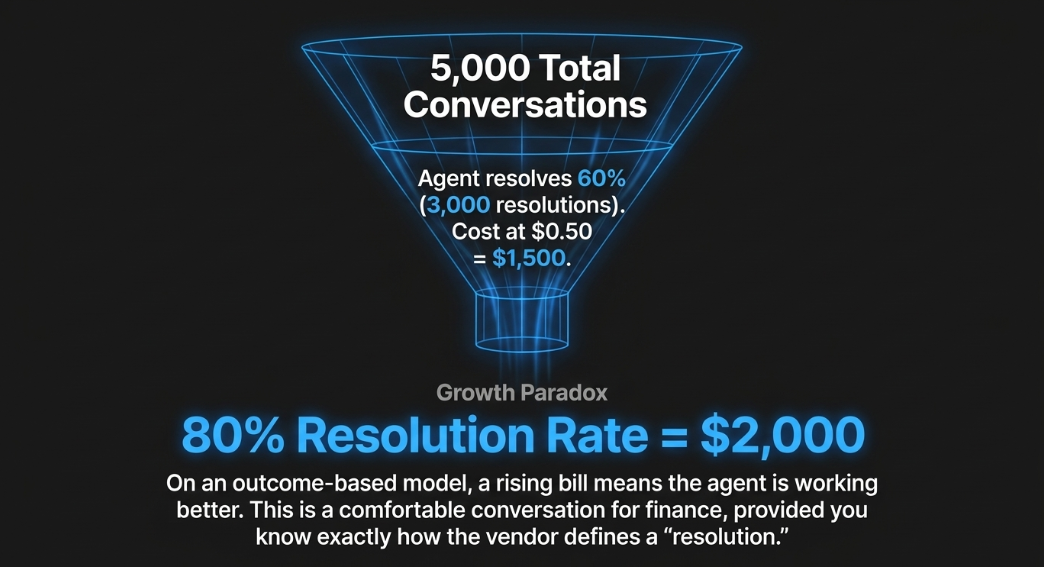
Where the surprises hide
The first surprise is the definition of the unit. An action, a resolved conversation, and a recommended lead are all contract terms, not common sense. Ask who decides whether a conversation was resolved, and what happens when a customer comes back an hour later with the same issue.
The second is that your own data changes your bill. An agent working against a messy CRM, with duplicate accounts, missing fields, and conflicting owners, tends to take extra lookups and retries to reach an answer. Dirty data is not just an accuracy problem. On an action-based model, it is a line item.
The third is the gap between pilot volume and production volume. A pilot handles a few hundred conversations chosen by enthusiasts. Production handles whatever customers actually send, including the strange ones, at all hours.
The fourth is what happens at the limit. Some caps stop the agent. Some alert a person. Some let usage continue and bill later. A customer-facing agent that quietly stops answering on the twenty-fifth of the month is a service failure, so the behavior at the cap should be decided deliberately, not discovered.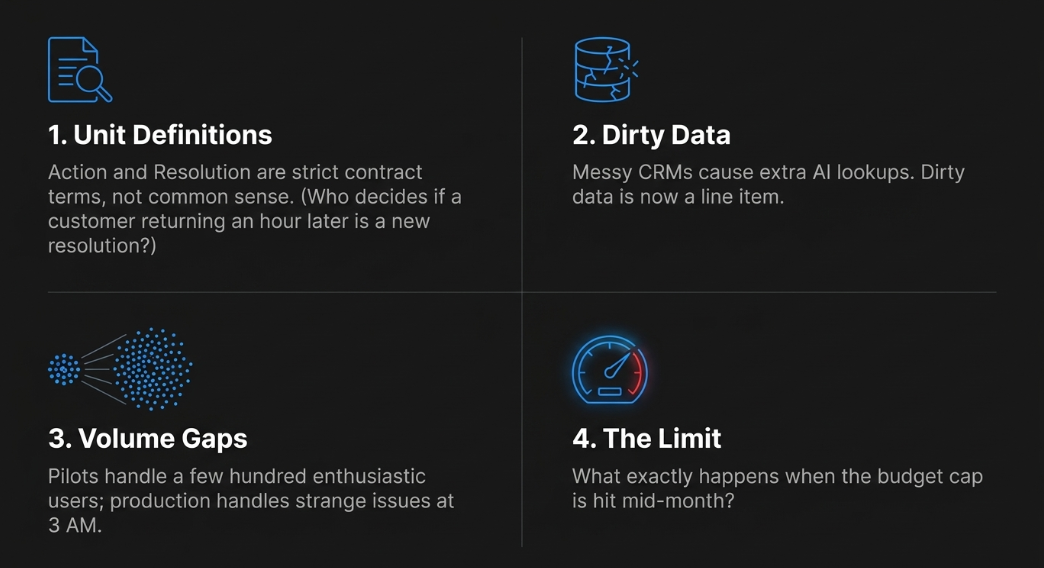
Five questions to put on the table before you sign
Ask what exactly is being counted, and ask for the vendor's definition in writing. Ask for a worked example using one of your own typical workflows, from first message to final record update, and have someone on your side redo the math. Ask how test and sandbox usage is charged, because a team that cannot afford to test will test in production. Ask what happens at the cap, and who is notified. And ask who inside your company owns the monthly consumption report, because a metered service without an owner is a budget without a steward.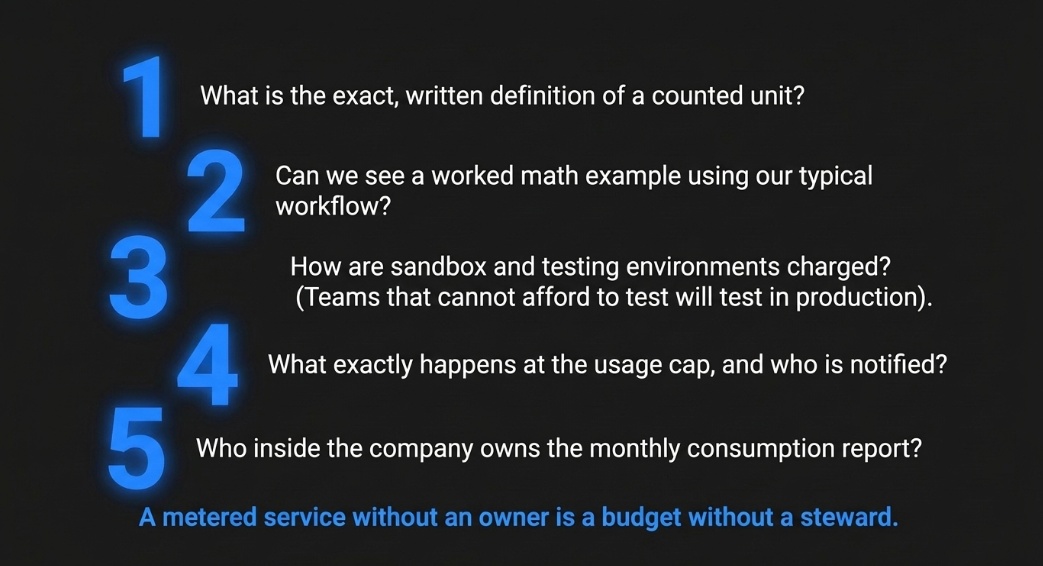
A pilot is a pricing instrument
The most useful thing a pilot can do is not prove that the agent works. It is to produce your own unit economics. Instrument it from day one: record actions per conversation, resolution rate, handoffs to humans, and cost per outcome, week by week. Then model three cases, best, expected, and worst, and put the worst case in front of the board before launch rather than after the first invoice. If the worst case is tolerable, you have a decision. If it is not, you have found out cheaply.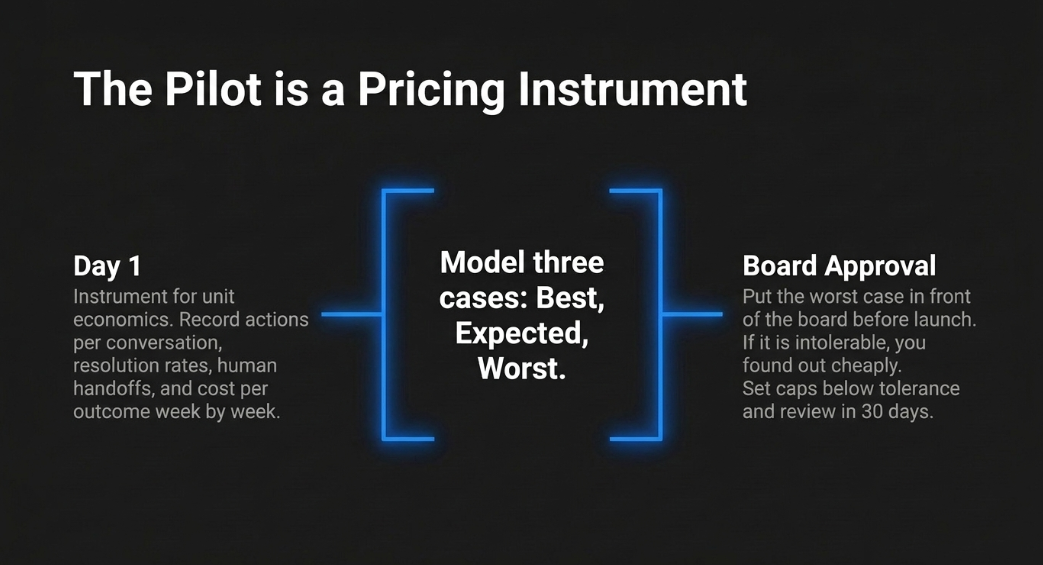
Set caps below your tolerance, not above it, and review them after thirty days with real numbers. Decide in advance which workflows are worth the cost per outcome and which are not. An agent that saves a ten-minute task at a cost of ten cents is an easy yes. One that spends sixty cents on something a customer would have solved on a help page is not.
Where a partner earns its place
Consumption pricing rewards good design. Fewer, better-chosen actions, clean data, clear escalation rules, and honest measurement all lower cost per outcome, and none of that is visible on a rate card. CETDIGIT's role in these engagements is to model the economics before the build, structure the pilot so it produces usable numbers, clean the CRM data that agents depend on, and set up the reporting and guardrails that keep a metered service predictable. We do this on both Salesforce and HubSpot, and we have no stake in which meter you end up under.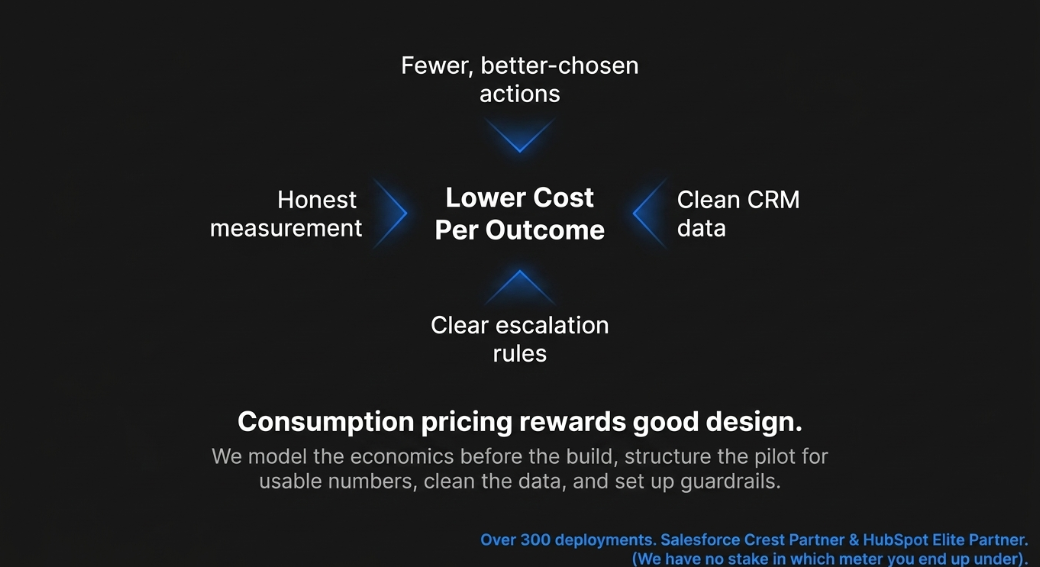
Talk with CETDIGIT
If you are being asked to approve an AI agent budget and cannot yet explain what it will cost, a short consultation can help. Cetrix Technologies LLC has completed more than 300 AI and CRM deployments and is a Salesforce Crest Partner and HubSpot Elite Partner. Schedule a consultation with CETDIGIT and bring one real workflow; we will build the cost model with you on the spot.
Related Reads
The Pilot Worked and the Rollout Stalled: What Executives Should Settle Before an AI Pilot Becomes a Production System
Where to Start With AI: A Practical Guide for Business Leaders Who Know They Are Behind
The Real Cost of Waiting: What Business Owners Lose by Delaying AI Adoption


Leave a Comment