


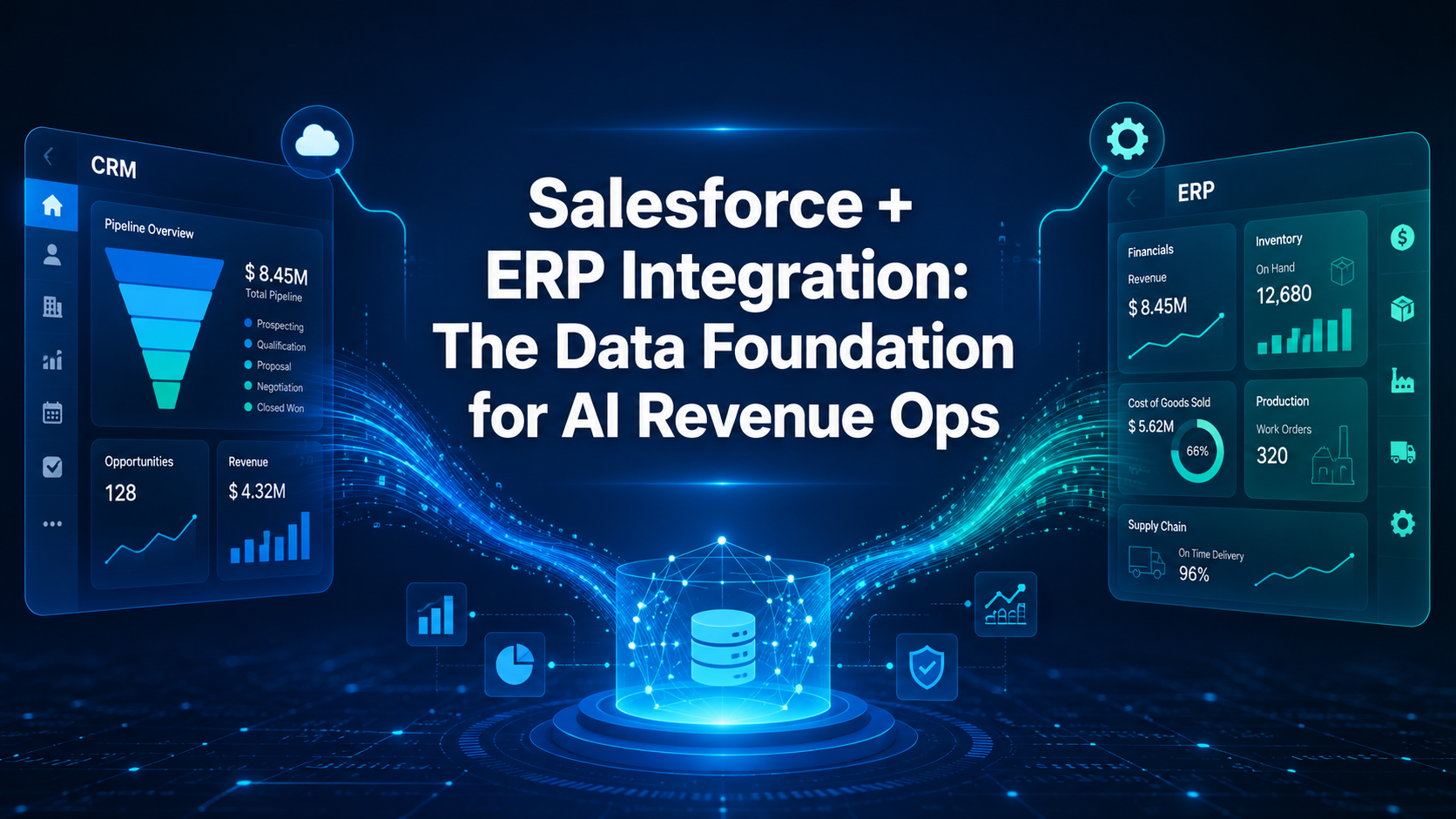
Salesforce–ERP integration connects a CRM that holds the customer and commercial record to an ERP that holds finance, supply chain, production, and inventory, so data flows between them and both reflect the same transactions. It delivers fewer manual re-entries, fewer discrepancies, and one view spanning quote to fulfillment. In 2026, the open question is different: whether the two systems together produce a Data Foundation that an AI layer can act on, or two tidy systems trading files.
The RFP arrived on a Thursday. The account was live in Salesforce with three years of history behind it, the bid was priced against a standard cost the ERP had updated eleven days earlier, and after a procurement cycle that ran most of a quarter, the contract was awarded. Both systems did precisely what they were built to do. The CRM recorded the win. The ERP recorded the cost. The sync moved both records within the minute, exactly as designed.
What neither system was built to do, what no sync has ever done, is tell the business what that contract actually earned before the quarter closed, and someone in finance assembled the answer by hand. This is the part worth stating plainly, because it is where accounts of this moment usually go wrong: the integration was correct. It was expensive, it was hard, it was probably the most difficult infrastructure work in the category, and it is load-bearing for everything that follows. Nobody bought the wrong thing. The requirement moved, and it moved toward Revenue Intelligence, the real-time measurement layer that shows what revenue work actually produced, rather than what the systems recorded about it afterward.
What is Salesforce–ERP integration
Salesforce is a CRM platform: it manages customer interactions, sales processes, and marketing campaigns. An ERP system manages core business processes, finance, supply chain, production, inventory, and human resources. Integrating them means data flows between the two so that a transaction recorded in one is reflected in the other, creating a unified view supporting end-to-end business processes and letting an organization use the strengths of both.
Architecturally, it is a transport problem, and that framing matters later. Records move bidirectionally: an order created in the CRM lands in the ERP; a cost, stock level, or fulfillment status updated in the ERP appears in the CRM. Master-data ownership gets settled, which system is authoritative for a customer, a product, or a price. The quote-to-cash path gets wired end-to-end. Done well, the two systems stop disagreeing.
What it delivers, and where it still wins
The seven benefits that hold
Every one of these is real, and every one of them is still true.
- Streamlined operations. Connecting the systems eliminates data silos between departments and cuts manual re-entry, which reduces errors and accelerates the process. An order created in the CRM automatically triggers inventory checks, production scheduling, and shipping in the ERP.
- Enhanced data accuracy. Data entered in one system updates in the other, reducing discrepancies and establishing a single source of truth. Business development sees real-time inventory and production schedules, which means delivery commitments stop being optimistic.
- Improved customer service. Support teams see prior interactions, purchase history, and current order status across both systems, rather than one half and a phone call.
- Better resource management. Real-time visibility into raw materials, labor, and equipment. When demand shifts in the CRM, the ERP can adjust production plans against it.
- Increased agility. Real-time insight into demand trends, inventory, and production capacity lets an organization adjust and scale against opportunities rather than against last month's picture.
- Enhanced collaboration. Business development, production, finance, and supply chain work from the same data, which removes an entire category of avoidable disagreement.
- Comprehensive reporting and analytics. Combining both systems gives deeper operational insight, commercial performance, production efficiency, and supply chain effectiveness in a single dashboard.
For a manufacturer, that last one was the point. Before the integration, answering "how is the business doing" meant one person in finance and one person in operations agreeing to reconcile two exports. After it, there is a dashboard.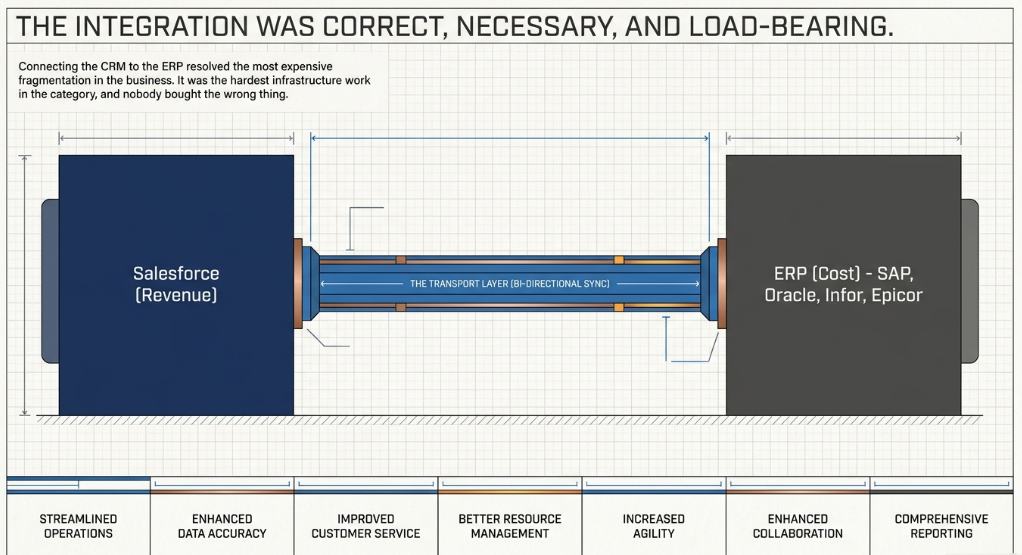
Which ERP systems integrate with Salesforce
The ERP platforms most commonly integrated with Salesforce in manufacturing are SAP (comprehensive, production planning through supply chain), Oracle (advanced analytics, financial management, procurement), Infor (industry-specific configurations), and Epicor (strong in small-to-mid-sized manufacturing, production management, planning, inventory control). Each integrates through established patterns, and the choice is usually settled by what the plant already runs rather than by integration considerations.
Who does this affect in 2026
If you are evaluating a CRM–ERP integration, everything above is the case for it, and the case still stands.
If you already run one, and if you are a VP of RevOps or an integration lead at an enterprise or upper-mid-market manufacturer, you probably do, the rest of this article is about the question that arrived after the project closed. The sync works. The dashboard exists. And the AI initiative the board approved two quarters ago is still waiting on data that, by every measure the integration was scored on, is already fine.
What changed by 2026
What held then still holds: connecting the CRM to the ERP was the correct answer to the most expensive fragmentation in the business, and all seven of those benefits still land. What changed is that the connection stopped differentiating. Every serious competitor is connected now, and the ground has moved fast enough that it has moved while the case was still being made.
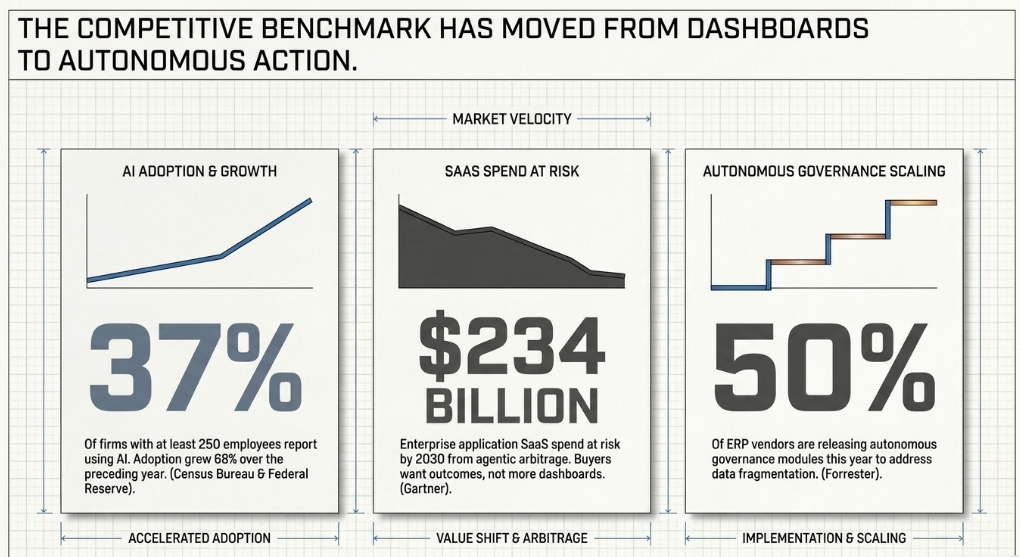
The government data is the honest way to see it. The Census Bureau's Business Trends and Outlook Survey, collecting from 14 December 2025 through 3 May 2026, puts US business AI use at 19.8% as of early May, roughly a fifth. But the firm-size cut is the one that matters here: 37% of firms with at least 250 employees report using AI, and 32% of firms with 100–249. Adoption rose among firms with at least 20 employees over that period and did not move significantly among the smallest. Your peers at your scale are moving.
One caution about numbers, from a source with no product to sell. The Federal Reserve's analysis of AI adoption notes that credible estimates of work-related AI adoption have ranged from about 5% to 40%, depending entirely on sampling, units of analysis, question framing, and what counts as material. The Fed also records that before a late-2025 methodology change, adoption grew 68% over the year ending in September. So the numbers being quoted at you are unreliable by a factor of eight, and the direction is unambiguous anyway.
Two analyst houses describe what that means for systems like yours. Gartner puts up to $234 billion of enterprise application spending, roughly 20% of enterprise application SaaS spend by 2030, at risk from agentic arbitrage, where AI agents complete work across multiple systems and reduce the need for people to sit inside each interface. "Agentic AI changes the economics of software," says Gartner's George Brocklehurst. And the specific line worth sitting with: enterprise buyers will deemphasize buying more tools or dashboards, because what they want is outcomes. Forrester, predicting 2026, names the remaining bottleneck as business process standardization and data fragmentation, and classifies it as an ERP and data problem rather than an AI problem. Forrester also expects half of ERP vendors to release autonomous governance modules this year, which tells you the substrate question is live inside the ERP world itself.
The dashboard was a real achievement. What changed is that a dashboard is where the question gets asked, not where it gets answered.
The Silo Tax at the CRM–ERP boundary
The Silo Tax is what an organization pays when connected systems move fragmented data faster, instead of making it mean one thing. At the CRM–ERP boundary, it has a specific and expensive shape, and you can verify it against your own quarter-close rather than taking anyone's word for it.
The CRM holds revenue. The ERP holds cost. Between them, they hold the two halves of the margin, and a perfect bidirectional sync still cannot tell you the margin per contract in real time. Sync moves records. It does not compute a joint answer. So the answer gets assembled by a person, after the fact, from two systems that both did their jobs correctly. That is not an integration defect. It is what integration is: transport, not computation.
You are paying the Silo Tax at this boundary if:
- The sync is healthy, the dashboards are current, and margin per contract still arrives at quarter-close rather than at award.
- Answering "what did this account actually earn" requires a person who knows both systems.
- Every AI use case opens with a data-preparation project nobody scoped.
- Governance exists per system, and nothing governs a record as it crosses between them.
The root cause is scope, not execution. The integration was specified to make the two systems agree, and it does. Governance at the asset level, use-case alignment, and metadata that a machine can act on were never in the specification, because in 2024, nothing was going to read the record autonomously.
This is also why Cost per Outcome lands more naturally here than anywhere else in the AI conversation. A manufacturer already prices the cost per unit to four decimal places. Cost per outcome is the same discipline applied to revenue work, and it requires exactly what the sync does not provide: revenue and cost as one computable picture rather than two accurate halves.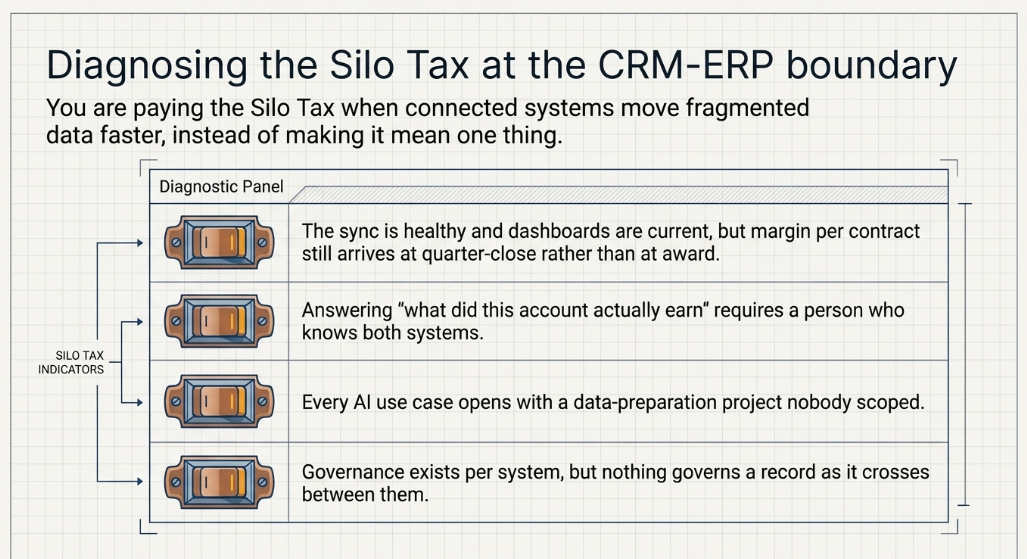
The Data Foundation: what the two systems have to produce together
A Data Foundation is the substrate beneath AI: data aligned to the use cases it serves, governed at the asset level, delivered through prepared pipelines, described by metadata that is active rather than passive, and continuously assured.
Those five criteria are Gartner's own steps to AI-ready data, which is what makes the Data Foundation testable instead of rhetorical, and reading them against a sync is clarifying. Not one of the five is about whether records move between systems. A perfect integration satisfies none of them. Gartner predicts that through 2026, "organizations will abandon 60% of AI projects unsupported by AI-ready data," and reports that 63% of organizations either lack or are unsure of the right data management practices for AI. Its description of the failing estate, data collected in silos across repositories, systems, and platforms, managed by practices too slow and too rigid for AI teams, describes connected estates, not disconnected ones.
The 2026 question follows: not whether Salesforce and the ERP are integrated, but whether they together produce an AI-ready data foundation, one substrate where revenue and cost are the same picture, governed and use-case aligned, or two well-run systems trading files on schedule.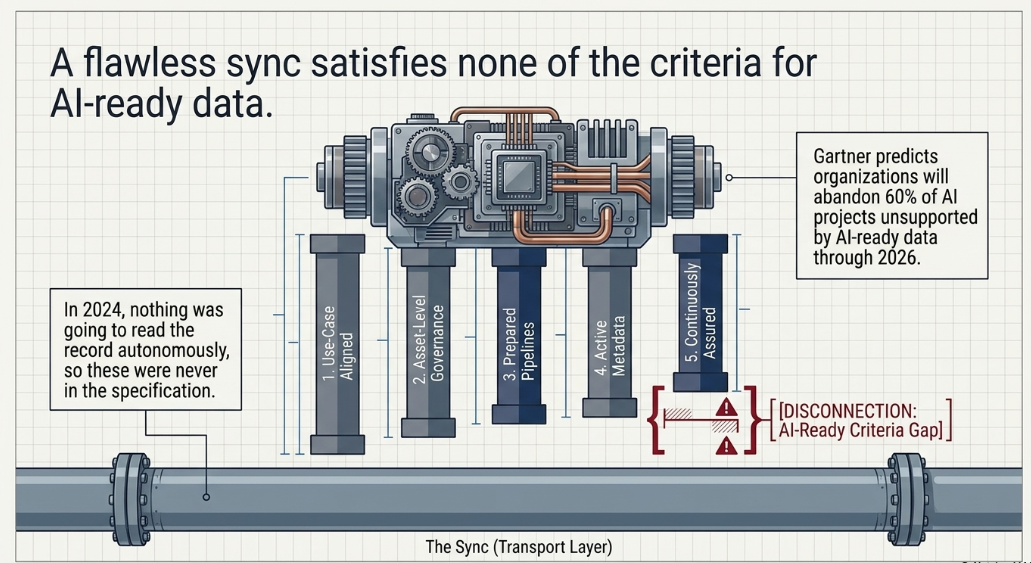
Evaluating a CRM–ERP integration against a 2026 requirement: the decision table
|
The benefit of the integration delivered |
What it means today |
What AI-readiness additionally requires |
|
Streamlined operations |
Orders flow from CRM to ERP without re-entry |
The flow completes without a person triggering or checking it |
|
Data accuracy |
Both systems hold the same values |
The values are governed at the asset level, with an owner per field |
|
Resource management |
Real-time visibility into materials, labor, and capacity |
The system acts on what it sees rather than displaying it |
|
Reporting and analytics |
Commercial and production data in one dashboard |
Revenue and cost are computed as one answer, continuously |
|
Collaboration |
Teams work from the same data |
An agent can act on that data without a human interpreting it first |
No row says the integration fell short. Each shows a benefit that was correctly specified for a connected estate, now carrying a second requirement nobody wrote into the original scope.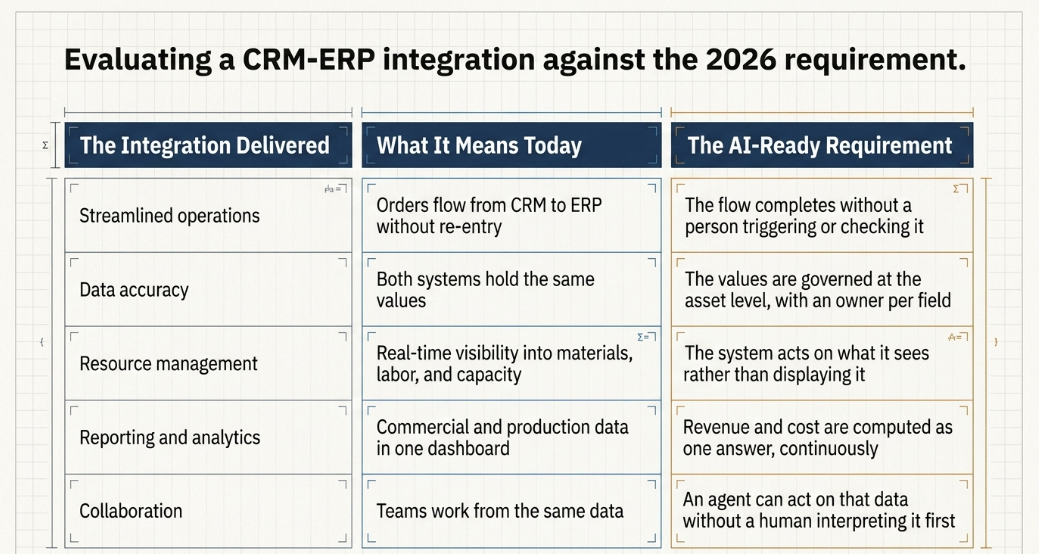
The CETDIGIT perspective
CETDIGIT's position is that the CRM–ERP integration is the hardest prerequisite in the category, and that the organizations that completed it are the ones best placed for what comes next, which is the opposite of what most AI vendors tell this reader.
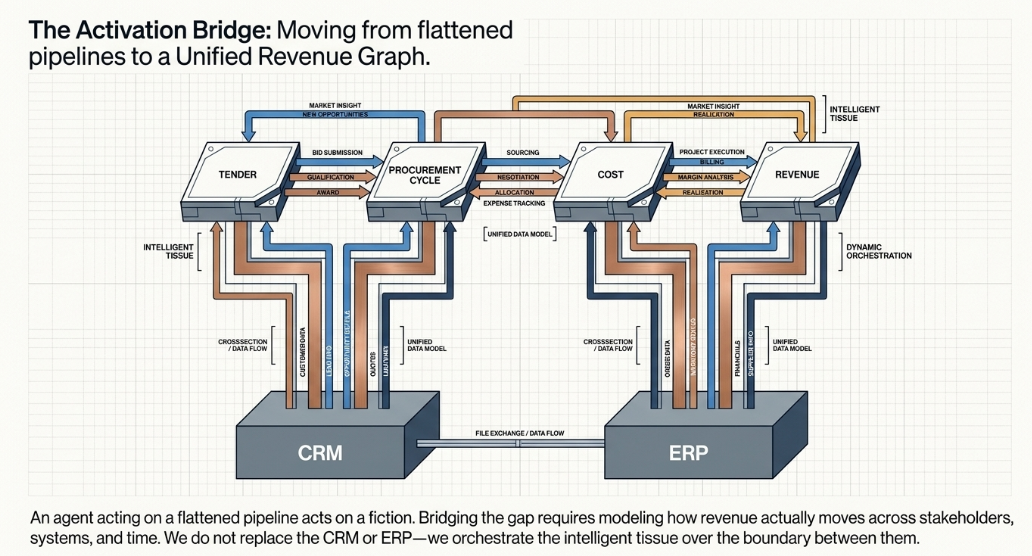
What sits above it is different work. A connected estate is a system of record: it stores, syncs, and reports accurately. A System of Action senses a signal and executes revenue work without waiting for a person to notice it. The gap between them is the activation layer, which nobody specifies at implementation time, because at implementation time, no one was going to read the data but a human. Getting there requires modelling how revenue actually moves, which is why we work from a Revenue Graph rather than a linear funnel, since a tender forms across stakeholders, systems, and a procurement cycle in ways a pipeline flattens, and an agent acting on a flattened model acts on a fiction. That is the work of connecting the record to revenue outcomes. We orchestrate that architecture; we don't sell the CRM, we don't sell the ERP, and we're not a partner of either.
Recommended path
If your sync is healthy and your AI initiative is stalled on data questions that the integration can't answer, those two facts are related, and neither is a failure. The sequence that works starts beneath the AI: score what the two systems produce jointly against the five AI-ready criteria, and find out which are actually satisfied. Most integrated estates satisfy none, and that is a finding rather than an indictment.
CETDIGIT's Data and AI Foundation engagement builds what the agents will read on top of the integration you already have, asset-level governance, resolved definitions across the CRM–ERP boundary, and pipelines aligned to the revenue outcomes you intend to produce. It sits within CETDIGIT's broader AI services framework, and how a stack unification engagement actually runs is documented if you want the methodology before a conversation.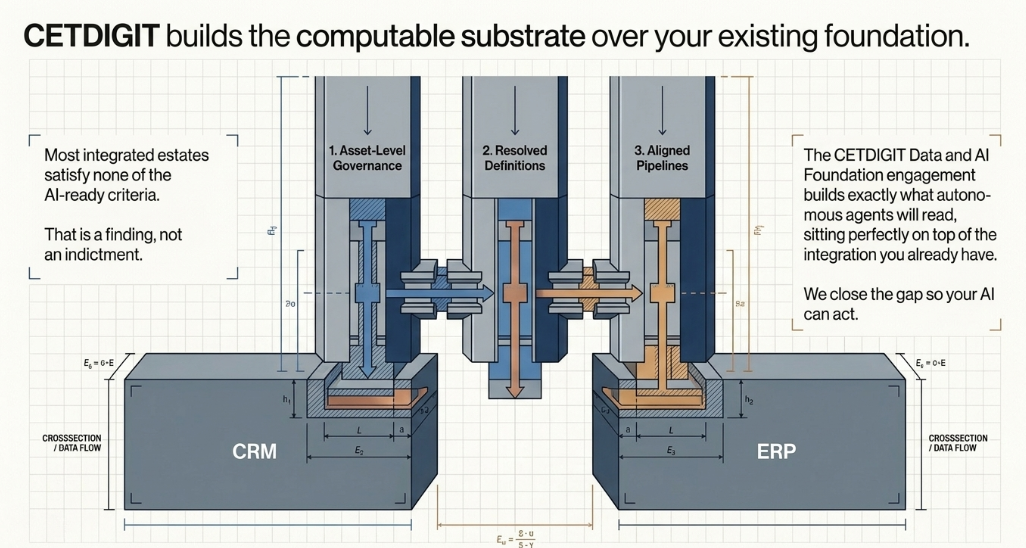
Frequently asked questions
What is Salesforce ERP integration?
Salesforce ERP integration connects Salesforce, which holds customer, commercial, and sales-process data, to an ERP system, which holds finance, supply chain, production, and inventory. Integration means data flows between them, so both reflect the same transactions, creating one view across end-to-end processes rather than two systems that disagree. Architecturally, it is a transport achievement: records move bidirectionally, master-data ownership gets settled, and the quote-to-cash path gets wired end to end.
What are the benefits of Salesforce ERP integration?
Seven, and they all still hold in 2026: streamlined operations from eliminating manual re-entry between departments; better data accuracy from a single source of truth; improved customer service from full order visibility; better resource management through real-time views of materials, labor, and capacity; increased agility from live demand and production data; stronger collaboration across commercial, production, and finance teams; and comprehensive reporting combining both systems in one dashboard.
How do you integrate Salesforce with an ERP?
At the architectural level, three things get settled. First, master-data ownership, which system is authoritative for customers, products, and pricing, since both will hold all three. Second, the sync pattern, which records the move in which direction, how often, and what happens on conflict. Third, the quote-to-cash path, how an order in the CRM becomes a production and fulfillment event in the ERP, and returns as cost and status. The technical connection is the easy part; the data model agreement is where projects run long.
Why do manufacturers integrate Salesforce with their ERP?
Because the CRM–ERP gap is the most expensive fragmentation in a manufacturer's business. The commercial side prices tenders against costs the ERP owns; the plant schedules production against demand the CRM owns. Unintegrated, business development commits to delivery dates that production hasn't agreed to, and finance reconciles the difference after the fact. Integration means a bid is priced against a real standard cost, and an awarded contract triggers a real production schedule.
Which ERP systems integrate with Salesforce?
The platforms most commonly integrated in manufacturing are SAP, comprehensive across production planning and supply chain; Oracle, strong in analytics, financial management, and procurement; Infor, which ships industry-specific configurations; and Epicor, widely used in small-to-mid-sized manufacturing for production management, planning, and inventory control. All integrate through established patterns. The choice is usually determined by what the plant already runs rather than by integration considerations.
If our CRM and ERP are synced, why can't we see the margin per deal?
Because the CRM holds revenue and the ERP holds cost, sync moves records rather than computing a joint answer. Both systems can be perfectly current and perfectly consistent, and the margin per contract still requires a person to assemble it from two accurate halves. That is not an integration defect; it is what integration is. The gap closes when revenue and cost become one computable picture rather than two synced ones, which is a data-substrate change rather than a connection change.
Does an integrated CRM and ERP mean our data is AI-ready?
Not by itself. Gartner defines AI-ready data as aligned to specific use cases, governed at the asset level, supported by prepared pipelines, described by active metadata, and continuously assured, and none of those five is satisfied by records moving between systems. Gartner predicts organizations will abandon 60% of AI projects unsupported by AI-ready data through 2026, and Forrester names data fragmentation as the remaining bottleneck, classifying it as an ERP and data problem rather than an AI problem.
Stack Unification Audit
Diagnose where your AI investment is leaking, connect the stack, then activate AI. You've done the connecting. Book a 60-minute Stack Unification Audit, and we'll score what your CRM and ERP produce jointly against what an AI layer actually needs, and show you which gap to close first.

Leave a Comment