


It is a quarter to eleven on a Thursday night, and the funeral director who closed out the evening visitation is finally home. Her phone shows three voicemails from the main line, all left since five o'clock. One is a daughter asking what time Saturday's service begins. One is a pastor confirming the graveside arrangements. One is a caller asking what a direct cremation costs, who hung up before leaving a number. None of them is an emergency, and all of them will be waiting in her head when the phone rings again at three in the morning with a hospital on the line.
Anyone who has worked in death care knows this rhythm. A funeral home is one of the few businesses where the most important call of the week can arrive at the worst possible hour, and where the ordinary calls arrive in clusters that no small staff can fully absorb. The question worth asking is not whether technology should ever answer a family in grief. It is which calls genuinely need a human voice at that moment, which ones simply need a correct answer, and how to keep the first group from being buried under the second.
What a funeral home's phone actually carries
Listen to a week of calls and the mix is more varied than outsiders expect. There are first calls, when a family or a hospice nurse reports a death. There are service questions about times, addresses, livestream links, and where to send flowers. There are calls from clergy, cemeteries, florists, and vital records offices, pre-need inquiries from people planning ahead, and price questions from people comparing homes. Most are routine. A few are the reason the home exists.
Family-owned homes usually handle all of this with a handful of people who also run the services and meet with families. When the day fills up, the phone is answered by whoever is nearest, and after hours it rolls to a voicemail box that nobody wants to check.
The call that must always reach a person
The design principle for any voice agent in this industry is simple and non-negotiable: a first call is never handled by a machine alone. When the caller says that someone has died, or that death is expected within hours, the agent's only job is to respond briefly and kindly, confirm a callback number and location, and transfer the call or page the on-call director immediately, with a written summary delivered at the same moment. It does not ask a string of intake questions, and it does not try to sound like a counselor.
What the agent can do is make sure that handoff never fails. A properly configured system tries the primary on-call director, then the backup, and keeps trying until a human picks up, logging every attempt. For a funeral director who has lain awake wondering whether the overnight service really caught that call, a reliable, logged escalation path is a meaningful change.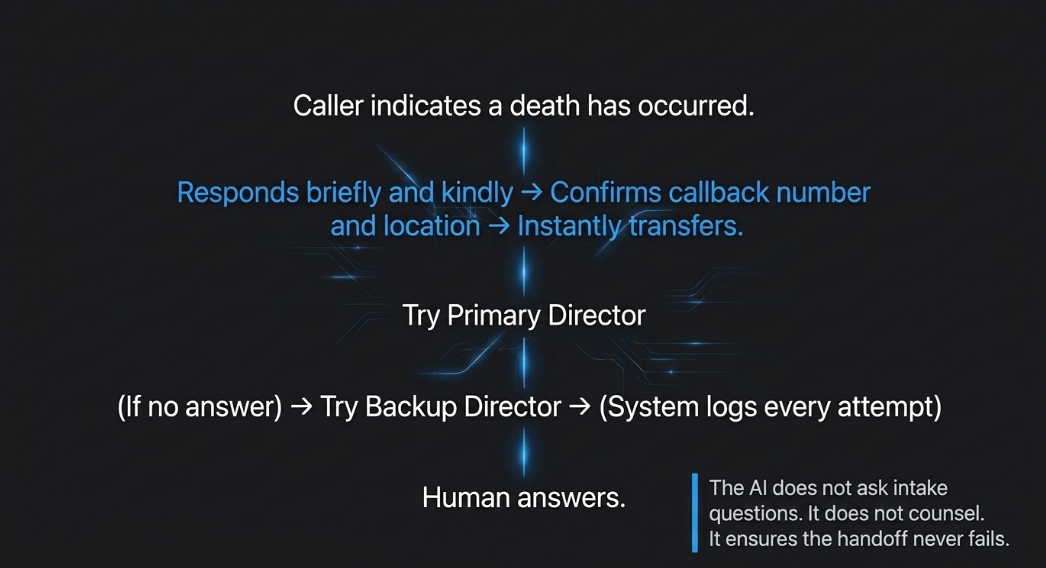
The calls that do not need to wait for morning
Everything else on that voicemail list can be answered on the spot, accurately, at any hour. The daughter wants the service time. The pastor wants confirmation of the graveside details. A family wants to know whether the visitation has been extended or where overflow parking is located. These answers already exist in the home's own materials, and a voice agent that answers only from approved sources, with citations back to the record, will repeat them correctly every time, in English or Spanish or whatever languages the community speaks. This is the layer of calls that consumes staff attention without requiring staff judgment. For anything the agent should not answer, such as a family asking to change an arrangement, it takes a structured message and routes it to the assigned director's queue with the case number attached, so the callback is informed rather than cold.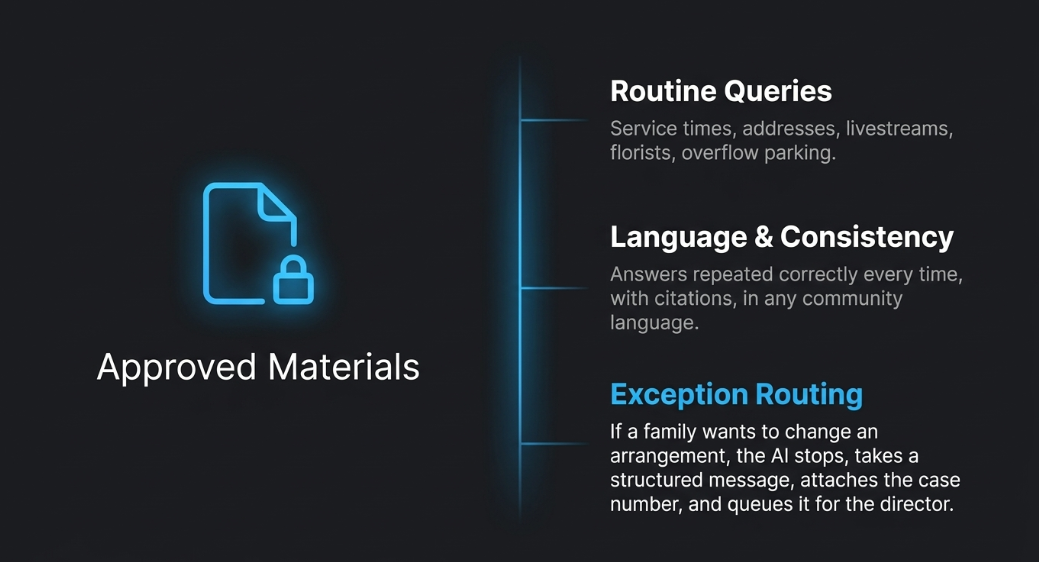
The price question and the Funeral Rule
Funeral homes operate under the FTC's Funeral Rule, which among other things requires providers to give accurate price information to people who ask by telephone, and does not allow a provider to insist on a caller's name, address, or phone number first. A price question at eleven at night is exactly the call that tends to go unanswered, which is both a compliance exposure and a lost family. A voice agent can read from the home's current general price list and offer to send it by text or email. It must not improvise, quote an outdated sheet, or steer. The price list should be a controlled document with a named owner, and homes should review their practices with counsel and their state board, since state rules vary.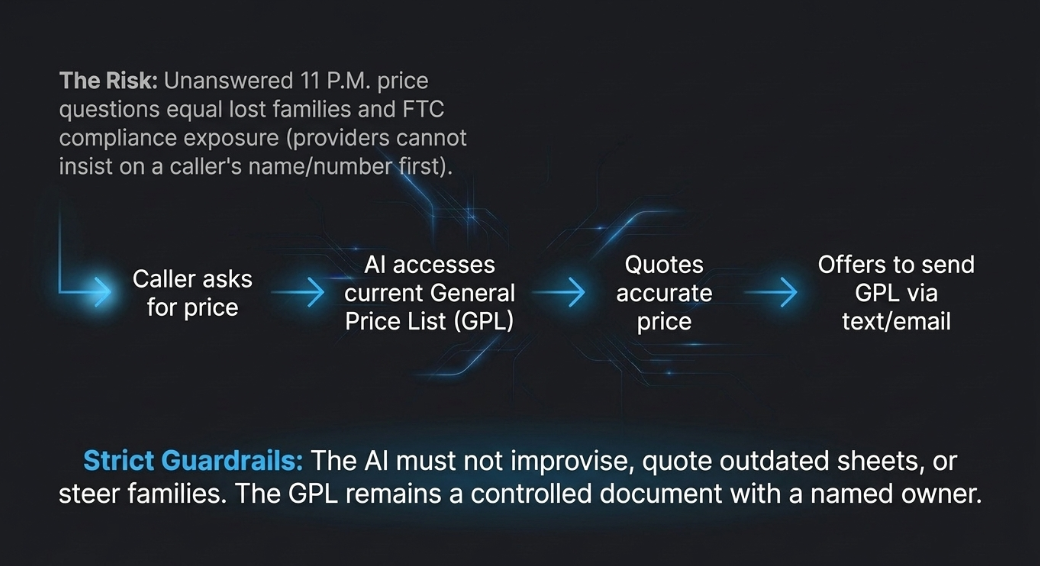
Pre-need: the quiet pipeline
Pre-need planning is where the CRM question becomes a business question. A person who asks about prearrangement is a lead that may take years to convert. Too many of those inquiries live on a sticky note. Whether the home uses HubSpot, Salesforce, or the pre-need module inside its case-management platform, every inquiry should become a contact with a source, a stated interest, consent to be contacted, and a follow-up date. A voice agent can capture these during the day or overnight and write them straight into the record, so that a planning counselor starts the next morning with a list rather than a rumor.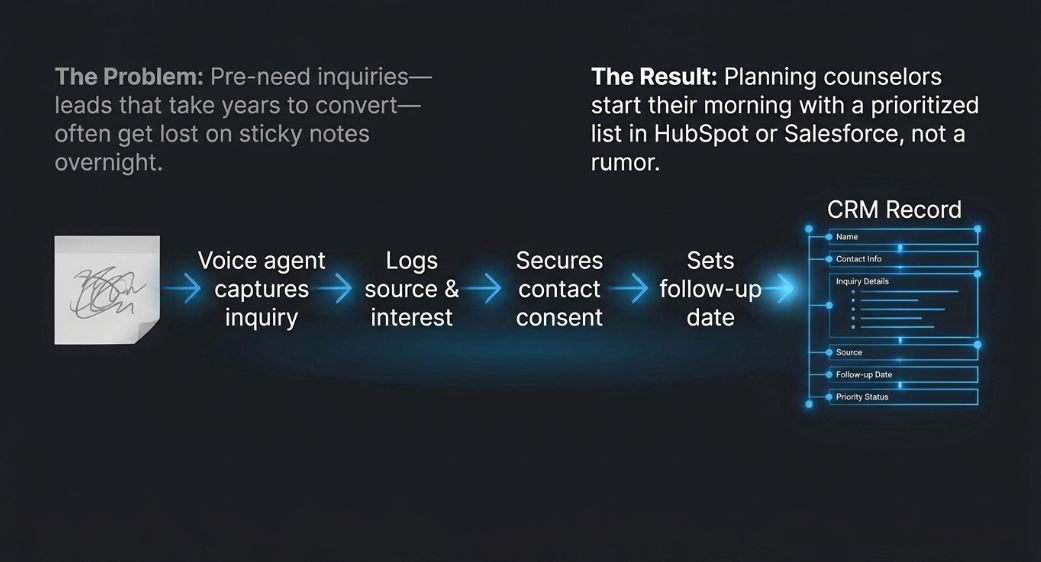
Where the information lives
Funeral homes typically run a case-management platform such as Passare, FrontRunner, or Osiris, plus a website and obituary platform and an accounting package. Service details come from the case record, the obituary is published elsewhere, and the price list is a PDF. A useful agent reads from these read-only at first, writes only to agreed places such as a call log or a pre-need contact, and never edits a case.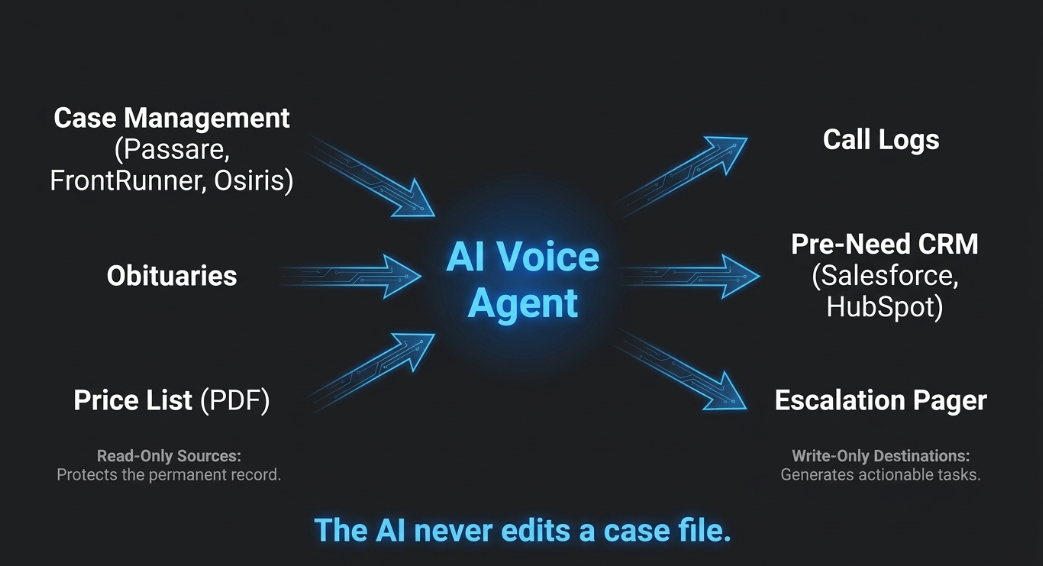
Guardrails that matter in this industry
Tone is a design decision, not a decoration. Scripts should be reviewed by the funeral director and, ideally, by someone who has sat across from families. The agent should never speculate about a death, never offer religious or emotional counsel, and always offer a human. Call recording needs a clear disclosure, particularly in states that require all-party consent. Any outbound pre-need follow-up falls under the TCPA, so consent has to be captured and opt-outs honored the same day. Families share sensitive information on these calls, so access to transcripts should be limited by role, with audit logging that shows who read what. Funeral homes are generally not HIPAA-covered entities, but minimum-necessary access is the right habit, and state privacy laws may apply.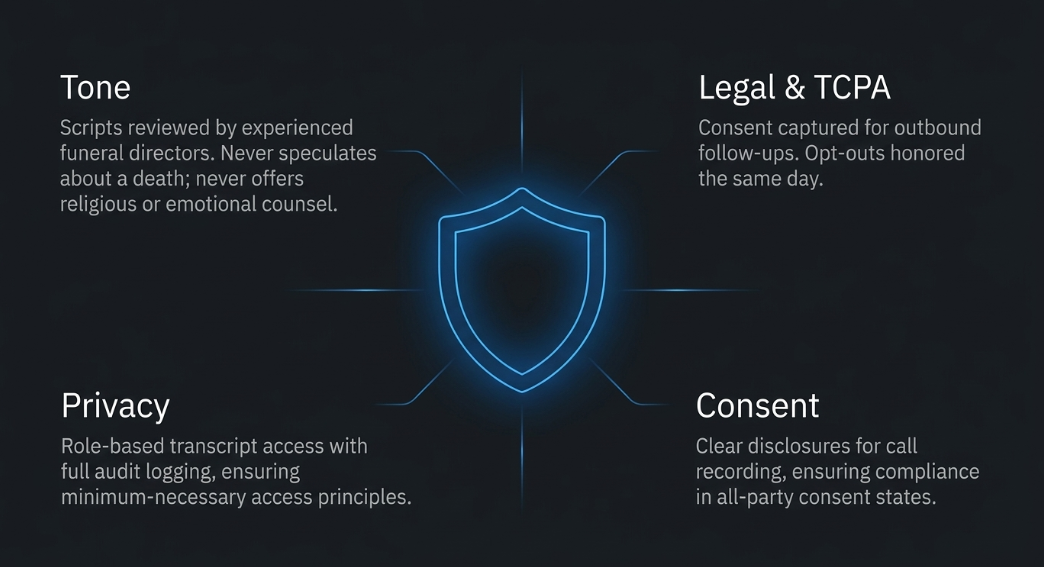
Where CETRAI fits
CETDIGIT builds this kind of call handling on CETRAI, our AI voice and chat platform for regulated, high-volume environments. It answers from a home's approved material with source citations, escalates on rules the home defines, supports multiple languages, and keeps audit logs that a careful owner can review. Teams that want to see how the platform handles escalation and after-hours coverage can look at cetrai.com as a starting point. The CRM and case-management connections are where CETDIGIT's Salesforce and HubSpot work comes in.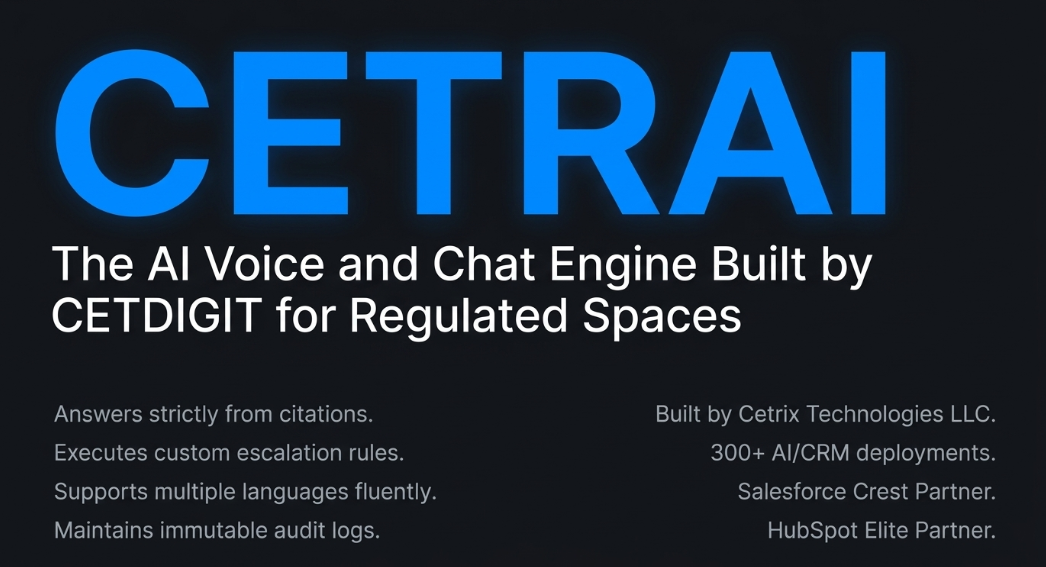
Talk with CETDIGIT
If your funeral home is losing evenings to voicemail, or you want pre-need inquiries to arrive in your CRM instead of on a notepad, CETDIGIT can walk through your call mix, your systems, and your escalation rules in a short consultation. Cetrix Technologies LLC has completed more than 300 AI and CRM deployments and is a Salesforce Crest Partner and HubSpot Elite Partner. Schedule a consultation, and we will map what should be automated, what should always ring a human, and how to get there without disturbing the families you serve.
Related Reads
The Daughter Who Called After Dinner: How Senior Living Communities Use AI Voice Agents to Answer Every Family Inquiry
Halloween Week at the Vet Front Desk: How Veterinary Practices Use AI Voice Agents to Triage Calls and Protect Their Teams
The Hygiene Recall List Nobody Has Time to Call: How AI Voice Agents Help Dental Practices Fill the Schedule
Leave a Comment