



Sometime in the next two weekends, most Salesforce production orgs will restart on the Winter '27 release. If your instance is in one of the October waves, the upgrade happens on October 3 or October 10, 2026, whether anyone on your team is watching or not. You can look up your own date on Salesforce Trust by searching for your instance and opening the Maintenance tab. Most years, this is a non-event for the executive team. An admin reads the release notes, a few page layouts shift, sales asks why a button moved, and the quarter carries on.
Winter '27 is not that kind of release. It is the release in which Salesforce stops asking whether you want Agentforce and starts assuming you do. Eligible orgs are having Agentforce enabled automatically at no additional cost, with rolling enablement already underway since early September, and Salesforce has said the setup toggle itself is being removed later in the cycle. At the same time, five release updates are being enforced rather than offered, including one that changes how SOAP API logins authenticate and one that changes who can see profile names. Any one of these is manageable. All of them arriving in the same upgrade window is a governance moment, and it deserves fifteen minutes of executive attention this week.
The headline change: Agentforce stops being opt-in
Since Agentforce launched, adopting it has been a decision. Someone had to turn it on, assign licenses or credits, and build a first agent. That decision point is what most governance processes are built around: nothing happens in the org until somebody chooses it.
Winter '27, which ships as Release 264 on API version 64.0, quietly retires that model. Agentforce is being auto-enabled across eligible editions, and existing orgs have been receiving rolling enablement since the first week of September 2026. Enablement is not the same as deployment. No agent starts answering your customers on its own, and nothing goes live without being built and activated. But the platform is now present in the org, the builder tools are available to anyone with the right permissions, and the question for leadership shifts from "should we turn this on" to "who in our company can now build an autonomous agent, and would we know if they did".
That question has real answers in the platform, and they are worth writing down. The Manage AI Agents permission controls who can build. The Einstein setting remains the master switch that disables the platform entirely. Individual agents can be activated and deactivated one at a time. If your org has accumulated broad permission sets over the years, and most mature orgs have, this is the week to check how many people effectively hold builder rights they never asked for.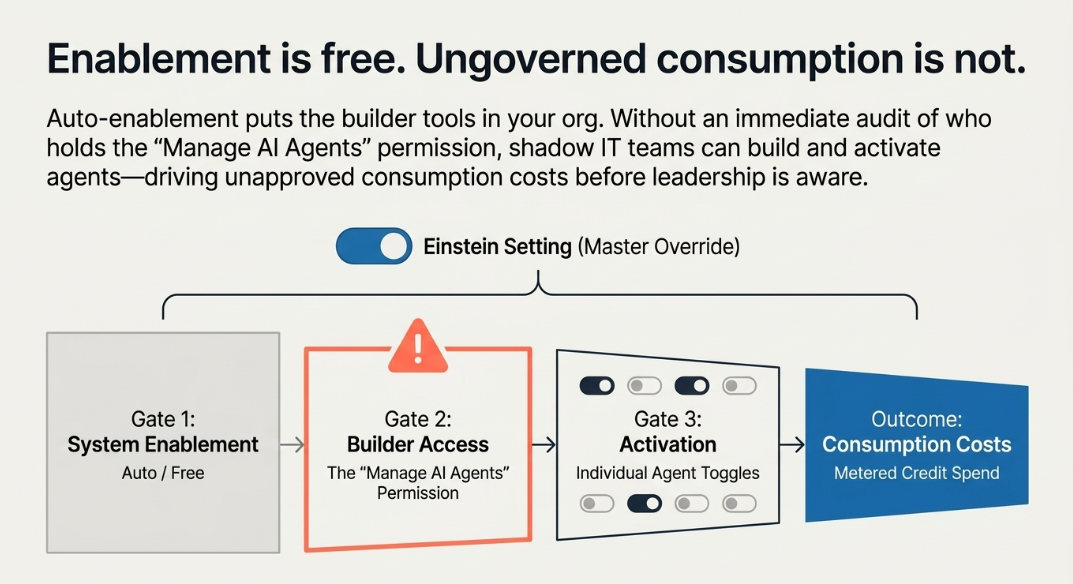
What else lands in the same upgrade
The auto-enablement headline can crowd out the rest of the release, which would be a mistake, because Winter '27 carries more substance than a typical seasonal update.
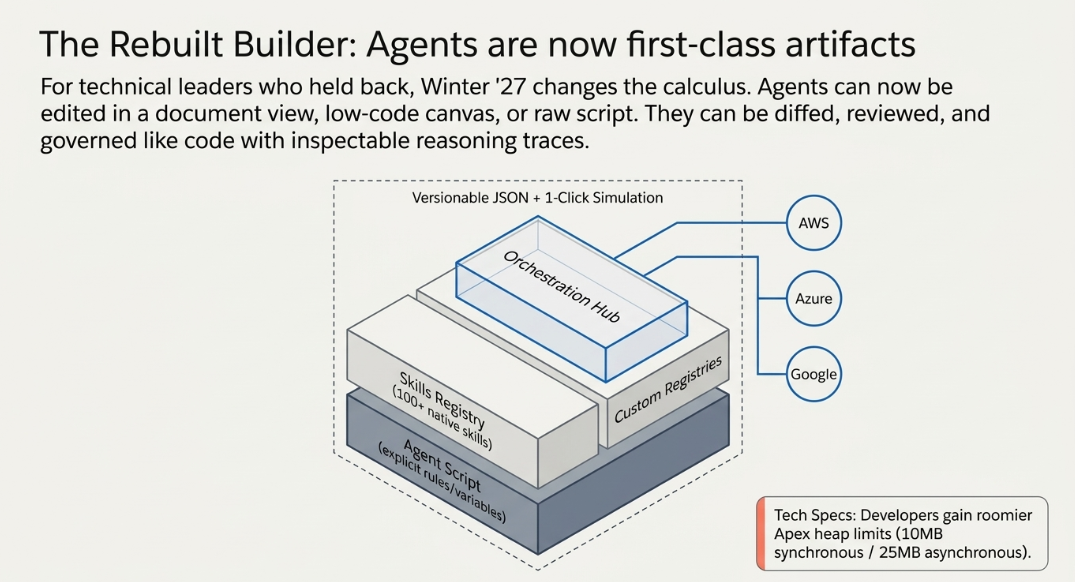
The build experience itself has been rebuilt. The new Agentforce Builder replaces the previous agent-building tools and is built on Agent Script, a scripting layer that lets teams define agent behavior with explicit rules and variables instead of purely conversational configuration. You can edit an agent in a document-style view, a low-code canvas, or the script itself, simulate it with one click, and version it as portable JSON. For CTOs who held back because early agent building felt too loose to trust, this is the most consequential change in the release: agents become artifacts you can review, diff, and govern like code, with reasoning traces you can inspect before anything touches a customer.
Around the builder, Salesforce is shipping a skills registry with more than a hundred prebuilt skills plus support for custom registries, native orchestration with third-party agents on AWS, Azure, and Google, and Agentforce Voice for branded voice conversations. Flow gets a dedicated test mode and the ability for screen flows to process multiple records from list views. Developers get roomier Apex heap limits, ten megabytes synchronous and twenty-five asynchronous. Sales teams get AI-suggested follow-up actions after meetings and pipeline forecasting with deal-risk visibility. None of these demands executive attention on its own, but together they signal where the platform is going: agents as a first-class, governable part of the org rather than a bolt-on.
The five enforced updates deserve a named owner
Every release carries release updates, and most orgs let them sit in the queue until the enforcement date forces the issue. Winter '27 is the enforcement date for five of them, and two have teeth.
The first is SOAP API authentication. After the update, users authenticating through the SOAP login() call need the "Use Any API Auth" permission. Plenty of companies have decade-old middleware, ETL jobs, or integration users that still authenticate this way, often built by a partner who is long gone. If one of those integration users lacks the permission when your wave lands, the nightly sync that finance depends on stops working on a Saturday, and nobody connects the failure to a Salesforce release until Monday afternoon.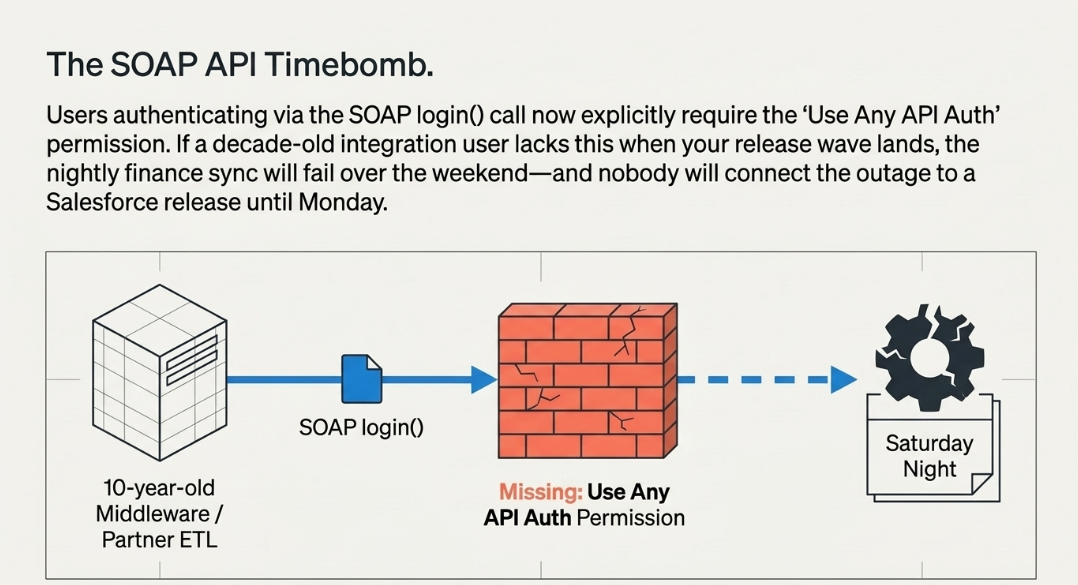
The second is profile filtering, which is now enabled by default and restricts profile name visibility to users with the "View All Profiles" permission. This is a sensible security default, but any internal tooling, reporting, or provisioning process that reads profile names with ordinary user rights will start seeing less than it used to.
The remaining three are accessibility enforcements: cards, docked containers, menus, panels, date pickers, record headers, page headers, and modals all adapt properly at 200 percent magnification and above. These are welcome, overdue, and mostly invisible, unless your org relies on pixel-perfect custom components that were never tested at high zoom.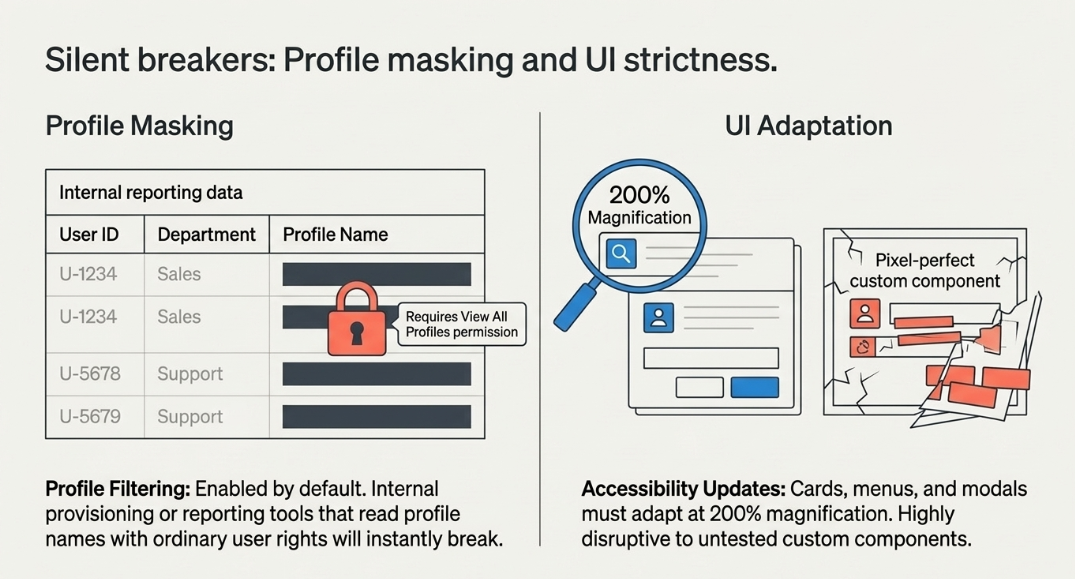
The pattern across all five is the same: nothing here is hard, but all of it punishes orgs where nobody owns release readiness. The fix is organizational, not technical. One named person reads the release notes against your org, runs the checks in a sandbox that is already on Winter '27, and reports exceptions before your production date.
Strategic considerations for CEOs and CTOs
There is a larger point underneath the checklist. Salesforce auto-enabling Agentforce is the clearest signal yet that the vendor considers the agent layer part of the core platform, not a product you evaluate. Combined with the September edition restructuring and the Dreamforce announcements, the direction is unambiguous: the CRM you are paying for is becoming an agentic platform, on the vendor's timeline rather than yours.
For leadership, that reframes the AI conversation. The question is no longer whether your Salesforce org will have agent capability. It will, possibly this weekend. The question is whether your company meets that capability with a plan or with a shrug. Companies with a plan decide deliberately which workflows justify an agent, what data those agents can ground on, who reviews agent behavior before activation, and how success is measured. Companies with a shrug discover six months later that three departments built agents independently, none of them documented, one of them quoting outdated pricing to customers.
There is also a budget dimension. Enablement is free, but consumption is not. Agent actions draw on credits, and an org where building agents is easy and ungoverned is an org where consumption costs arrive before anyone approved them. Treating agent capacity like cloud spend, with an owner, a budget, and monthly review, costs almost nothing to set up now and is painful to retrofit later.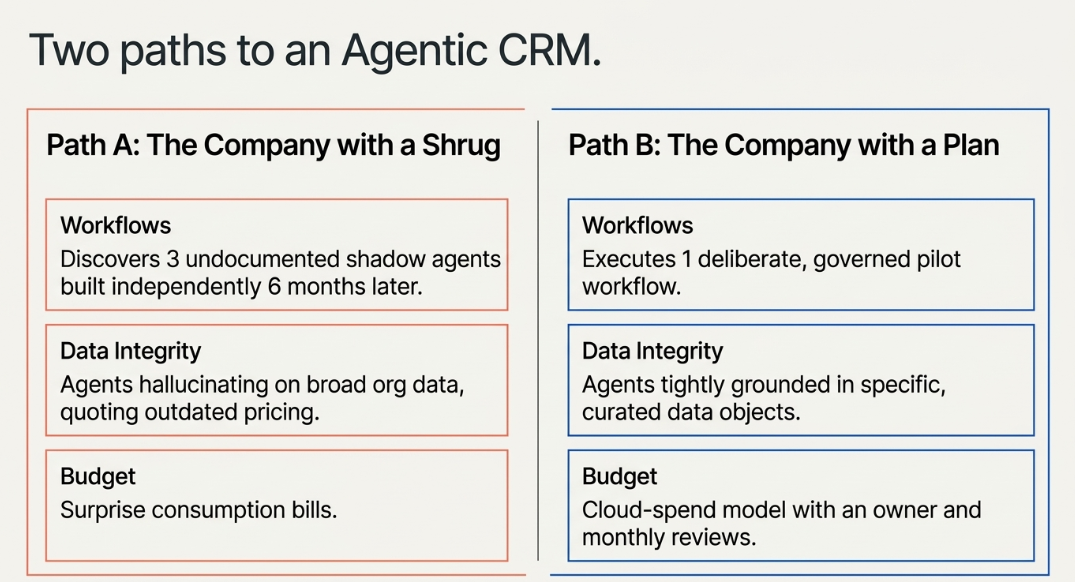
A practical week-one sequence
If your production wave is October 3 or October 10, the sequence for this week is short. Confirm your instance date on Salesforce Trust. Verify the five release updates in a preview sandbox, starting with SOAP authentication on every integration user. Audit who holds the Manage AI Agents permission and trim it to the people you would actually want building agents. Decide, even provisionally, your first governed agent use case, because a concrete pilot with an owner beats a policy document nobody reads. And put agent consumption on the same monthly review as your other platform spend.
None of this requires new spend. All of it requires that someone treats the release as an operational event rather than background noise.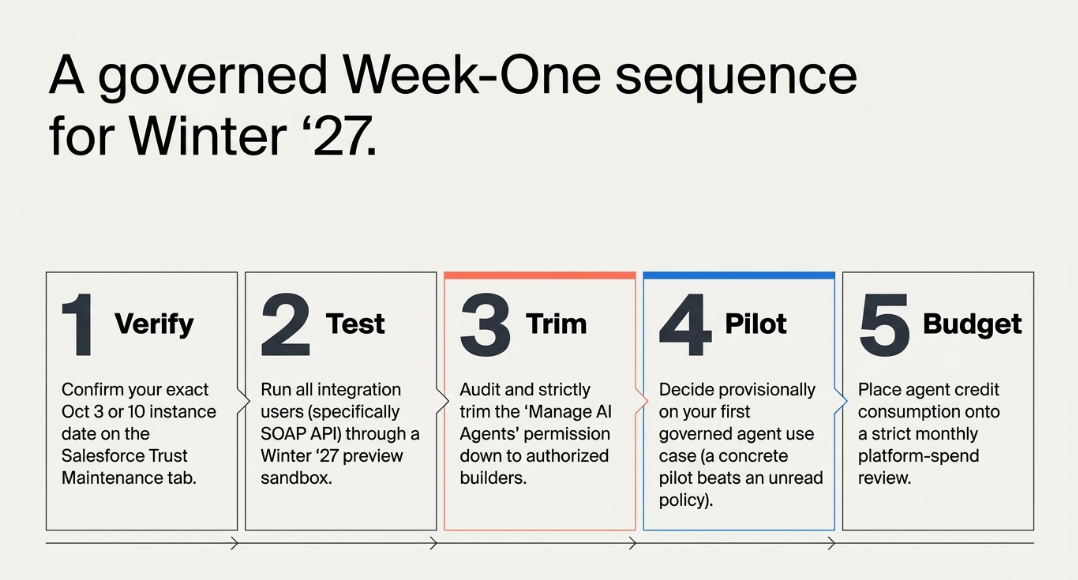
How CETDIGIT can help
CETDIGIT is a Salesforce Crest Partner and an AI solutions builder with more than 300 AI and CRM deployments. Our team runs Winter '27 readiness reviews that cover exactly the ground above: release-update verification against your actual org, integration-user authentication checks, Agentforce permission and governance setup, and a prioritized roadmap for which agent use cases are worth piloting first in your business. Because we build AI systems as well as implement Salesforce, we can take you from "Agentforce is enabled" to a working, governed agent grounded in your own data, with the guardrails your compliance posture requires.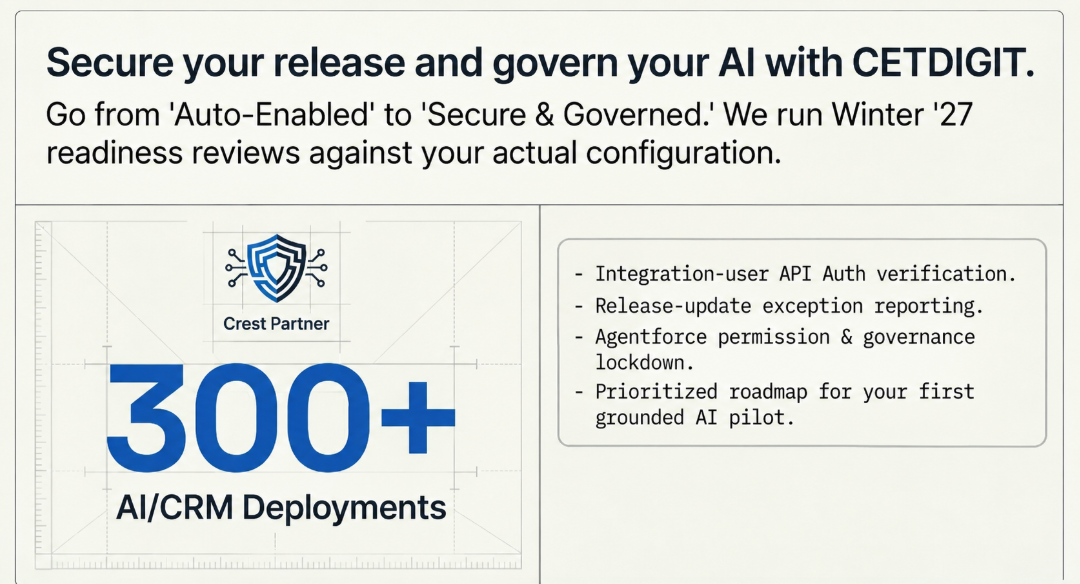
Frequently asked questions
When does the Salesforce Winter '27 release go live?
Production upgrades happen in waves, with the main release weekends on October 3 and October 10, 2026, following an early wave on August 29. Your org's exact date is listed on Salesforce Trust under Maintenance for your instance.
Is Salesforce really enabling Agentforce automatically?
Yes. Eligible editions are receiving Agentforce enablement automatically at no additional cost, with rolling enablement underway since early September 2026, and Salesforce has indicated the setup toggle is being removed later in the release cycle. Enablement makes the tools available; it does not activate any agent or create consumption charges by itself.
Can we turn Agentforce off?
Admins keep control at several levels: the Einstein master setting disables the platform, the Manage AI Agents permission controls who can build, and each agent must be individually activated before it does anything.
What is most likely to break at go-live?
Integrations that authenticate through the SOAP login() call are the most common risk, because the "Use Any API Auth" permission becomes required. Internal processes that read profile names are the second, due to profile filtering being enabled by default.
Conclusion
Winter '27 is the release where the agent era stops being optional for Salesforce customers. The upgrade itself will take care of itself, as it always does. What will not take care of itself is governance: knowing who can build agents in your org, keeping ten-year-old integrations authenticated, and meeting an auto-enabled platform with a deliberate first use case instead of an accidental one. The companies that spend one focused week on this now will spend the next year ahead of the ones that did not.
If you want a second set of eyes on your org before your release wave lands, or a partner to take your first governed agent from idea to production, schedule a consultation with CETDIGIT at https://cetdigit.com/meetings/mark114. We will walk your team through the release against your actual configuration and leave you with a concrete, prioritized plan.
Related Reads
Dreamforce 2026 Decoded: What AIforce, Koa, and the New Agentforce Editions Actually Mean for Your Salesforce Budget
Claudeforce, Explained: What the Salesforce and Anthropic Partnership Actually Ships, and What Your Org Should Do About It
Your CRM Already Knows the Answer: How AI Integration Turns Salesforce into an Intelligent Operating System

Leave a Comment