


Sales efficiency in 2026 is still revenue earned against cost spent, but AI has moved the measured unit from activity volume to the cost of a booked outcome. That unit is your Cost per Outcome: spend divided by verified results produced, not leads generated or tasks completed. The old efficiency ratio tells you what you spent per dollar booked. Cost per Outcome tells you what each dollar of effort actually produced.
A RevOps leader at a $60M B2B company opens the quarterly review. The dashboards are full. Automation is everywhere: calls logged, sequences sent, tasks auto-completed, response times down. Activity is up and to the right on every chart. Then someone asks the question that the dashboards can't answer: which dollar of effort actually produced booked revenue? The efficiency ratio looks healthy. The outcome of economics is invisible. Everyone in the room can see what the team did. Nobody can see what the work produced.
What Sales Efficiency Has Always Measured, And Still Does
For years, sales efficiency meant one ratio: gross revenue divided by sales and marketing spend. A higher ratio meant a leaner, better-converting revenue org. That math was correct, and it still is. If you spend a dollar and book three, you are more efficient than the team that spends a dollar and books two. Nothing about AI changes that arithmetic.
The supporting metrics were just as sound for their era: lead conversion rate, average sales cycle length, cost per lead, and cost to acquire a customer (CAC). Each one tightened a different part of the funnel. Each one assumed the same thing: that the way to improve efficiency was to optimize the activity feeding the funnel, faster follow-up, better training, cleaner data, and smarter automation. What held then still holds. Efficiency is still revenue earned against cost spent. The work the old playbook described wasn't wrong. It was incomplete in a way that only became visible when the market repriced.
What Changed by 2026: Activity Optimization Stopped Differentiating
What changed is that activity optimization no longer differentiates. Every team now has automation, dashboards, and AI-assisted workflows. When everyone can send more sequences faster, sending more sequences faster stops being an advantage.
The market priced this shift before most operators felt it. In the early-2026 software repricing, Forrester traced roughly $2 trillion in lost software-sector value to a single investor question: whether seat-based revtech still makes sense as AI replaces the human work those seats were sold to support. Pricing across the category began moving toward usage and outcomes rather than headcount. The implication for how you measure efficiency follows directly: if vendors are repricing from activity-capacity to outcomes, the metric you run your sales org on has to make the same move.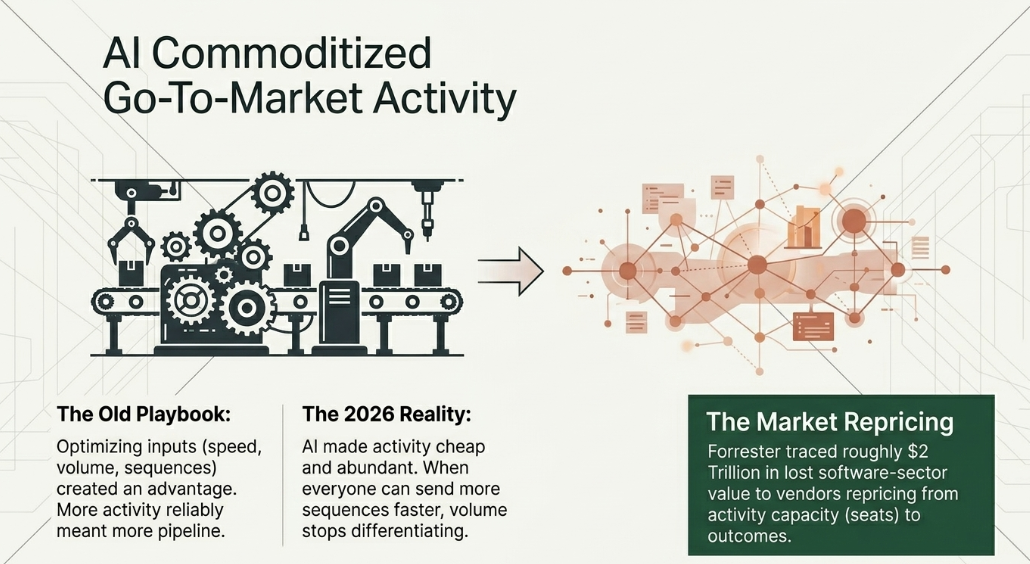
Gartner's analysis of why traditional productivity metrics fail sharpens the point: lagging indicators like win rate and deal size hide the real drivers of performance, and 47% of chief sales officers say their analytics carry less influence on results than leadership expects. Separately, McKinsey's research on sales automation found that high-performing reps spend 20–25% more time with customers than their peers, and that automating non-customer-facing work correlates directly with productivity. The AI bottleneck moved. It is no longer doing faster. It is knowing which outcomes were worth producing in the first place.
The Problem: A Full Dashboard That Can't Tell You What Worked
Here is the gap in operator terms. Your dashboard measures throughput, volume of activity, and completion speed at a low cost per unit. What it does not measure is the cost of the outcome that the activity was supposed to produce. You can see that 4,000 sequences went out. You cannot see what a booked, qualified, revenue-producing result costs you to generate.
Gartner names one version of the missing measurement "Average Interaction Value", revenue earned per interaction, and calls it the missing link between activity and outcomes. That's an analyst's framing of the same structural gap CETDIGIT addresses with Cost per Outcome. They are parallel diagnoses of one problem: the dashboard counts effort, and effort is not the outcome. When the cost of producing a result is invisible, you optimize the thing you can see, activity, and quietly stop improving the thing that actually matters.
Who This Affects
This is a VP RevOps and CRO problem first. You own a stack that runs clean, has high CRM adoption, working automation, accurate activity reporting, and you are still accountable for a revenue number the stack can't explain. The data exists. The connection between effort and outcome does not.
It reaches mid-market operators running a $5M–$150M revenue org just as directly, even without a dedicated RevOps function. The smaller the team, the more expensive it is to spend a quarter optimizing an activity that never moved the outcome. Gartner's buyer-side research adds a sharp edge here: in Gartner's B2B buyer survey, 73% of buyers actively avoid suppliers who send irrelevant outreach. More activity isn't neutral when it misses. It can subtract value.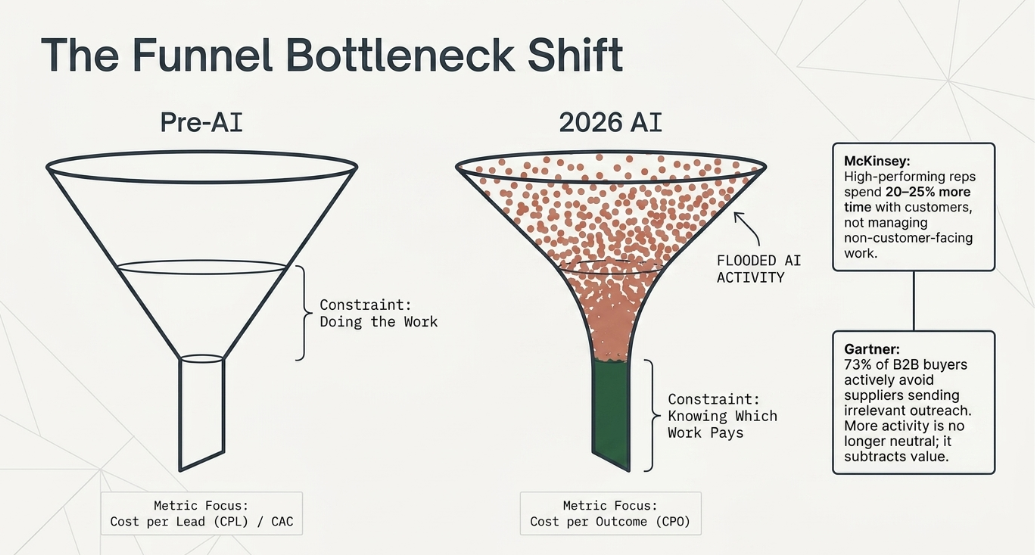
Symptoms, Signs You're Optimizing Activity, Not Outcomes
You're likely measuring activity instead of outcomes if:
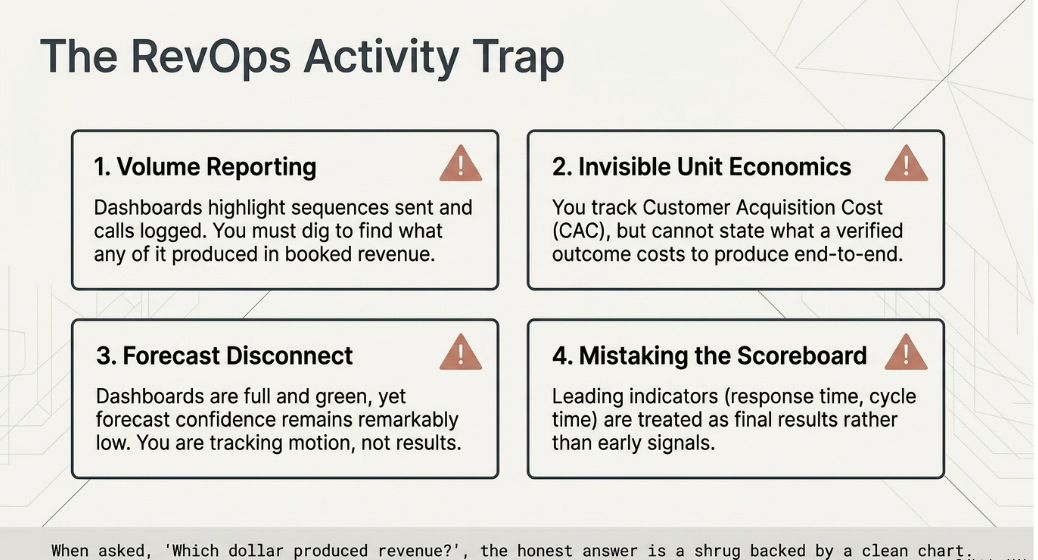
- Your efficiency reporting leads with volume metrics, sequences sent, calls logged, tasks completed, and you'd have to dig to find what any of it produced in booked revenue.
- You track cost per lead and CAC, but you can't state what a verified outcome costs to produce end-to-end.
- Your dashboards are full, and your forecast confidence is still low, because the numbers describe motion rather than results.
- Leading indicators that predict, but don't equal, outcomes, lead response time, interaction quality, and cycle time, are treated as the scoreboard rather than as early signals.
- When someone asks, "Which dollar of effort produced revenue this quarter?" the honest answer is a shrug backed by a clean-looking chart.
Why It Happens, Activity Metrics Are Leading Indicators, Not the Outcome
The mechanism is straightforward once you name it. Cost per lead and CAC measure the cost of inputs; they tell you what it costs to generate volume entering the funnel. Nothing in the legacy metric set measured the cost of the outcome, leaving it. Gartner's tiered seller-performance model makes the distinction explicit: leading activity indicators (response time, interaction quality, cycle time) sit a tier below the lagging outcome metrics they're meant to predict, and the link between activity and outcome shifts over time, which is why activity has to be continuously tested against the outcome rather than trusted as a proxy for it.
That's the incomplete part of the old playbook. It optimized leading indicators on the assumption that they tracked outcomes reliably. In a pre-AI world, where activity capacity was the binding constraint, that assumption mostly held. Once AI made activity cheap and abundant, the assumption broke, and the only way to know whether effort is producing return is to measure the cost of the return directly.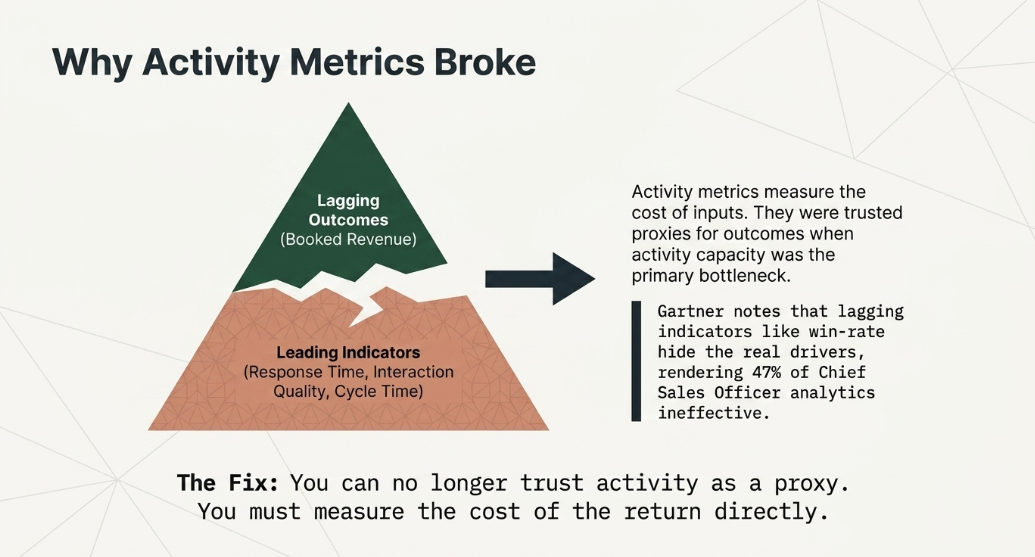
From the Sales Efficiency Ratio to Cost per Outcome
The 2024 page measured cost per lead and CAC, both cost-per-activity-input metrics. Cost per Outcome measures the cost per booked outcome. Same instinct, evolved unit. The bridge is this clean: CPO is what cost-per-lead and CAC become when you move the denominator from "activity generated" to "outcome produced."
|
Your situation |
The metric the era reached for |
The 2026 metric |
Why it changed |
|
Activity capacity is the constraint |
Cost per lead |
Cost per lead (still useful as a leading indicator) |
When more activity = more pipeline, input cost matters |
|
Automation has made activity cheap and abundant |
CAC |
Cost per Outcome |
The constraint moved from doing the work to knowing which work pays |
|
Marketing and sales report different revenue numbers |
Attribution reporting |
Cost per Outcome read against a Revenue Graph |
Alignment is an outcome question, not an activity-reconciliation question |
|
You can see effort, but not return |
Efficiency ratio alone |
Efficiency ratio plus Cost per Outcome |
The ratio shows spend-per-dollar-booked; CPO shows cost-per-outcome-produced |
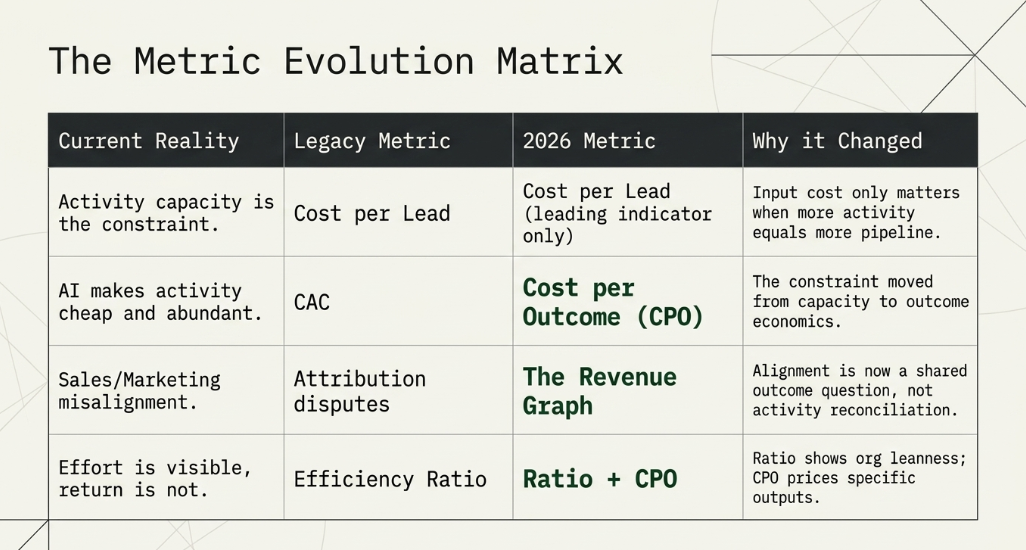
The ratio doesn't retire. It sits alongside Cost per Outcome, one tells you how lean the whole org is, the other tells you what a specific result costs to produce. And once you're measuring outcomes rather than activity, sales-and-marketing alignment stops being a reconciliation argument and becomes a Revenue Graph question: a shared view of which connected signals actually produced revenue, read the same way by both teams.
The CETDIGIT Perspective
Cost per Outcome is the financial metric that replaces CAC as the question you bring to a board. CAC answered, "What did it cost to acquire a customer through our funnel?" Cost per Outcome answers the sharper 2026 version: "What did it cost to produce this verified result, and is that cheaper than the alternative?" It's the metric that ends activity-justified spend, because an outcome you can price is an outcome you can defend or kill.
Getting there isn't a reporting tweak. You can't measure Cost per Outcome on a stack where signals, actions, and results live in disconnected systems; the data that would let you trace effort to outcome is fragmented across tools that don't share a view. Measuring revenue by outcome, not activity, requires connecting those systems so that a result is traceable to the work that produced it and the cost of that work is visible. That's the difference between a stack that records activity and one that can tell you what activity was worth. It sits inside CETDIGIT's broader AI services framework, where outcome measurement is the layer that makes AI investment legible rather than just busy.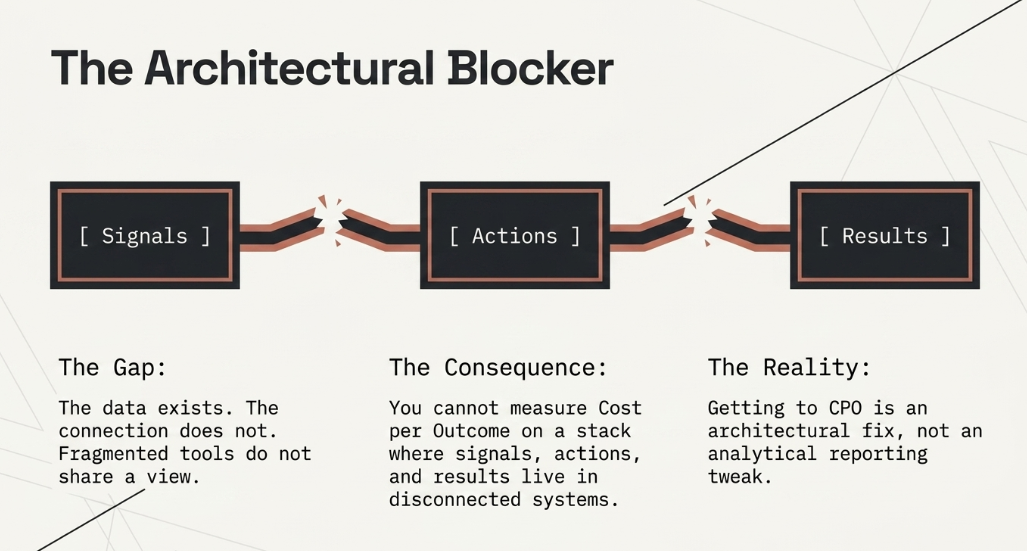
Recommended Path
If your dashboards are full and you still can't price an outcome, the gating issue is usually architectural, not analytical. Start with the AI Revenue Engine architecture, it's the layer that connects signal to action to result, so Cost per Outcome becomes measurable rather than theoretical. Where the blocker is data quality, outcomes you can't trace because the underlying records are fragmented or stale, the clean data foundation outcome measurement depends on it. Most teams need some of both: connected architecture sitting on data clean enough to trust.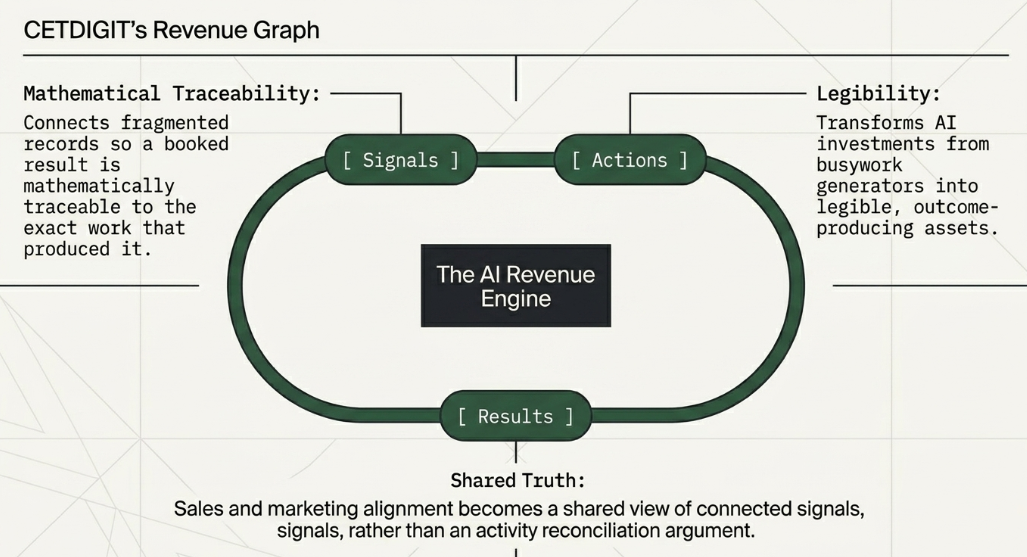
Frequently Asked Questions
How do you measure sales efficiency in 2026?
Sales efficiency in 2026 is measured in two ways together: the traditional efficiency ratio (gross revenue divided by sales and marketing spend) for org-level leanness, and Cost per Outcome, spend divided by verified results produced, for what specific effort actually returns. Gartner's research shows lagging metrics like win rate hide the real drivers, which is why the outcome-cost view matters now. The ratio tells you how lean you are; Cost per Outcome tells you what a result costs to produce.
What is Cost per Outcome?
Cost per Outcome is the cost of producing a verified, booked result, not the cost of the activity that led to it. It moves the denominator from inputs you generated (leads, sequences, calls) to outcomes you produced (qualified, booked, revenue-bearing results). It's the financial metric that replaces CAC for AI-era revenue operations, because it lets a board price effort against return directly rather than trusting activity volume as a proxy.
Is the sales efficiency ratio still useful?
Yes. Gross revenue over sales and marketing spend remains a valid measure of how lean a revenue org is, and it isn't going away. What changed is that it's no longer sufficient on its own. The ratio tells you what you spent per dollar booked across the whole org; it can't tell you what a specific outcome costs to produce. In 2026, you run both the ratio for org-level efficiency, Cost per Outcome for outcome-level economics.
What's the difference between sales efficiency and Cost per Outcome?
Sales efficiency is an org-wide ratio: total revenue against total go-to-market spend. Cost per Outcome is granular: the cost of producing one verified result. Efficiency tells you whether the whole machine is lean. Cost per Outcome tells you which specific outputs are worth what they cost. You need both; a lean ratio can still hide expensive individual outcomes, and cheap individual outcomes don't guarantee a lean org.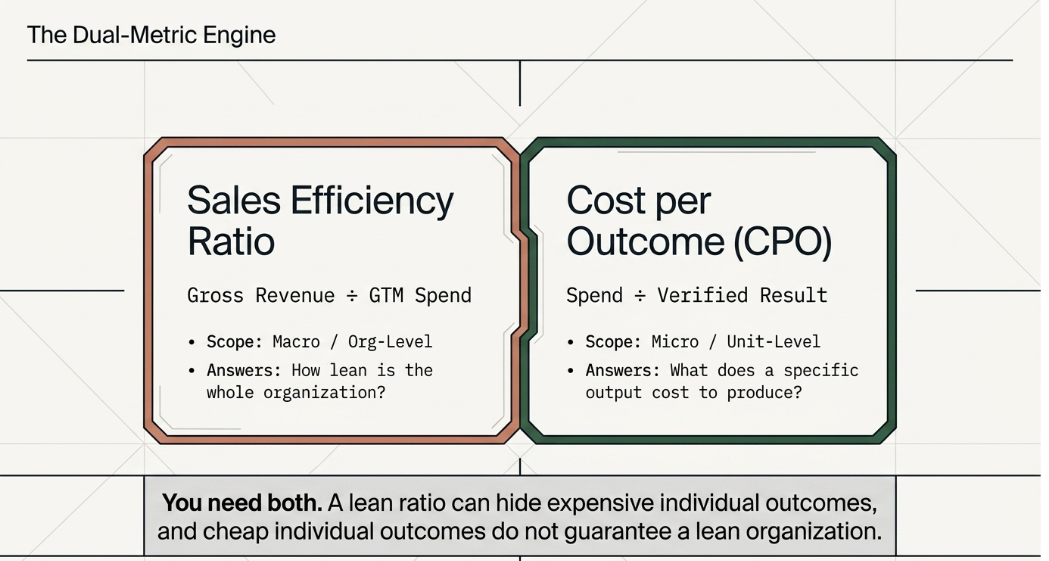
How is CPO different from CAC?
CAC measures what it costs to acquire a customer through your funnel, an input-and-activity-weighted number. Cost per Outcome measures what it costs to produce a specific verified outcome, which may be a booked meeting, a qualified opportunity, or a closed deal, depending on what you're pricing. CPO is the AI-era evolution of CAC: same cost-discipline instinct, but the unit shifts from "customer acquired through activity" to "outcome produced, priced directly."
Why don't activity metrics predict revenue anymore?
Because AI made activity cheap and abundant, which broke the old assumption that more activity meant more outcomes. Gartner's tiered model treats activity measures as leading indicators that must be continuously tested against outcomes, since the link between them shifts over time. When everyone can generate high activity volume at low cost, activity stops differentiating, and the only reliable signal is the cost of the outcome itself.
Stack Unification Audit
Diagnose where your AI investment is leaking, connect the stack, then activate AI. Book a 60-minute Stack Unification Audit, and we'll show you where activity is being measured in place of outcomes, and what it would take to make Cost per Outcome a number you can actually report.


Leave a Comment