


Every brokerage has the same uncomfortable report, if anyone dares to run it: thousands of leads sitting in the CRM that no one has touched in ninety days or more. Enquiries that came in on a Saturday night and got a Monday reply. Open house visitors who signed the sheet and never heard from anyone. Buyers who said "maybe in the spring" and were never asked again when spring arrived. Sellers who postponed and stayed postponed. Each one of those records cost real money to acquire, whether through portal spend, marketing, or an agent's weekend. And in most brokerages, they simply sit there.
The reason is not laziness. It is arithmetic. A brokerage running Lofty, Follow Up Boss, kvCORE, or BoomTown may be generating hundreds of new leads a month, and every study of residential real estate says the same thing: speed of first response is the single strongest predictor of conversion. So agents triage. They chase the newest, hottest enquiries and let the aged ones fall away, because no human team has the hours to call four thousand dormant contacts and have a real conversation with each one. The dormant database is not a discipline problem. It is a capacity problem.
Where the working day actually goes
Consider what a growing independent brokerage looks like from the inside. We recently worked through this with a large independent brokerage in California with more than a thousand affiliated agents. New consumer leads arrived from the CRM, from weekend open houses, from referrals, and from purchased homeowner data. Agents entered leads manually and followed up on their own schedule, which meant response time was whatever that agent's Tuesday looked like. Behind the new leads sat years of acquired contacts nobody was working.
Recruiting had the same shape. The brokerage sourced licensed agent data from a recruiting data platform, then worked the list entirely by hand: an in-office recruiter and a rotating cast of virtual assistants placing calls one at a time, with outreach history living in spreadsheets and personal inboxes. When a recruiter moved on, the pipeline history left with them. Recruiting effort did not compound; it restarted.
None of this is unusual. It is the default operating state of most brokerages over a few hundred agents. The conversations that drive the business- first response, follow-up, reactivation, recruiting outreach- are the most repetitive, most time-sensitive work in the building, and they are staffed by the people with the least spare time.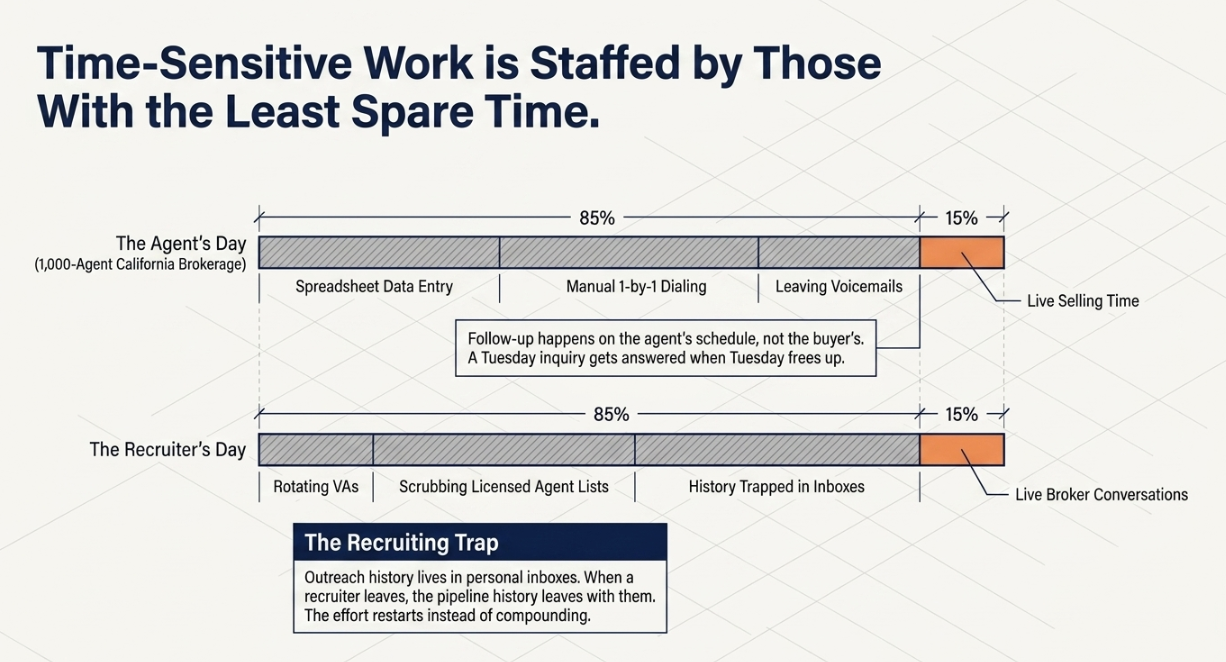
What changes when the phone answers itself
AI voice agents have crossed a threshold in the last two years. The best of them no longer announce themselves as machines within the first sentence; they hold natural conversations, qualify on budget, financing, area, and timeline, and they can warm-transfer a live, interested buyer to the on-duty agent in the moment. That last part matters most: the goal is not to replace the agent conversation; it is to make sure the agent only spends time on conversations worth having.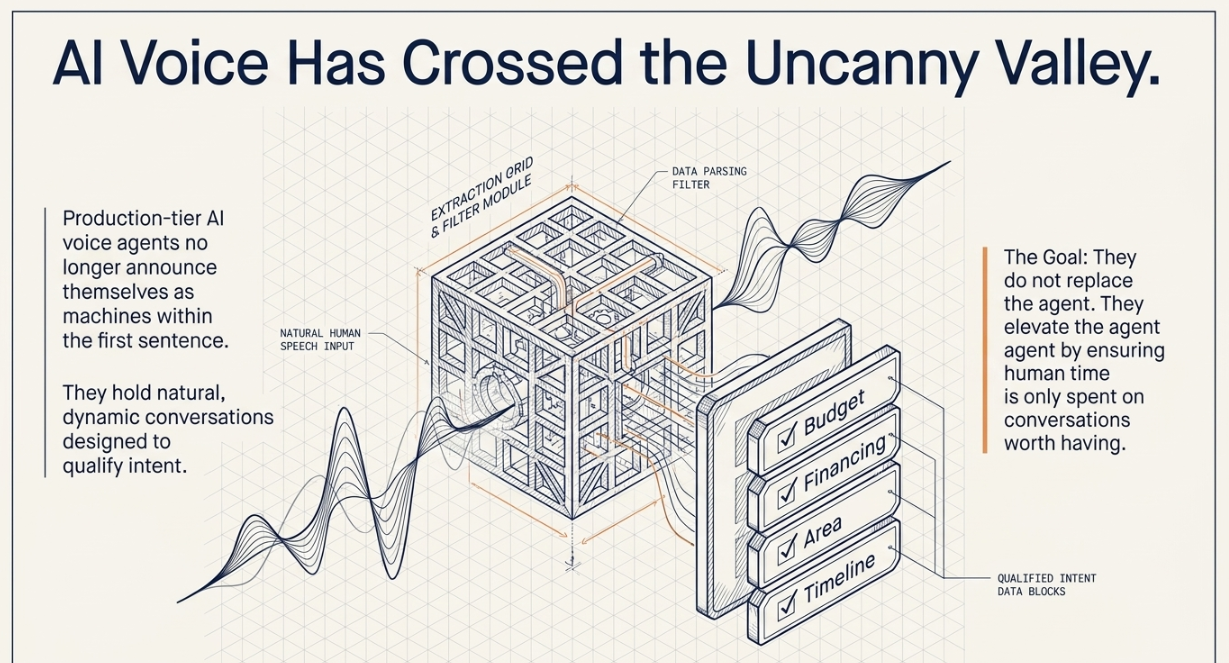
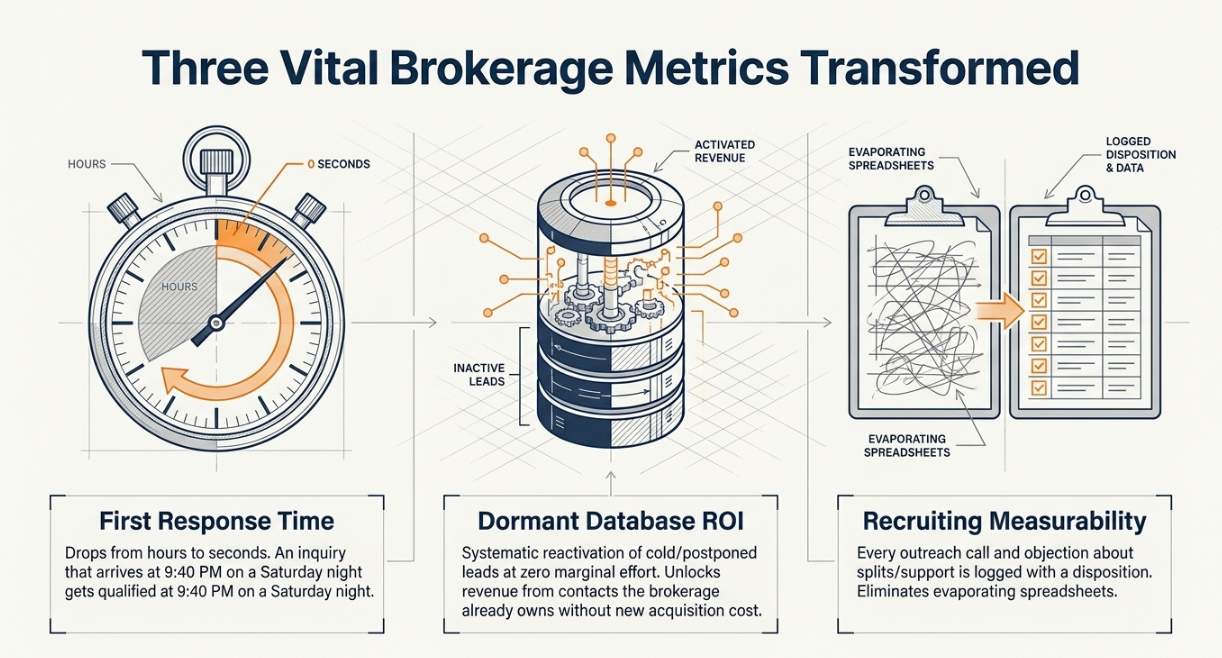
In operational terms, a voice agent changes three numbers a brokerage can measure. First response time drops from hours to seconds; at any hour, on any day, the enquiry that arrives at 9:40 on a Saturday night gets qualified at 9:40 on a Saturday night. Second, the dormant database becomes workable for the first time, because an agent that can place hundreds of calls a day at no marginal effort can systematically re-approach every cold enquiry, every postponed seller, every not-ready buyer, and contacts the brokerage already owns, with no new acquisition cost. Third, recruiting becomes measurable, because every outreach call, every objection about splits and support, and every booked broker conversation is logged with a disposition instead of evaporating into a spreadsheet.
The part that separates a system from a demo
Here is the lesson from every deployment we have done in this industry: the voice is not the hard part anymore. The hard part is that every conversation must land in a system the brokerage can see. An AI agent that talks beautifully but writes nowhere simply produces faster invisible activity, which is exactly the disease the brokerage already has.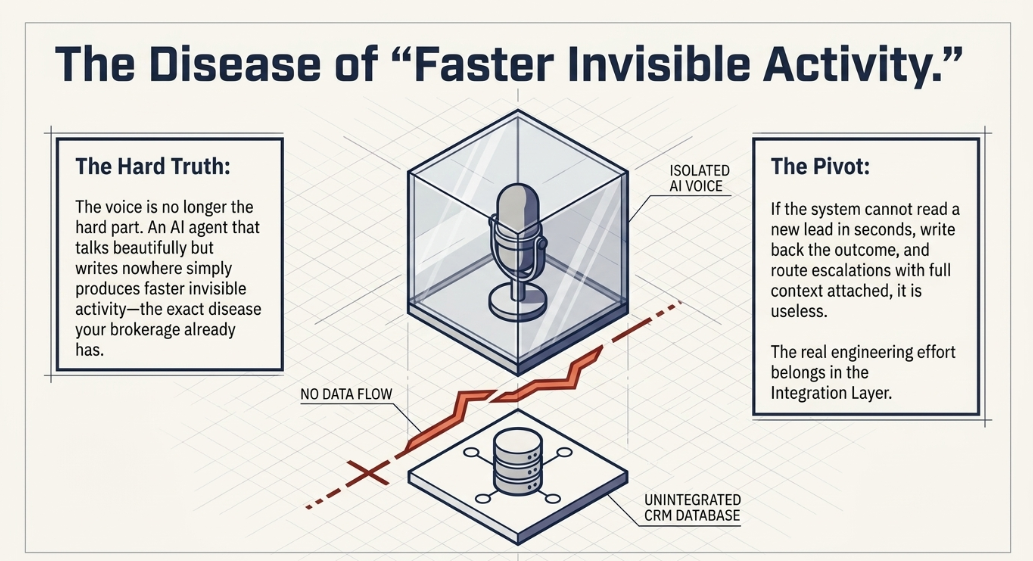
That means the integration layer is where the real engineering effort belongs. The agent has to read new leads out of the CRM within seconds of arrival, write back the outcome, transcript, and summary against the contact record, update the pipeline stage, and route escalations to a person with full context attached. For recruiting, it means building an actual system of record, pipeline stages, dispositions, and ownership configured for agent records rather than buyer records, so the brokerage can finally report on recruiting conversion the way it reports on sales.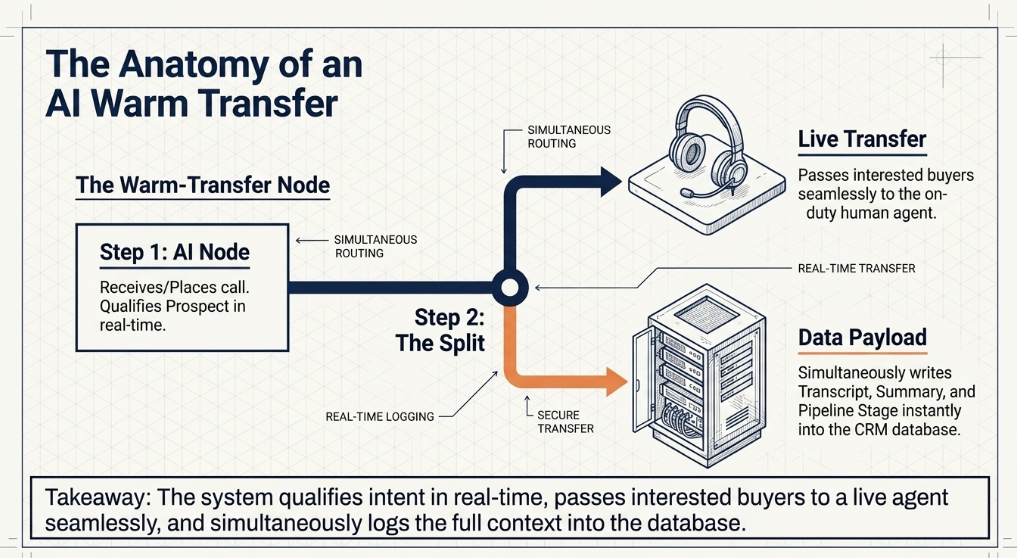
Compliance belongs in the architecture too, not in a memo. The FCC has confirmed that AI-generated voices fall under the TCPA's artificial and prerecorded voice provisions, which means outbound calls to mobile numbers generally require prior express consent, captured before dialling, not requested mid-call. California adds bot-disclosure requirements and two-party consent for recording. A properly built programme handles this with consent capture at the source, Do Not Call and litigator scrubbing before every campaign, disclosure and opt-out built into the script, and an audit trail that logs every consent record and every opt-out per contact. Brokerages that treat this as an afterthought are betting the brand on it.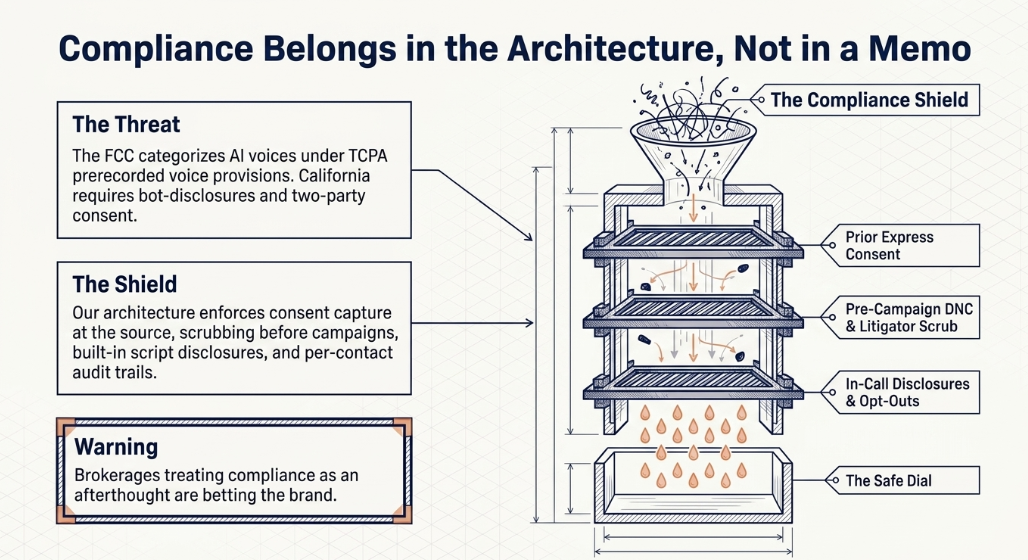
Where to start
The sensible sequence is inbound first. Answering the phone, responding to new CRM leads, and following up open house visitors carries no regulatory exposure and produces value immediately, while the consented outbound base is assembled properly. Reactivation of the dormant database typically comes next, because it is the fastest return in the programme: the contacts already raised their hands once. Recruiting outreach follows once the pipeline exists to catch what it produces. For brokerages evaluating the conversational layer itself, CETDIGIT builds on its own CETRAI platform as well as leading voice infrastructure, and the CETRAI real estate overview is a useful reference for what production voice agents handle in this vertical, from speed-to-lead response through qualification and live transfer.
What a brokerage should not do is buy a disconnected point solution that answers calls but never touches the CRM. Six months later, there are two databases, neither trusted, and the agents have gone back to their cell phones.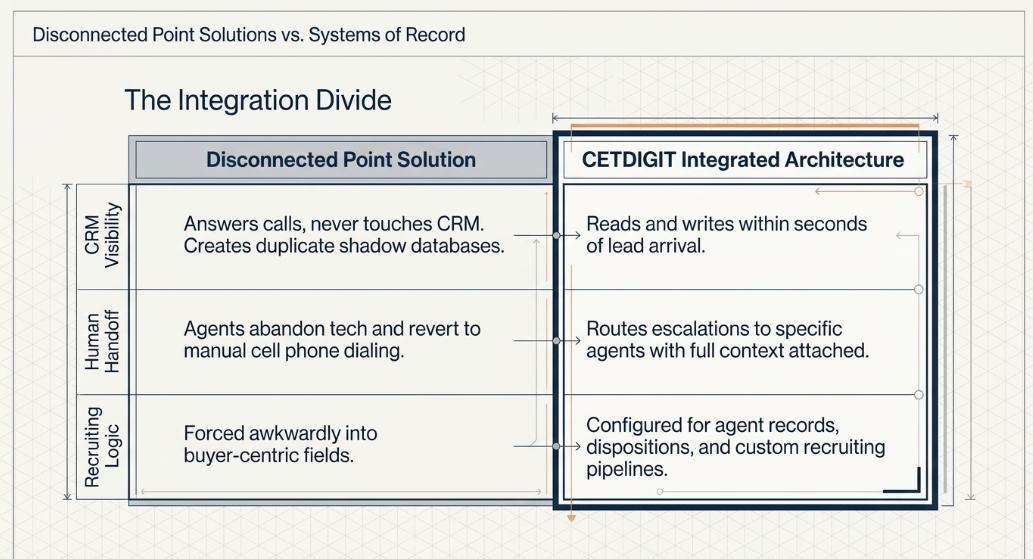
Talk to the team that builds the whole system
CETDIGIT (Cetrix Technologies LLC) is an AI solutions builder with more than 300 AI and CRM deployments, a Salesforce Crest Partner and a HubSpot Elite Partner, with substantial delivery experience in real estate. We design the conversation layer, build the CRM and data integrations that make it accountable, and engineer the consent and audit controls that outbound calling requires. If your brokerage is sitting on a database nobody calls, or a recruiting effort that restarts every time someone leaves, schedule a consultation with our team, and we will map the fastest path from missed conversations to measured pipeline.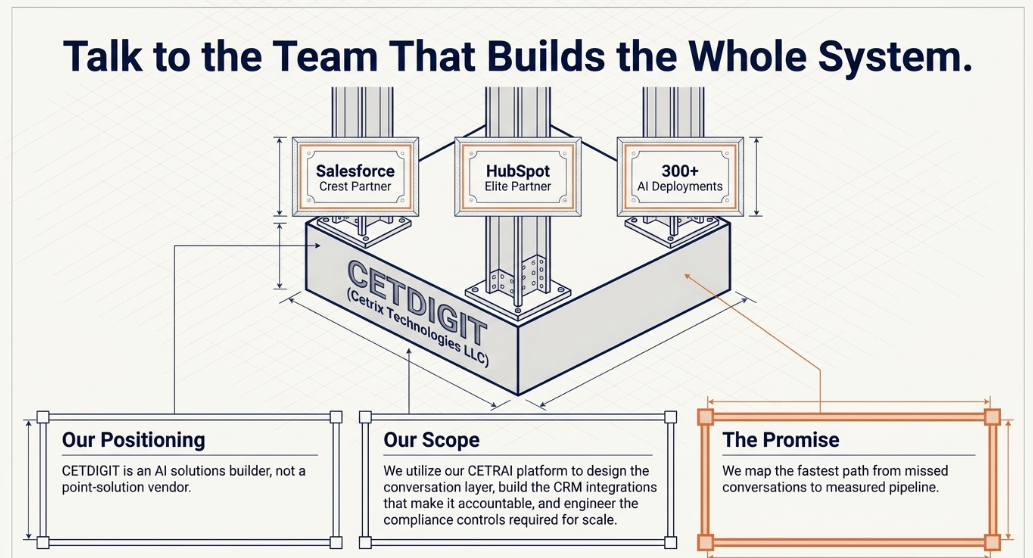
Related Reads
From Bid to Build: How AI-Powered CRM Automation Stops Construction Firms from Losing the Jobs They Never Followed Up On
The Tasting That Never Got Booked: How AI Voice Agents Help Catering Companies Capture Every Event Inquiry
The Missed Call Problem in Healthcare: How AI Voice Agents Give Medical Practices Their Phones Back
Leave a Comment