


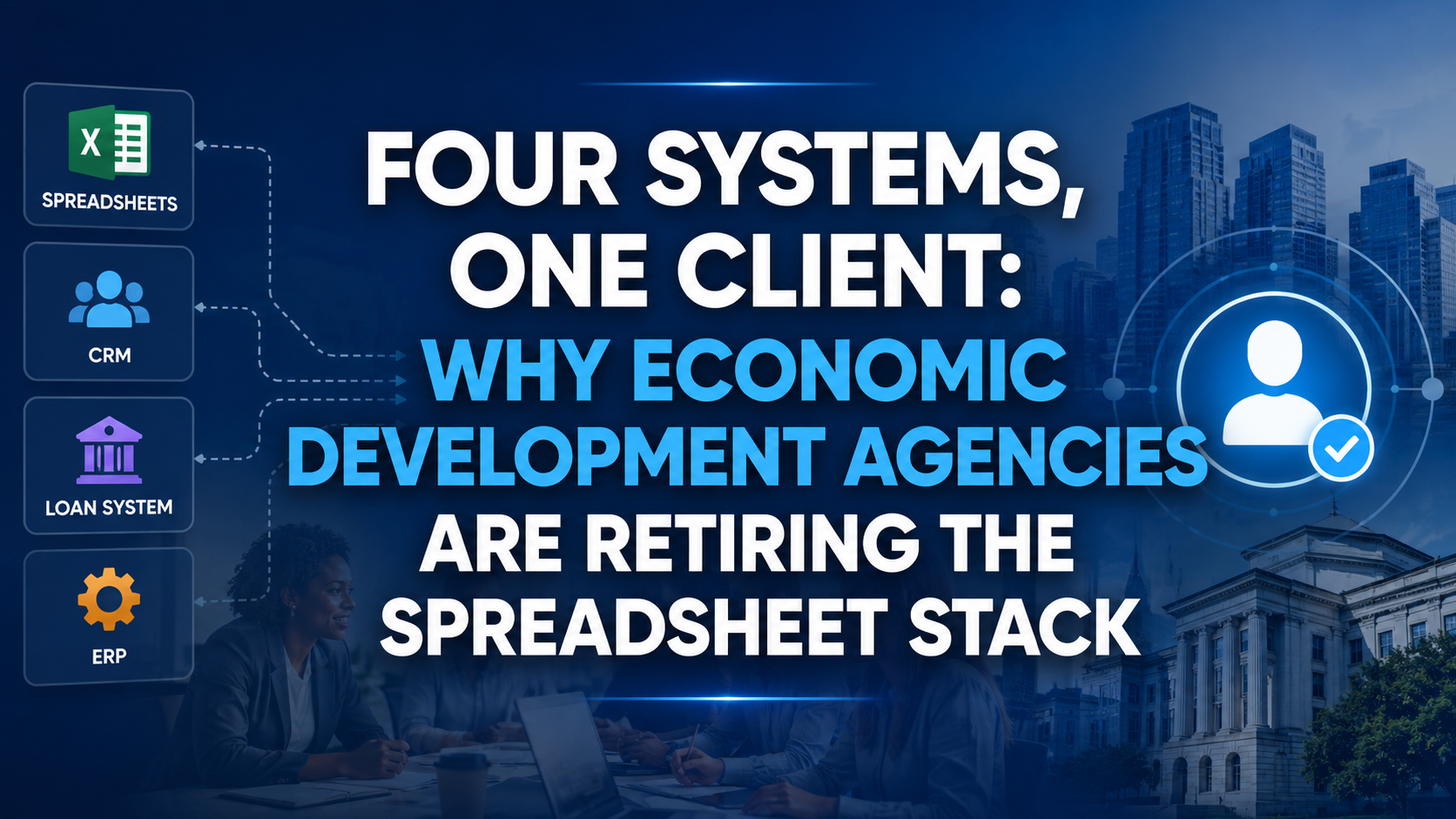
A small-business owner applies for a storefront improvement grant from her city's economic development agency. She fills out a web form, which lands in one system. A program officer who met her at an outreach event two years ago has her in a spreadsheet. The loan she received during the pandemic lives in a legacy loan-servicing tool. The agency's finance office tracks her disbursement in the ERP. Four systems, four versions of the same person, and when a council member asks the agency how many businesses it has helped in her district, three analysts spend a week reconciling exports and still deliver a number with an asterisk.
This is not a caricature. It is the operating reality of most economic and urban development agencies, housing authorities, and program-driven public offices in the country. These organizations run on relationships with business owners, developers, community partners, and lenders, yet the relationship data is scattered across whatever tools each program adopted when it launched. Airtable here, Jotform there, an aging donated CRM somewhere else, and the ERP standing apart in finance. Every tool made sense when it was adopted. Together they make the agency's most basic question unanswerable: who are we serving, and what have we done for them?
The cost is not inconvenience. It is credibility.
For a public agency, fragmented client data has consequences that a private company never faces in quite the same way. Public agencies must report outcomes to boards, councils, and the communities they serve, and the numbers must hold up to scrutiny. When the same business appears three times under slightly different names, program counts inflate quietly, and the day someone notices, every other number the agency has published becomes suspect. Duplicate records are not a data-hygiene annoyance in government; they are an audit finding waiting to happen.
Fragmentation also breaks the client experience in ways the public remembers. A business owner who has worked with an agency for years should not have to reintroduce herself to every new program. When a staff member leaves, the relationships in their spreadsheet leave with them. And when programs cannot see each other's clients, the agency loses its best growth lever: the ability to notice that a grantee is a natural fit for the loan program, or that a district's businesses are all asking about the same barrier.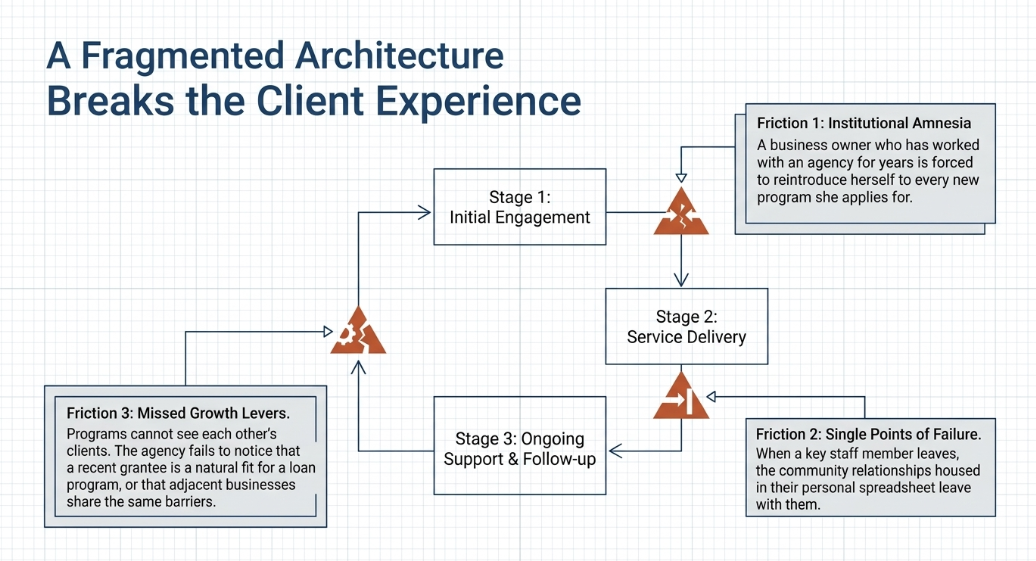
What "one client record" actually requires
The fix is conceptually simple and operationally demanding: a single CRM platform where every person and business the agency touches exists exactly once, with a unique identifier that follows them across every program, intake, technical assistance, grants, loans, events, site visits. Salesforce, configured for public-sector program delivery, has become the common choice for agencies of this kind, and the configuration pattern is well established: a universal client record at the center; program applications as related records with their own eligibility, review, approval, and compliance stages; portals for external partners and for the public; and dashboards that answer the council member's question in one click rather than one week.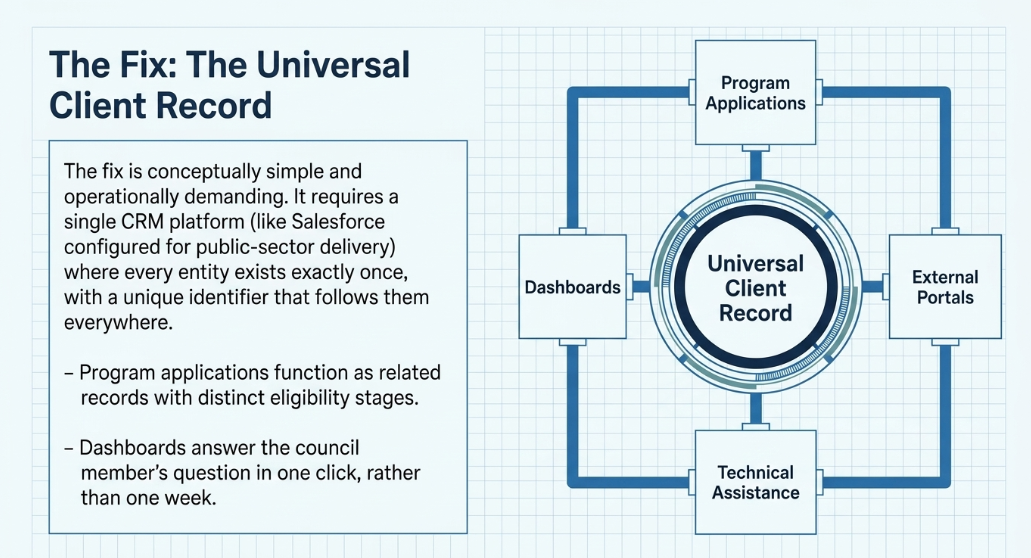
Three parts of these projects deserve most of the planning attention, because they are where public-sector implementations succeed or stall.
The first is migration and deduplication. Consolidating fifteen thousand records from four systems is the highest-risk workstream in any agency CRM project, and it cannot be an afterthought priced as "data load." The discipline that works: profile every source system first; build a field-by-field mapping workbook that agency data owners sign; agree on matching keys, normalized business name and address, tax ID where present, email, and on survivorship rules that decide which value wins when systems disagree; run at least two full rehearsal migrations into a sandbox, reconciled record-for-record; and treat the final reconciliation report as a formal acceptance artifact. Modern implementations add AI-assisted fuzzy matching that flags near-duplicates for human review, faster than manual cleanup, safer than silent auto-merging.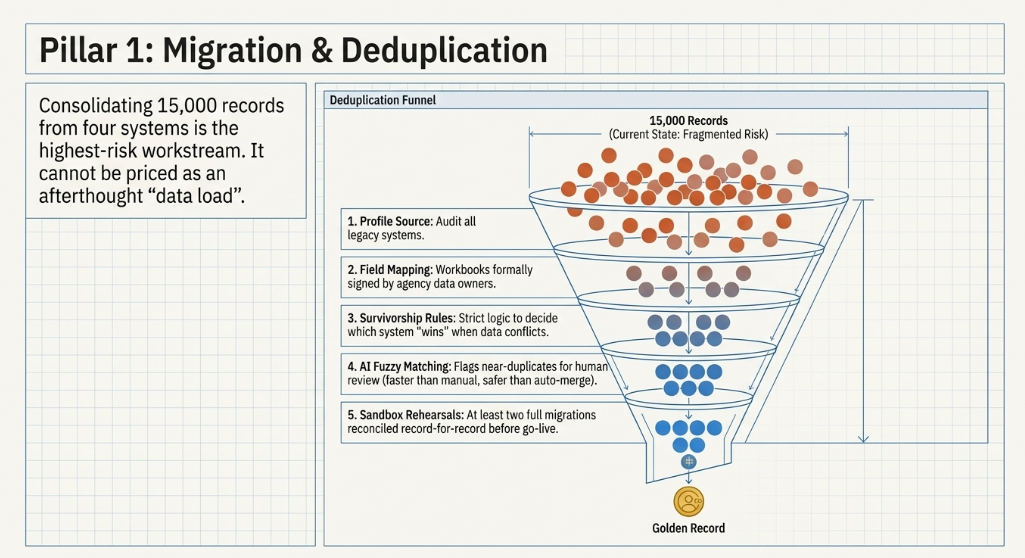
The second is respecting the systems that should not move. A common failure mode is the CRM project that tries to swallow everything. Finance almost always stays in the ERP, and the right design is a one-way sync: disbursement dates and amounts flow from the ERP into the client record so program staff can see them, while the ERP remains the system of record for money. If the agency has an existing analytics investment, such as Power BI, the CRM should feed it through a live connector rather than forcing analysts to rebuild everything. Retiring four tools is a win; retiring the two that work is a self-inflicted wound.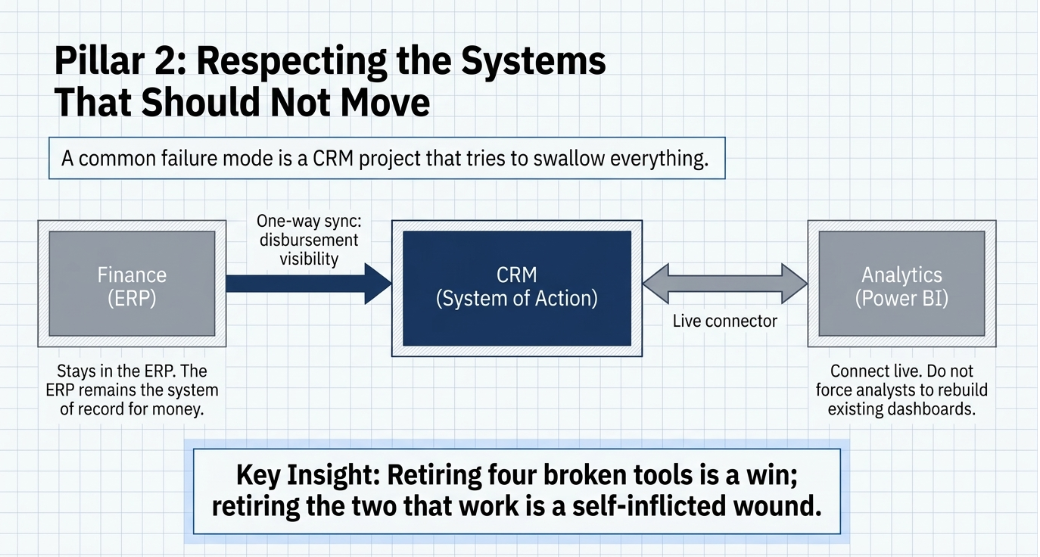
The third is the public-facing edge. Agencies serve residents who will never log into anything, applicants who need to check a status at 9 p.m., and partner organizations that refer clients. That argues for multilingual public smart forms that write directly into the CRM instead of a form tool's inbox, an authenticated portal for application status, and a partner portal with a carefully designed permission model; external users should see precisely their own clients and nothing more. Because these are public interfaces, accessibility to WCAG 2.1 AA is not optional, and the data design must anticipate public-records requests from day one.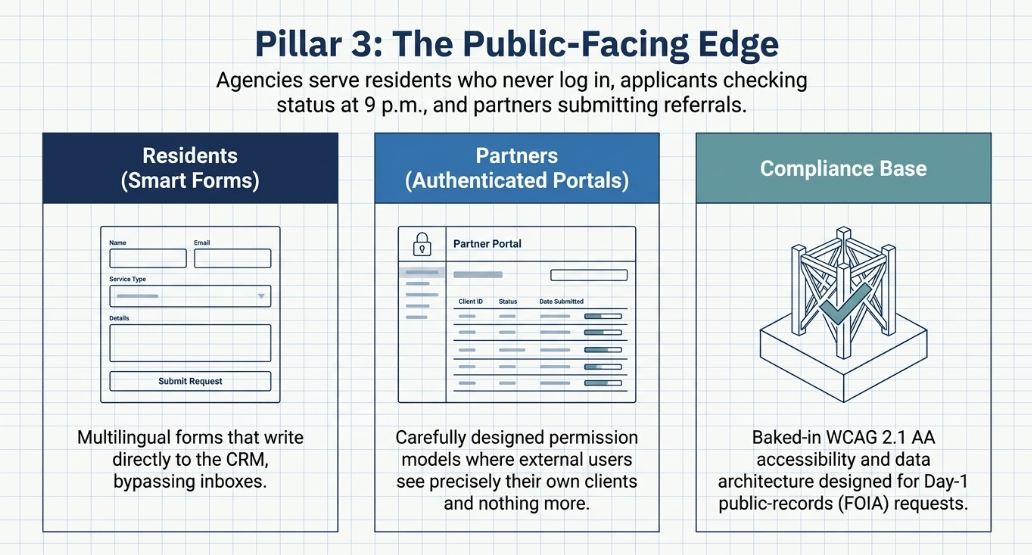
The procurement path matters as much as the platform
Public agencies buy differently, and vendors who pretend otherwise create pain later. A realistic engagement respects the RFP process, prices implementation as fixed-cost milestones accepted in writing before invoicing, presents five-year software costs honestly rather than a teaser first year, and handles change control formally: every scope change estimated, priced, and approved before work proceeds. Agencies should also weight adoption planning heavily, a champions network from each program area, role-based training, and 30-, 60-, and 90-day adoption metrics after go-live, because the difference between a CRM that transforms an agency and a fifth ignored system is almost never the software. Training, documentation, and administrator handoff should appear as named milestones, so the agency is self-sufficient when the support period ends.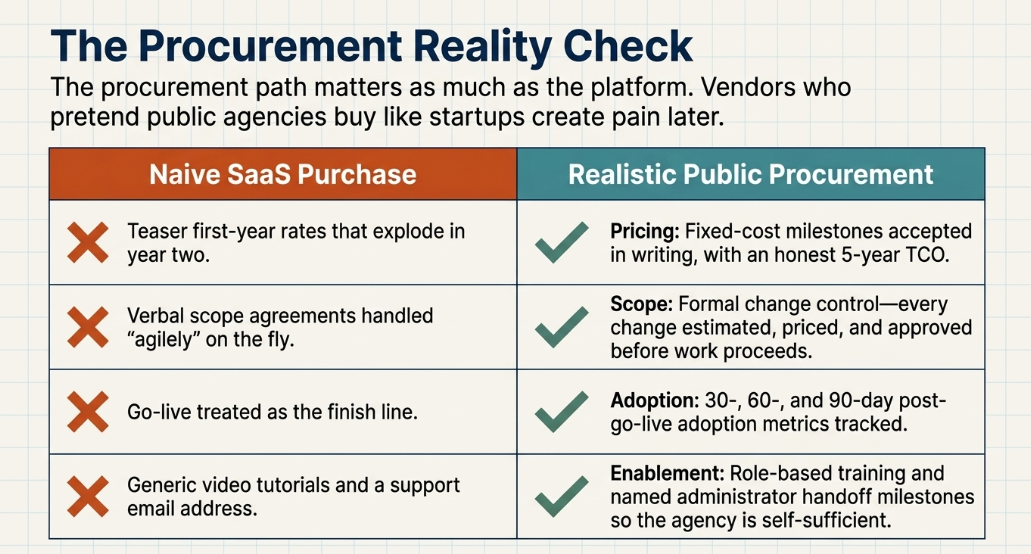
What it looks like when it works
Picture the same storefront-improvement applicant a year after consolidation. Her web form, in her own language, creates or matches her record automatically. The program officer sees the pandemic loan, the outreach meeting, and the new application in one view, and refers her to a technical-assistance program in two clicks. Finance disburses in the ERP, and the disbursement appears on her record the same day. The council member's question is a dashboard, and a public impact page tells the neighborhood's story with numbers the agency can stand behind. None of this is exotic technology. It is disciplined implementation of a platform that already exists, shaped around how public agencies actually work.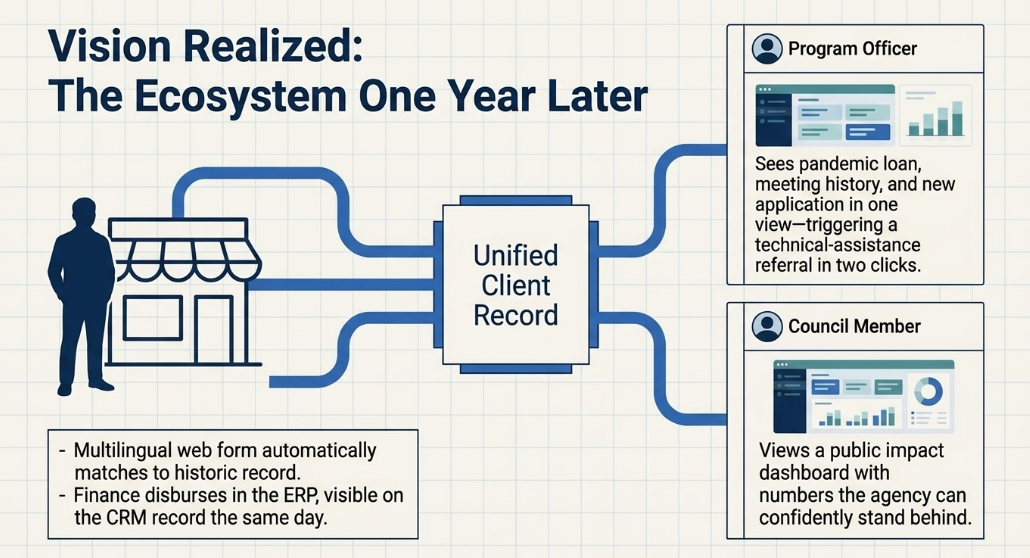
CETDIGIT has spent more than fifteen years implementing CRM for public agencies, school districts, universities, and mission-driven organizations, with over 300 AI and CRM deployments delivered as a Salesforce Crest Partner and HubSpot Elite Partner. We have built exactly the kind of universal-client-record, grants-workflow, portal, and ERP-integration architecture described here for public-sector clients, under public procurement rules and public scrutiny. If your agency is ready to answer "who are we serving?" with one number instead of three exports and an asterisk, schedule a consultation with our public-sector team and we will map your current systems to a consolidation plan with honest costs and a realistic timeline.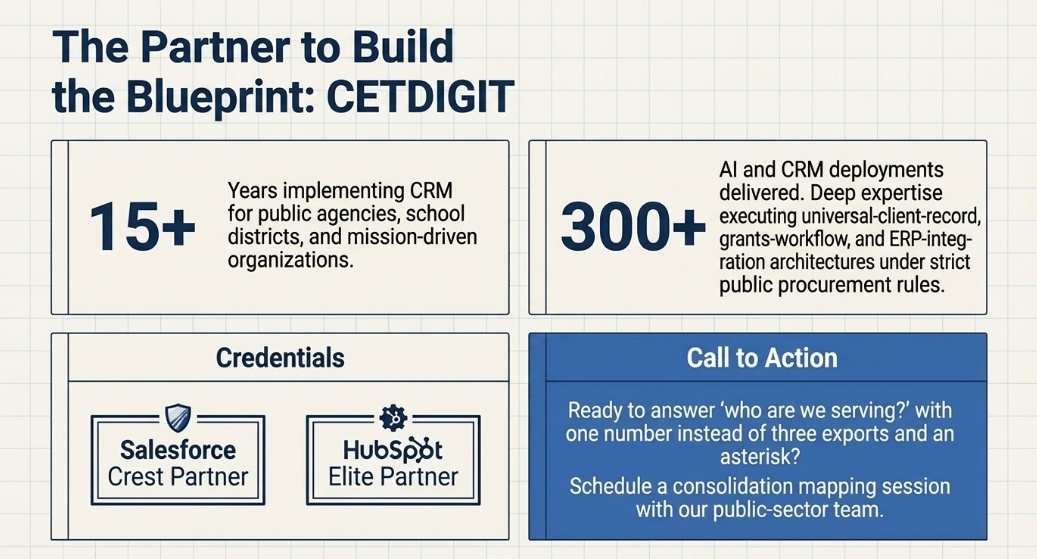
Related Reads
Your CRM Already Knows the Answer: How AI Integration Turns Salesforce into an Intelligent Operating System
From Bid to Build: How AI-Powered CRM Automation Stops Construction Firms from Losing the Jobs They Never Followed Up On
Beyond Standard RAG: How Agentic RAG is Transforming Enterprise AI in Salesforce and HubSpot
Leave a Comment