


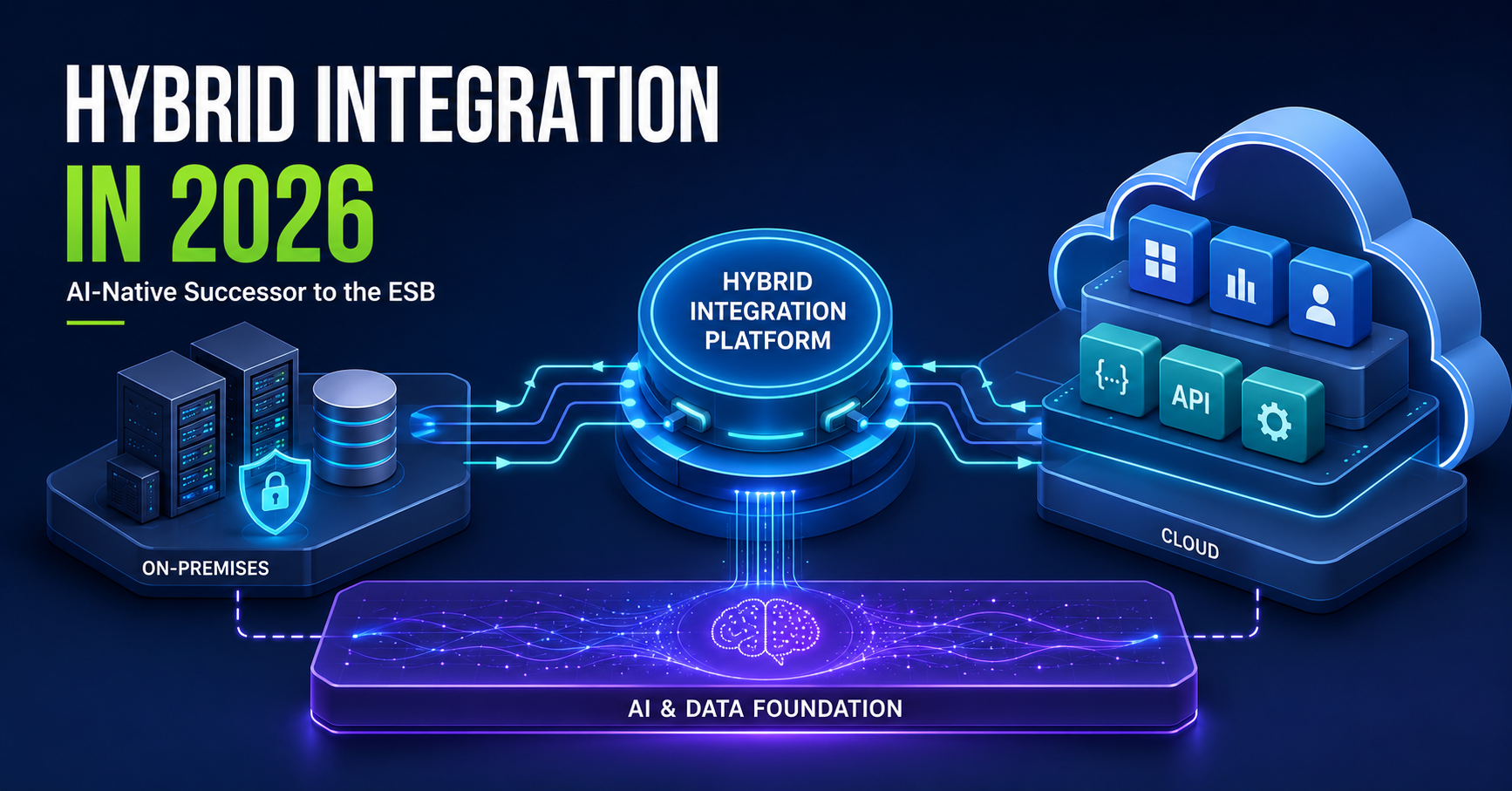
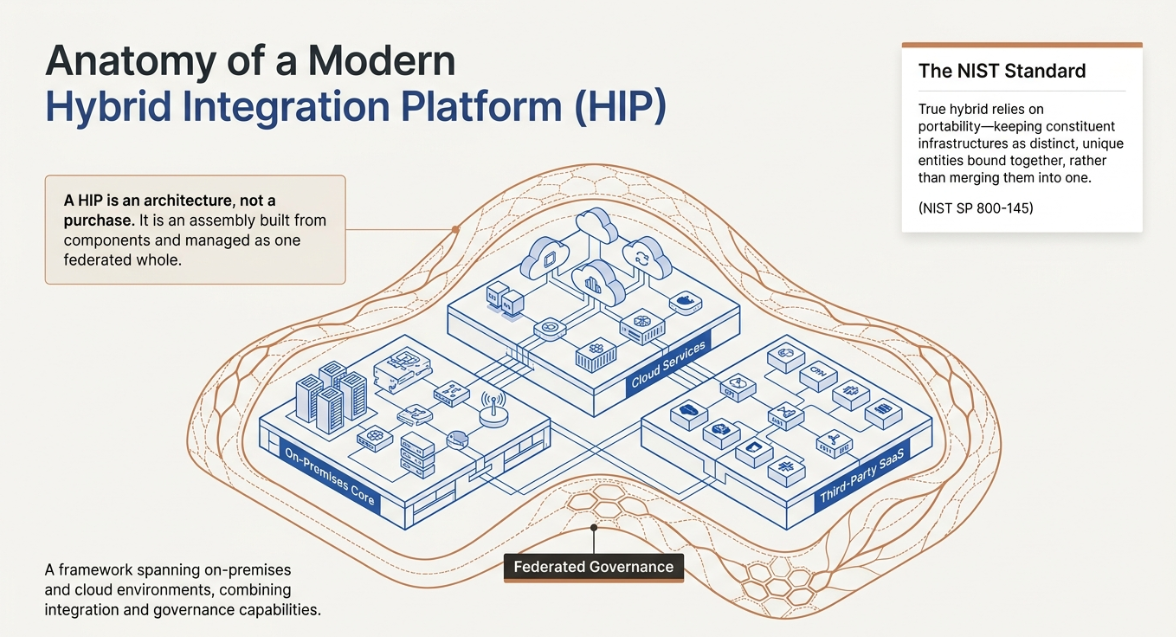
A hybrid integration platform (HIP) is a framework of on-premises and cloud integration and governance capabilities that lets differently skilled teams connect systems across both environments. It is not a product you buy. It is an assembly you build from components, often from several providers, managed as one federated whole. In 2026, the selection question has changed: the platform must produce a Data Foundation that AI can act on, not just move records between environments.
In April 2018, this page opened with a claim that ran against the prevailing advice: you do not need to move all your IT systems to the cloud. Keep the sensitive data on-premises. Put the rest where it makes sense. Bind the two with a platform that spans them. That advice was right, and the estates built on it are still running: a private core holding what regulation or risk said could not leave, cloud services doing the elastic work, and an integration layer carrying traffic between them.
Eight years later, an AI initiative lands on that estate. The agents are expected to read across both environments, act on what they find, and prove the return through Revenue Intelligence, the real-time measurement layer that shows whether AI activity is producing revenue rather than activity. The estate spans both environments exactly as designed, and the initiative stalls anyway. This is the point worth being precise about, because the reader who built that estate is usually being told the wrong thing about it: hybrid architecture is rarely negligence. It is what an acquisition, a regulator, or a deliberate risk decision produces, handled well. Nobody bought the wrong thing. The requirement moved.
What a hybrid integration platform actually is
A hybrid integration platform is a capability framework spanning on-premises and cloud environments, combining integration and governance capabilities so that both specialist and non-specialist teams can build and run integrations across a mixed estate. The definition comes from the Gartner analyst who led the firm's HIP research, Massimo Pezzini, and one point in it does more work than the rest: an organization's HIP is normally implemented by assembling technology building blocks, from one or more providers, managed as a cohesive, federated whole. The category is an architecture, not a purchase. That single fact resolves most of the confusion buyers bring to it.
The "hybrid" half has a precise, vendor-neutral definition too. The NIST definition of cloud computing (SP 800-145, Mell and Grance, September 2011) describes a hybrid cloud as a composition of two or more distinct infrastructures — private, community, or public — that "remain unique entities, but are bound together" by technology that enables data and application portability. It remains the active, unrevised federal standard. Note what it concedes: the parts stay distinct. Binding them is a portability guarantee, not a merger.
Hybrid integration happens at five levels, and the decomposition still holds: service-level integration (SOA), the enterprise service bus, managed APIs, data integration, and identity and access control. Each is a place where a platform either does or does not carry your estate. Together, they are also the surface against which you evaluate a HIP.
HIP, iPaaS, and ESB: what the terms actually mean
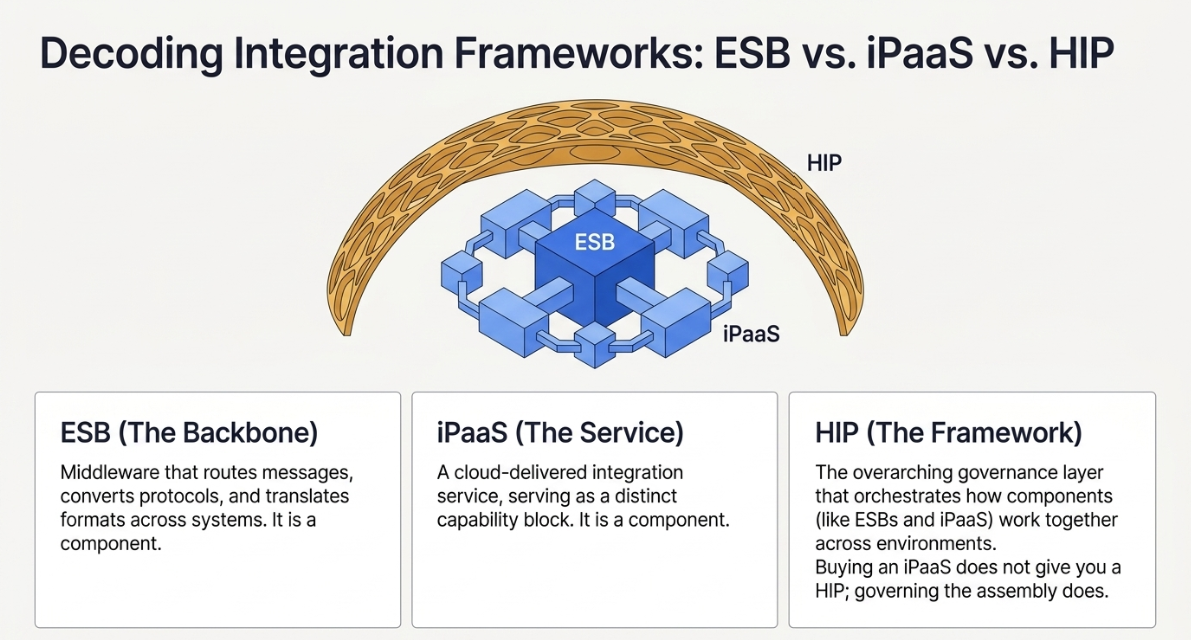
These three get used interchangeably and are not interchangeable. An ESB is middleware: a central backbone that routes messages, converts between protocols, and translates between formats across systems. It is a component. iPaaS — integration platform as a service — is a cloud-delivered integration service and the current analyst-recognized category; Gartner published a Magic Quadrant for Integration Platform as a Service on March 16, 2026, authored by Humphreys, Guttridge, Pasricha, and Wilkins. A HIP is neither a component nor a single service. It is the framework that governs how your components — which may include an ESB, one or more iPaaS services, API management, and data integration tooling — work together across on-premises and cloud. Buying an iPaaS does not give you a HIP. Assembling and governing the set does.
Why hybrid, and when it is still the right architecture
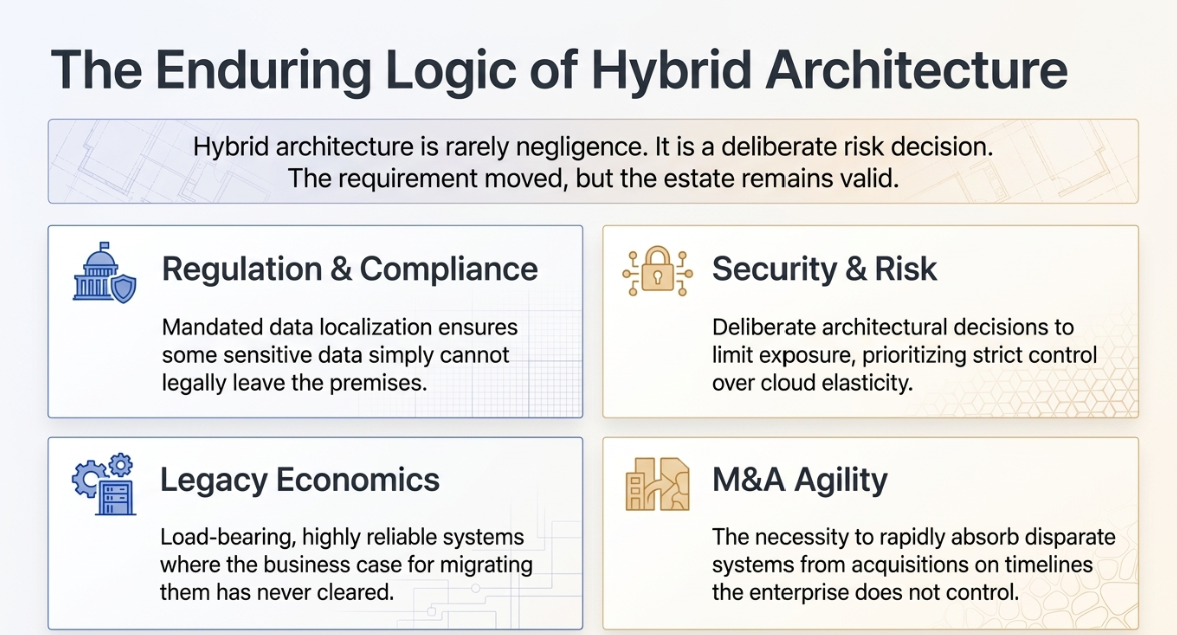
The 2018 position holds. Some data cannot leave the premises because a regulator says so. Some stay because a security review said the risk was not worth the elasticity. Some systems are load-bearing, expensive to touch, and working fine, and the business case for moving them has never cleared. Any of those is a sound reason to run a hybrid estate, and the enterprises that reached that conclusion generally reached it through analysis, not inertia.
A hybrid integration platform is still the right architecture when your estate genuinely spans environments, and you intend to keep it that way, when different teams with different skill levels need to build integrations without routing every request through a specialist queue, when compliance requires that specific data classes stay put and be provably so, and when you are absorbing systems from acquisitions on timelines you do not control. None of that has changed since 2018, and nothing in this article argues for collapsing a hybrid estate that exists for those reasons.
How to evaluate a hybrid integration platform
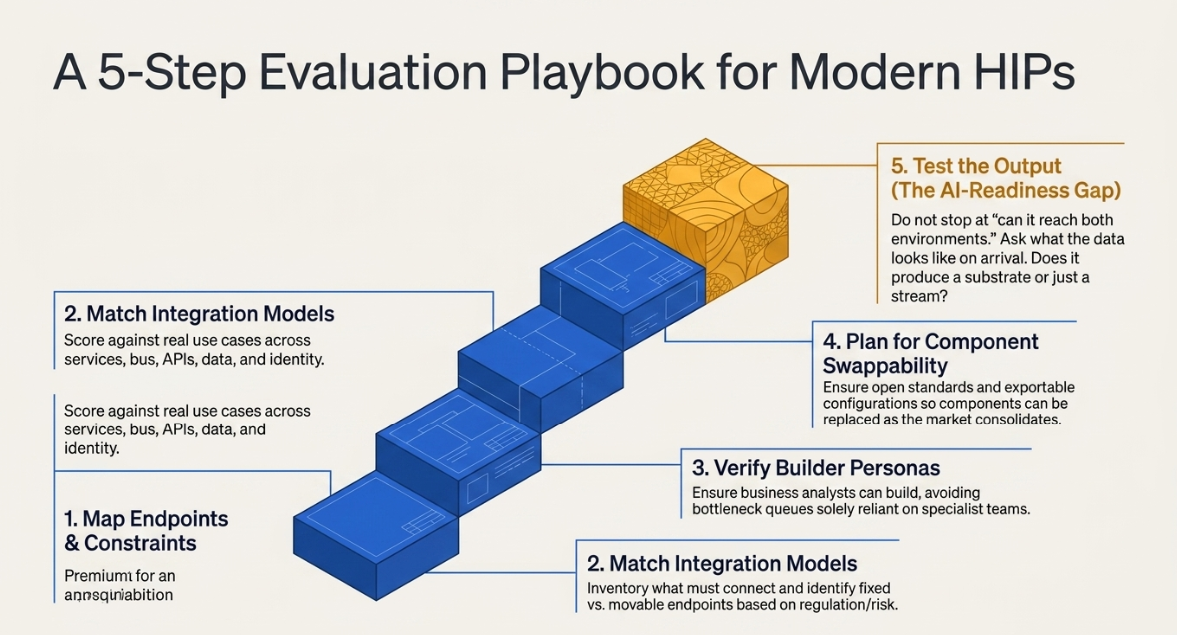
Here is the part the original guide promised and never quite delivered: how to actually run the selection. Five steps, in order.
Step 1: Map your endpoints and their constraints
Inventory what has to connect and what governs each side — on-premises systems, cloud services, third-party SaaS, data stores, and the compliance class of the data moving between them. Mark, which endpoints are fixed by regulation or risk, and which are movable? This map is the requirement; all subsequent steps are scored against it.
Step 2: Match integration models to real use cases
Score candidate assemblies against the five levels: service integration, the message bus, managed APIs, data integration, and identity and access control. Most estates need three or four, not all five. A platform strong at API management and weak at bulk data integration is the right choice or the wrong one, depending entirely on the map from Step 1.
Step 3: Check who can actually build on it
Pezzini's framing puts differently skilled personas at the center of the definition for a reason. Establish who will build integrations in practice: the specialist team, the analysts in the business units, or both. A platform that only your integration specialists can operate produces a queue, which becomes the bottleneck that the platform was bought to remove.
Step 4: Assume you will replace components
In 2018, Pezzini advised buyers to take a pragmatic, short-term approach to selecting building blocks, assuming some would have to be replaced as the market matured and consolidated. That advice aged well. Evaluate each component on how cleanly it can be swapped: open standards, documented interfaces, exportable configuration, and no proprietary lock on the data model. Also accept that some integration capability will sit inside SaaS applications you do not control at all.
Step 5: Test what the platform produces, not just what it connects
This is the new criterion, and it belongs within the evaluation rather than after it. Do not stop at "can it reach both environments." Ask what the data looks like on arrival. Gartner's five steps to AI-ready data are: data aligned to the specific AI use cases it will serve; governance requirements identified specifically for AI; metadata evolved from passive to active; pipelines prepared; and data assured and enhanced on an ongoing basis. Run a candidate assembly against those five, and you learn whether it produces a substrate or a stream.
Who does this affect in 2026
The reader with a live decision is a RevOps or integration lead at an enterprise or upper-mid-market company running a genuinely mixed estate: a private core that regulation or risk keeps in place, cloud services around it, and a platform spanning both. The pattern is consistent. The integration works, the dashboards are green, and the AI initiative approved two quarters ago is still waiting on data. If you are being asked to explain why a fully connected estate cannot support an agent that reads across it, the next three sections are the explanation.
From ESB to HIP to what comes next: the lineage
The category has a dated ancestry, and it runs through one analyst house. Gartner analysts Roy Schulte and Yefim Natis introduced service-oriented architecture in a two-part report on April 12, 1996; the academic record carries the lineage through the peer-reviewed literature on service-oriented architecture. Schulte predicted the emergence of the enterprise service bus as a named category in December 2002. The ESB, as the 2018 version of this page put it plainly, was created to handle hybrid integration — the bus was the first serious answer to systems that would not live in one place. Gartner then defined the HIP as the capability framework for estates that the bus alone could not govern. iPaaS is where the analyst-recognized market sits today.
What held then still holds: an estate spanning environments needs a deliberate integration architecture, and assembling one from governed components beats hand-built connections. What changed is that the connection stopped differentiating, because every competitor is connected. Gartner's July 1, 2026, analysis puts the shift in spending terms: up to $234 billion in enterprise application software spend, roughly 20 percent of enterprise application SaaS spending by 2030, is exposed to agentic arbitrage, in which AI agents complete work across multiple systems and reduce the need for people to sit inside each interface. "Agentic AI changes the economics of software," says Gartner's George Brocklehurst. What delivers value, in Gartner's reading, is autonomous end-to-end workflow execution and cross-system orchestration, backed by systems that retain institutional memory and customer context over time. A HIP is cross-system by definition. The question now is whether yours produces the substrate that orchestration requires.
The Silo Tax: why a connected hybrid estate still fails an AI project
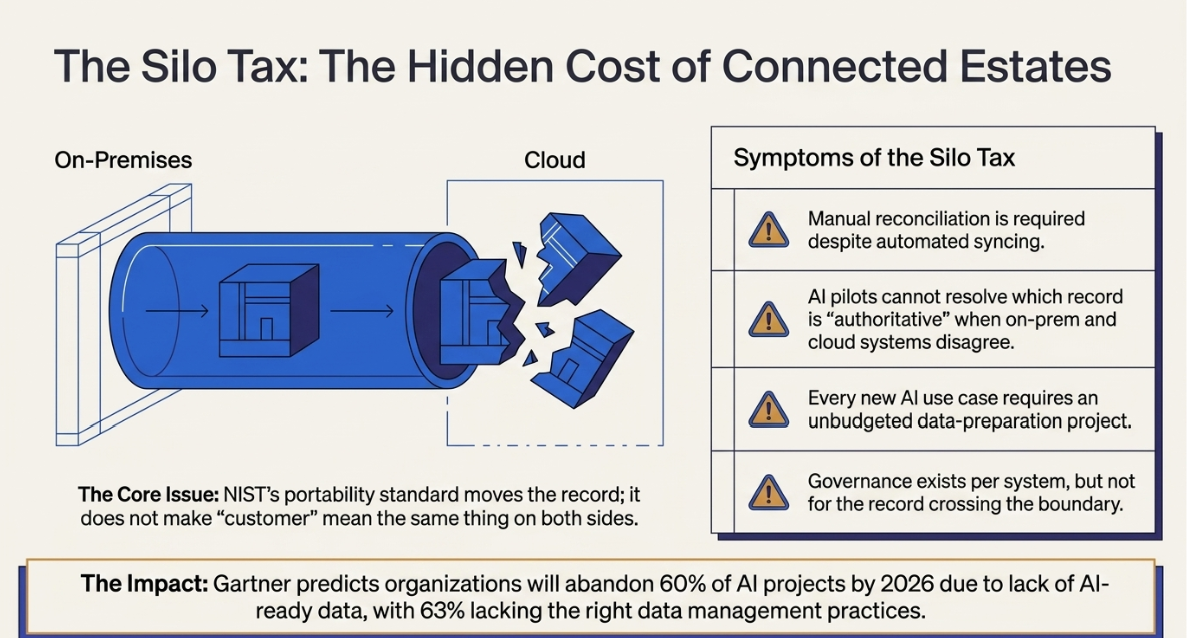
The Silo Tax is the cost an enterprise incurs when connected systems move fragmented data faster rather than making it mean one thing. On a hybrid estate, it is paid twice, and NIST's own wording shows why. Hybrid means the constituent infrastructures remain unique entities, bound by technology enabling portability. Portability moves the record. It does not make "customer" mean the same thing on both sides of the boundary, and it was never asked to govern that record at the asset level. Gartner's research on AI-ready data asks for precisely what portability does not deliver, and measures the consequence: the firm predicts "organizations will abandon 60% of AI projects unsupported by AI-ready data" through 2026, and reports that 63 percent of organizations either lack, or are unsure whether they have, the right data management practices for AI. Gartner's diagnosis — data collected in silos across repositories, systems, and platforms, managed by practices too slow and too rigid for AI teams — describes the connected estate, not the disconnected one.
You are paying the Silo Tax if any of the following is true:
- Your platform reliably syncs both environments, and analysts still reconcile the two by hand before anyone trusts a number.
- The AI pilot cannot resolve which record is authoritative when the on-premises system and the cloud system disagree.
- Each new AI use case opens with a data-preparation project that was not in its budget.
- Governance rules exist per system, and no rule governs the record as it crosses the boundary.
The root cause is scope, not execution. The platform was scoped to carry data between environments, and it does. Meaning, governance and use-case alignment were never in the specification, which is why adding connections does not reduce the tax.
What the 2026 selection question actually is: the Data Foundation
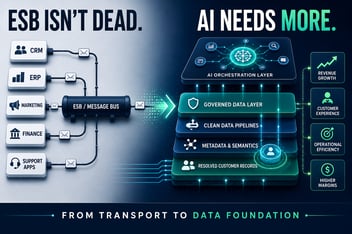
A Data Foundation is the substrate beneath AI: data aligned to the specific use cases it serves, governed at the asset level, delivered through prepared pipelines, described by metadata that is active rather than passive, and continuously assured. Those criteria are Gartner's own five steps to AI-ready data, which is what makes the Data Foundation testable rather than aspirational — you can score an assembly against them this quarter.
The selection question follows from that. It is no longer "which platform spans my hybrid estate," because most credible platforms do. It is "that which assembly produces a substrate an AI layer can act on." Those are different questions with different answers, and the second one is not satisfied with a better pipe. It is satisfied by what a data foundation actually requires: resolution, governance, and use-case alignment applied to the data itself, above the transport layer that carries it.
Evaluating a HIP against a 2026 requirement: the decision table
|
Evaluation criterion |
What it meant in the connection era |
What does it mean now |
|
Endpoint coverage |
Can the platform reach every system, on-premises and cloud? |
Can it reach them and resolve the same entity consistently across the boundary? |
|
Integration models |
Does it support the models our use cases need — services, bus, APIs, data, identity? |
Do those models carry governance with the data, or only the payload? |
|
Personas |
Can specialists and non-specialists both build on it? |
Can an AI agent consume what they build without a human interpreting it first? |
|
Component strategy |
Can we swap building blocks as the market consolidates? |
Can we swap them without the data model becoming a hostage? |
|
Output |
Does data arrive intact in the target system? |
Does data arrive use-case aligned, asset-level governed, and assured? |
No row implies the existing estate was a mistake. Each row shows where a criterion that was correctly specified for connection now carries a second requirement it was never scoped against.
The CETDIGIT perspective
CETDIGIT's position is that integration selection in 2026 is a revenue architecture decision. A connected estate is a system of record: it stores and syncs. A System of Action senses signals and executes revenue work without waiting for someone to move the deal along. Between them sits the layer nobody specifies at implementation time, because in 2018, nothing was going to read the data autonomously. That is also why we model the estate as a Revenue Graph rather than a linear funnel — buying decisions form across systems and environments, and the graph describes how revenue actually moves through a mixed estate in a way no single platform's topology can. Once the substrate is right, the orchestration question becomes tractable, which is where the orchestration layer that acts on the data does its work: triggering revenue actions from signals rather than reporting on them afterward. We are the orchestrator of that architecture, not a partner of any platform in it, and not a competitor to the HIP category.
Recommended path
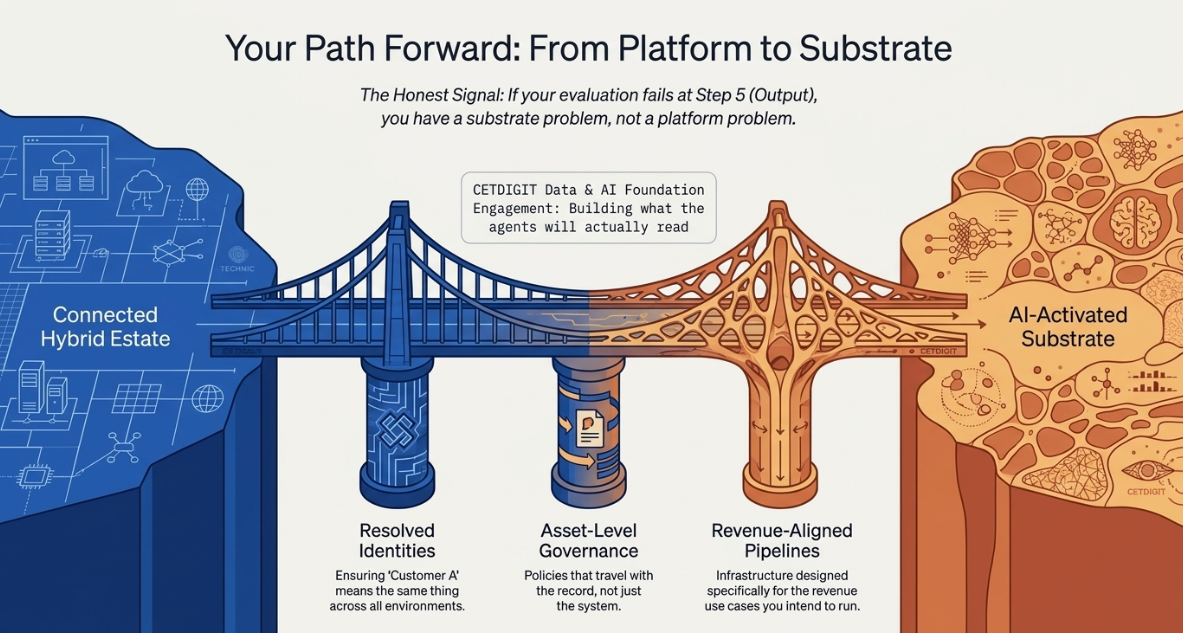
If Step 5 is where your evaluation gets uncomfortable, that is the honest signal, and it is a substrate problem rather than a platform problem. CETDIGIT's Data and AI Foundation engagement builds what the agents will read: resolved identities across both environments, asset-level governance that travels with the record, and pipelines aligned to the revenue use cases you intend to run. It sits inside CETDIGIT's broader AI services framework, and how a stack unification engagement actually runs is documented if you want the methodology before the conversation.
Frequently asked questions
What is a hybrid integration platform?
A hybrid integration platform is a framework of on-premises and cloud integration and governance capabilities enabling differently skilled teams to support a range of integration use cases, per Gartner's definition of the category. It is normally implemented by assembling building blocks from one or more providers and managing them as a federated whole. The important consequence: a HIP is an architecture you assemble and govern, not a single product you purchase.
What is the difference between a HIP and an ESB?
An ESB is a component: middleware that routes messages, converts protocols, and translates formats through a central backbone. A HIP is the framework that governs an assembly of components across on-premises and cloud environments, which may include an ESB alongside API management, iPaaS services, and data integration tooling. The ESB was created to handle hybrid integration; the HIP is the governance layer for estates that outgrew what a single bus could carry.
How do you choose a hybrid integration platform?
Map your endpoints and the compliance constraints on each. Score candidate assemblies against the integration models your use cases actually need, rather than all five. Establish who will build integrations in practice: specialists, business teams, or both. Assume you will replace components as the market consolidates, and weight swappability accordingly. Then test what the assembly produces — whether data arrives use-case aligned and governed, not merely delivered.
Is a hybrid integration platform the same as iPaaS?
No. iPaaS — integration platform as a service — is a cloud-delivered integration service and the current analyst-recognized category in the integration market; Gartner published a 2026 Magic Quadrant for it on March 16, 2026. A HIP is a framework that spans your entire estate, which may include one or more iPaaS services as building blocks alongside on-premises components. Buying an iPaaS is a component decision. Assembling and governing a HIP is an architecture decision.
Do you have to move everything to the cloud?
No, and that has not changed since this page first said so in 2018. Regulation, security posture, and the economics of load-bearing legacy systems are all sound reasons to keep specific systems on-premises, and hybrid estates typically result from deliberate decisions rather than avoidance. What has changed is the requirement placed on the integration layer: AI workloads need data that is governed and use-case-aligned, not merely portable across the boundary.
Why do AI projects fail on a fully connected hybrid estate?
Gartner predicts organizations will abandon 60 percent of AI projects through 2026 due to a lack of AI-ready data, and reports that 63 percent of organizations lack or are unsure of the right data management practices for AI. The mechanism of a hybrid estate is specific: NIST's definition of hybrid concedes that the constituent infrastructures remain unique entities bound by portability. Portability moves records; it does not make them mean the same thing on both sides. The agent inherits that ambiguity.
What makes data AI-ready, and how is it different from integrated data?
Gartner's five steps define it: align data with AI use cases, identify AI-specific governance requirements, evolve metadata from passive to active, prepare pipelines, and continuously assure and enhance the data. Integrated data guarantees only that a record has been moved from one system to another. AI-ready data can be acted on autonomously. The gap between the two is what a Data Foundation exists to close, and it is where most stalled pilots are actually stuck.
Stack Unification Audit
Diagnose where your AI investment is leaking — connect the stack, then activate AI. Book a 60-minute Stack Unification Audit, and we will score your hybrid assembly against what an AI layer actually needs, and show you which gap to close first.
Reference:
Hybrid cloud integration Platform and solutions
Understanding Hybrid Integration Platforms
Enterprise Application Integration
Hybrid Cloud: 10 notable statistics
Leave a Comment