


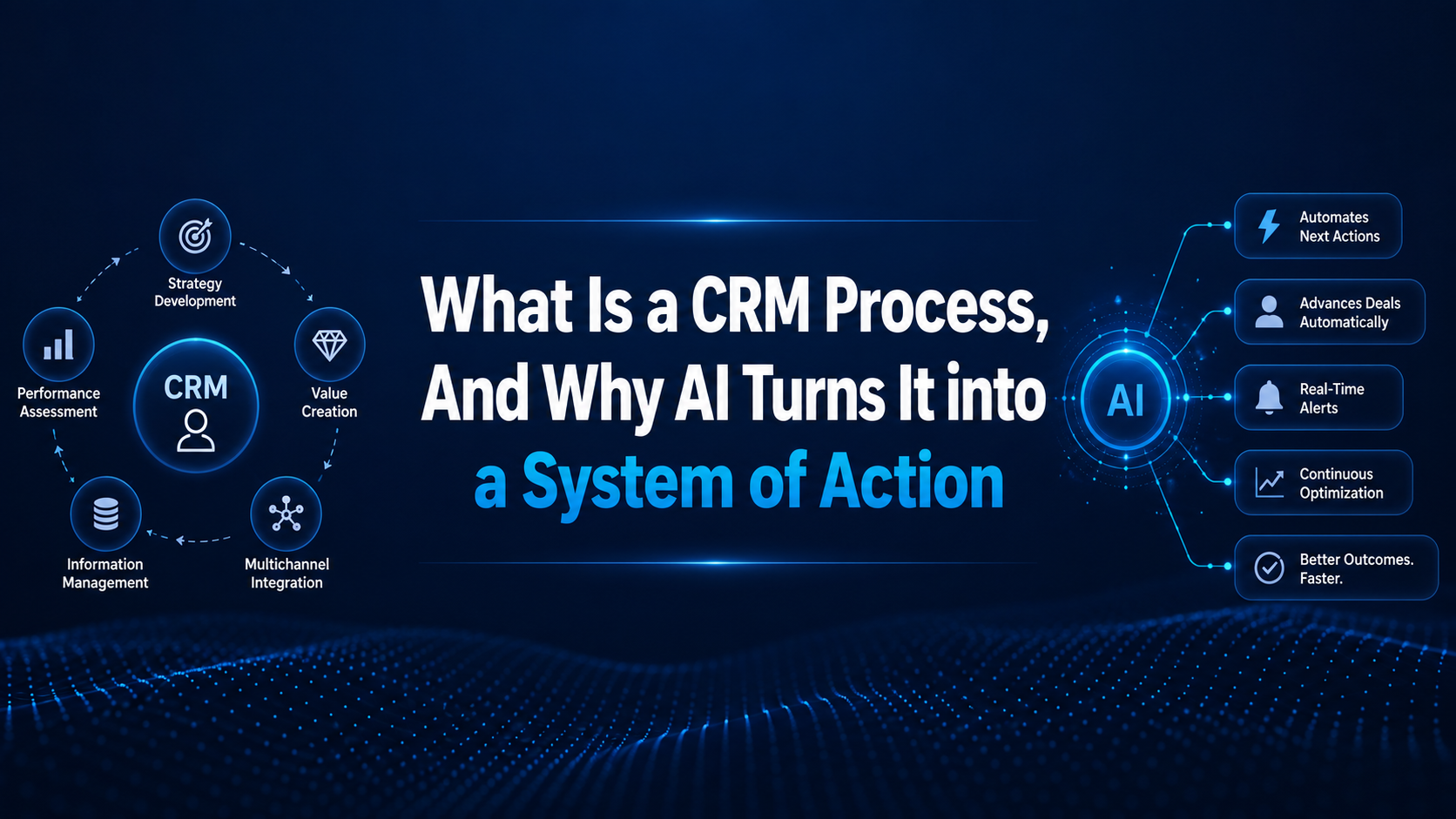
A CRM process is the set of cross-functional processes an organization uses to manage customer relationships, not a feature of CRM software, but the work the software supports. The standard academic framework identifies five: strategy development, value creation, multichannel integration, information management, and performance assessment. Together they define how a company decides who its customers are, what it offers them, how it reaches them, what it knows about them, and whether any of it worked.
It was mapped in a workshop over two days. Every stage has an owner, an exit criterion, and a required field. It was built into the CRM, tested, documented, and trained out to the whole team. By any reasonable standard, it's a good process; most organizations never get this far, and the ones that do tend to have someone who fought for it.
And on a Tuesday in the second week of the quarter, a deal sits in stage three because the person who was supposed to advance it has been in back-to-back meetings since Monday. The system knows the deal has been there for eleven days. It knows the exit criterion hasn't been met. It knows who owns it. And it does exactly what it was built to do about all of that: nothing.
What a CRM process is
A CRM process is the set of activities by which an organization manages its relationships with customers, from deciding which customers to pursue through to assessing whether the relationship produced value.
The distinction that matters, and the one most definitions skip: a CRM process is not the same thing as a CRM system. The system is software. The process is work, and most of it happens across functions rather than inside a tool. In the standard academic framework, published in the Journal of Marketing in 2005 by Adrian Payne and Pennie Frow, this is the central argument: CRM should be understood through "a cross-functional, process-oriented approach that positions CRM at a strategic level," rather than as a technology you install.
That framing holds at any size. A twenty-person company and a two-thousand-person company run the same five processes, one does it in a shared inbox and a spreadsheet, the other in a configured platform with a RevOps team behind it. The processes are the same. The infrastructure differs.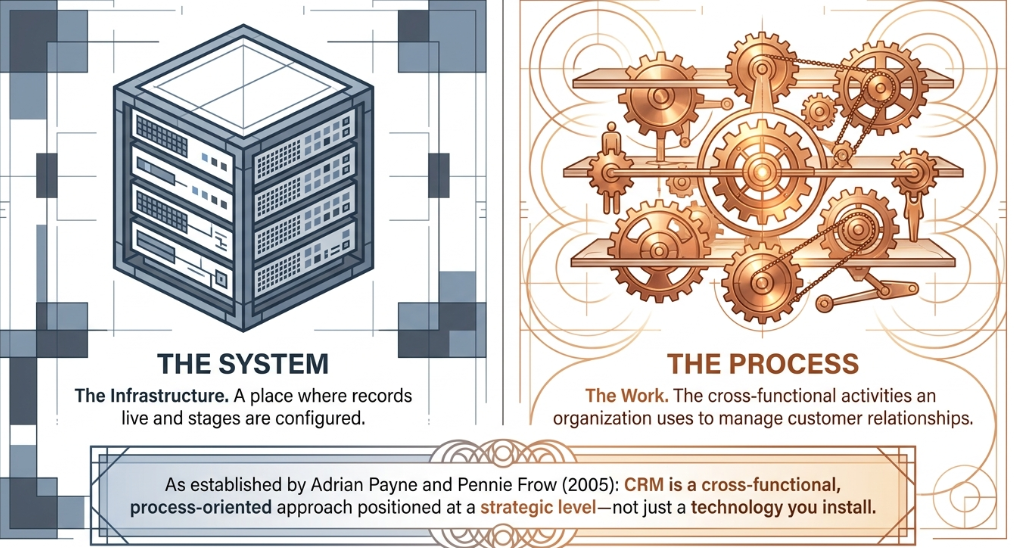
The stages of a CRM process
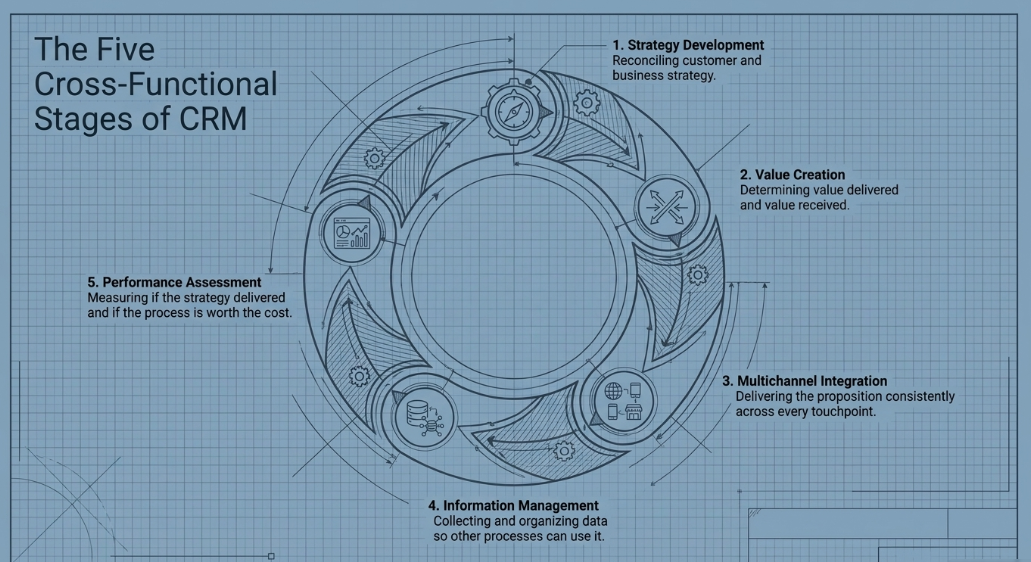
Payne and Frow identify five cross-functional processes. Read them as stages of a cycle rather than a linear funnel, because the last one feeds the first.
- Strategy development. Deciding which customers you want and what your business strategy implies about how to serve them. This is where the customer strategy and the business strategy get reconciled, and it is upstream of every tool decision.
- Value creation. Determining what value you deliver to customers and what value you receive back. Both directions matter; a process that only tracks what you extract will produce customers who notice.
- Multichannel integration. Taking the strategy and the value proposition and delivering them consistently across every channel the customer touches. This is where most processes visibly break, because each channel tends to grow its own habits.
- Information management. Collecting, storing, and organizing customer data so the other processes can use it. This is the part people usually mean when they say "CRM," and it's one of five.
- Performance assessment. Determining whether the whole thing produced anything, whether the strategy delivered, and whether the process is worth what it costs.
You'll also see CRM processes described as a customer lifecycle: reach, acquire, convert, retain, grow. That's a useful way to picture the customer's journey through your business, and most CRM software is organized around it. It answers a different question, though. The lifecycle describes the stages a customer moves through. The five processes above describe the work your organization has to do to make that movement happen.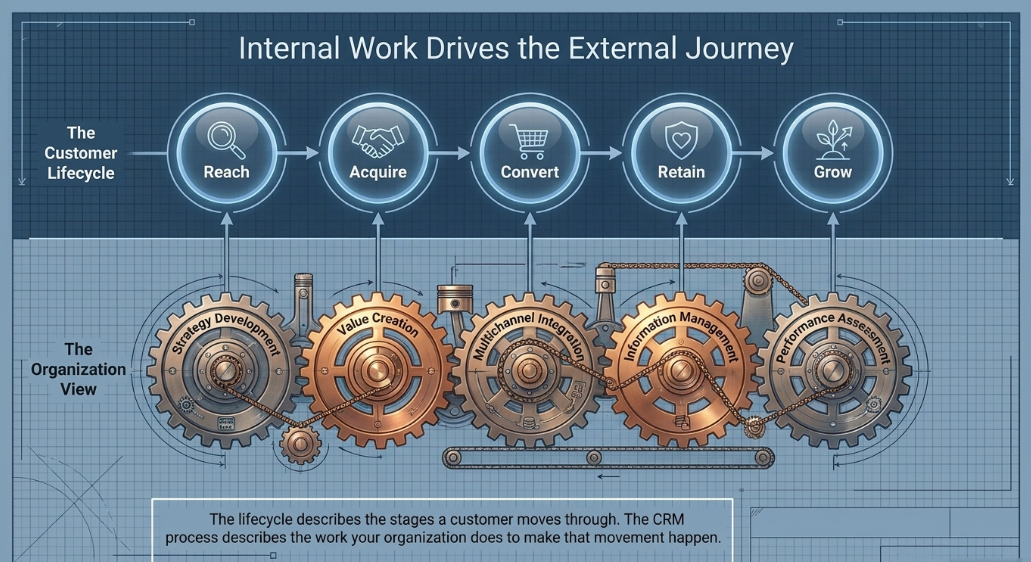
How a CRM process gets designed, and why the discipline still matters
The design discipline is straightforward to describe and genuinely hard to do. Map the stages. Define the exit criterion for each, the specific, checkable thing that has to be true before a deal advances. Assign an owner. Build it into the CRM as stages, fields, and required actions. Train the team. Then hold the line, because a process that gets negotiated at every deal review isn't a process.
That work is real, and the organizations that do it properly are a minority. It's also worth saying that the cross-functional part, the thing Payne and Frow insisted on in 2005, is the part most often skipped, because it's the part that requires other departments to agree to something. Gartner's April 2026 research puts a number on what that discipline is worth: sales organizations that collaborate on enablement content with other functions, such as marketing and service, are 2.4x more likely to achieve strong commercial growth.
Twenty-one years apart, the same finding. The framework was right. If you mapped your process across functions and enforced it, you did the thing the evidence supports.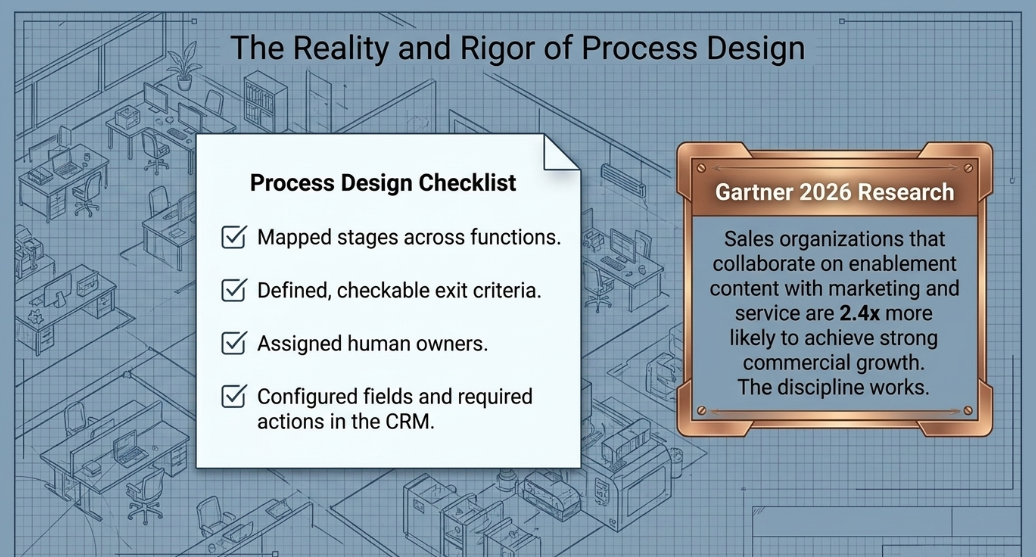
Who does this affect in 2026
If you came here to learn what a CRM process is, you now have the definition and the model, and the rest of this is optional. If you run RevOps and you've already done the mapping, the workshop, the stages, the exit criteria, the training, the rest of this article is about the thing you've probably noticed since: the process is good, the process is documented, and the process still only runs when someone remembers to run it.
What changed by 2026
What held then still holds: mapping the process across functions and enforcing it in the tool was the right discipline, and it still is. What changed is that the process definition stopped being the scarce thing. Every serious organization has a mapped CRM process now. The constraint moved from defining the process to executing it.
Gartner describes the shift precisely, in a sentence about sales enablement that applies to the whole category. Traditional enablement, in the words of Gartner's Shayne Jackson, was built as a reactive support function, "not as a system engineered to drive measurable seller performance," and what it has to become is a function that orchestrates behavior in real time. Gartner predicts AI-driven enablement will deliver 40% faster sales stage velocity than traditional methods by 2029.
Gartner's May 2026 research attaches a number: organizations providing sellers with AI-enabled next best actions are 2.6x more likely to achieve commercial growth. Greg Hessong's framing of why is the part worth holding onto. The organizations getting this are "redesigning seller workflows so AI can support execution, recommendations, and orchestration," not simply adding AI to how they already work.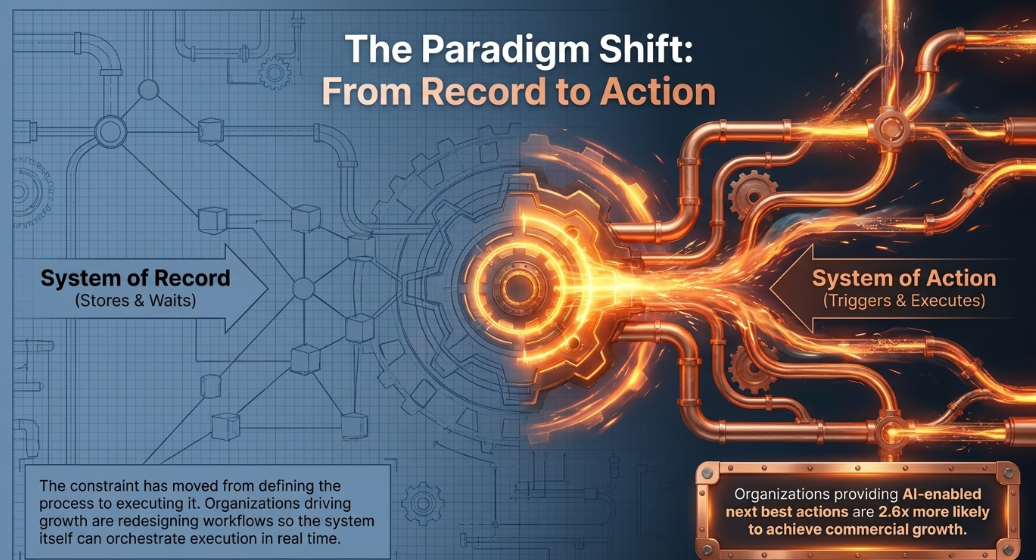
Which brings up the honest complication, and it's a real one. Gartner also predicts that by 2028, AI agents will outnumber human sellers ten to one, and that fewer than 40% of sellers will report that those agents improved their productivity. The same research finds B2B buyers are 28 percentage points more likely to say a human rep, rather than GenAI, helped them advance to the next step, and 32 points more likely to say a rep gave them confidence in the decision.
So this is not an argument for buying agents. Agents added to a process that still waits for a person are just more things that wait.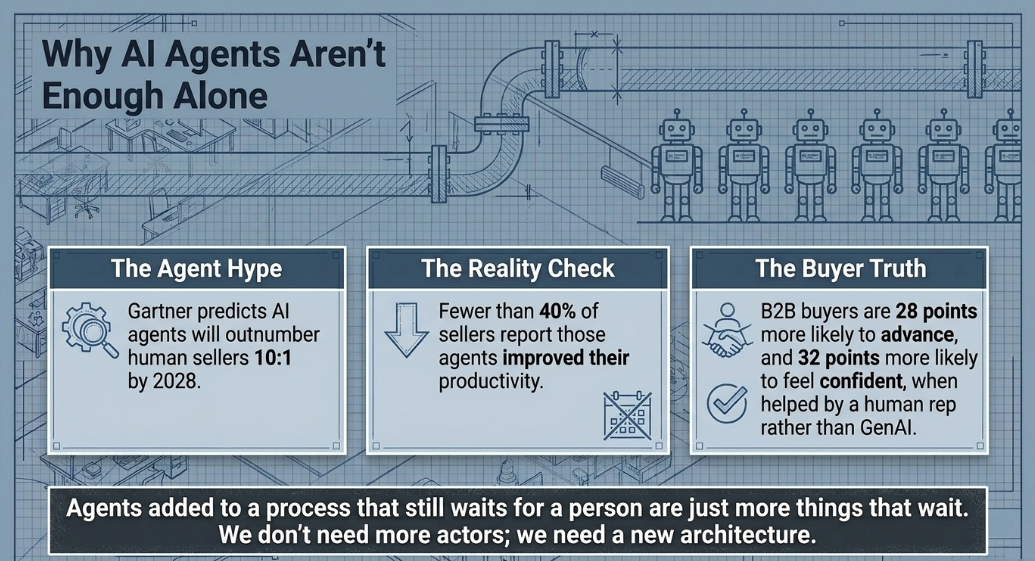
A process that describes actions, and a system that takes them
Here's the thing that's been sitting inside this topic since before anyone had a name for it. A CRM process is, by definition, a description of actions the CRM does not take.
That's not a criticism of the CRM. A System of Record stores what happened; a System of Action does something about it. Your CRM was built to be the first thing, and it is good at it. The stages are there, the fields are there, the history is there, and the process is faithfully documented inside it. What the process describes is a sequence of actions, and every one of them is assigned to a person. The system holds the description. The person supplies the execution.
For a long time, that was the only possible arrangement, which is why nobody named it. It's also why the gap Payne and Frow identified in 2005 never closed: they said CRM was a cross-functional process rather than technology, and the technology responded by recording the process instead of running it. Twenty-one years later, Gartner is measuring the same gap from the other end.
You're looking at the execution gap rather than a process-design problem if:
- The process is well-mapped, well-documented, and advances only when a person advances it.
- Deals sit past their exit criteria, and the system that knows this does nothing about it.
- Process compliance depends on reminders, dashboards, and someone's Tuesday review.
- Your remediation plan is more training, and the training worked last time, briefly.
None of that is a failure of discipline. You did the disciplined thing. The gap is architectural.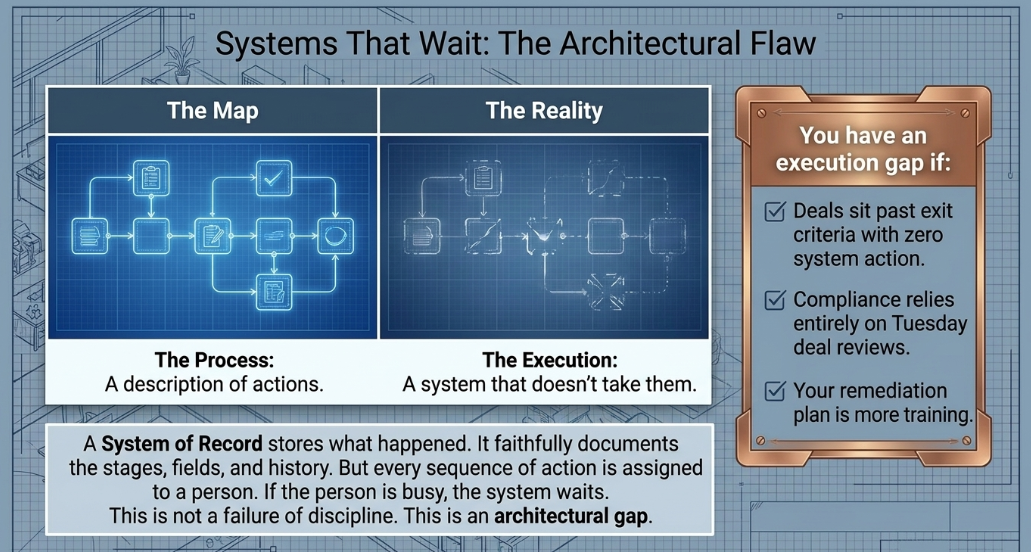
Does your process run, or does it wait: the decision table
|
Process stage |
What a System of Record does with it |
What a System of Action would do instead |
|
Strategy development |
Stores the segment definitions and target criteria |
Flags accounts that no longer match the strategy, continuously |
|
Value creation |
Records what was offered and what closed |
Detects when the offer stops matching the account and acts on it |
|
Multichannel integration |
Logs each touch in each channel |
Executes the next touch in the right channel without a person choosing |
|
Information management |
Holds the data and waits for a query |
Reads the data continuously and triggers on what changes |
|
Performance assessment |
Reports what happened, after it happened |
Measures what the system itself executed, as it executes |
Read down the middle column, and you have an accurate description of a well-run CRM. Read down the right, and you have the same five processes with the waiting removed. The stages don't change. What changes is whether they run.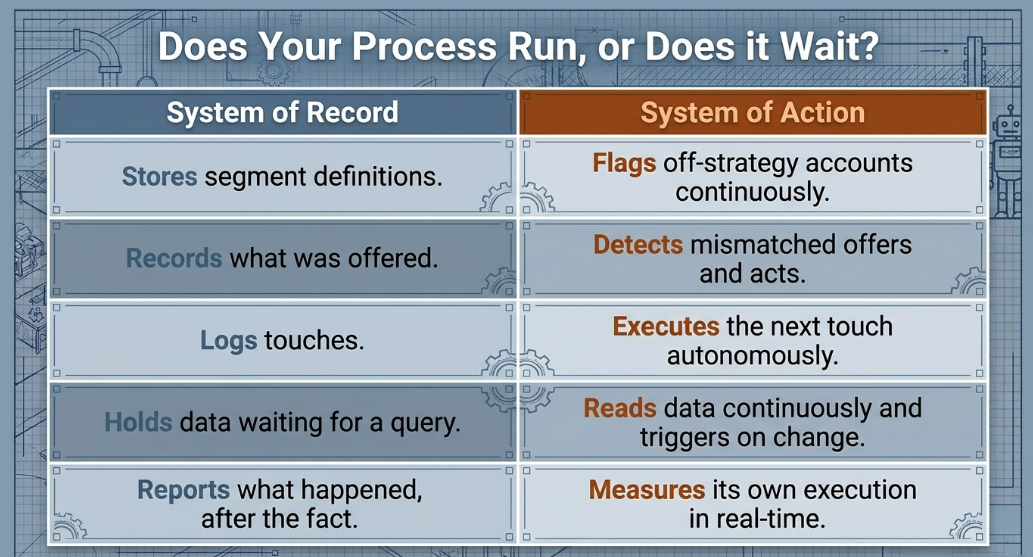
The CETDIGIT perspective
CETDIGIT's position is that the CRM process was never the problem, and that most organizations trying to fix execution reach for a better-mapped process, which is the one thing they already have.
The layer that closes the gap needs an accurate model of how revenue actually moves, which is why we work from a Revenue Graph rather than a linear funnel: customer decisions form across channels, functions, and stakeholders in ways a stage model necessarily flattens, and a system acting on a flattened model acts on a fiction. Payne and Frow's insistence that the process is cross-functional is the same observation, made before anything could act on it.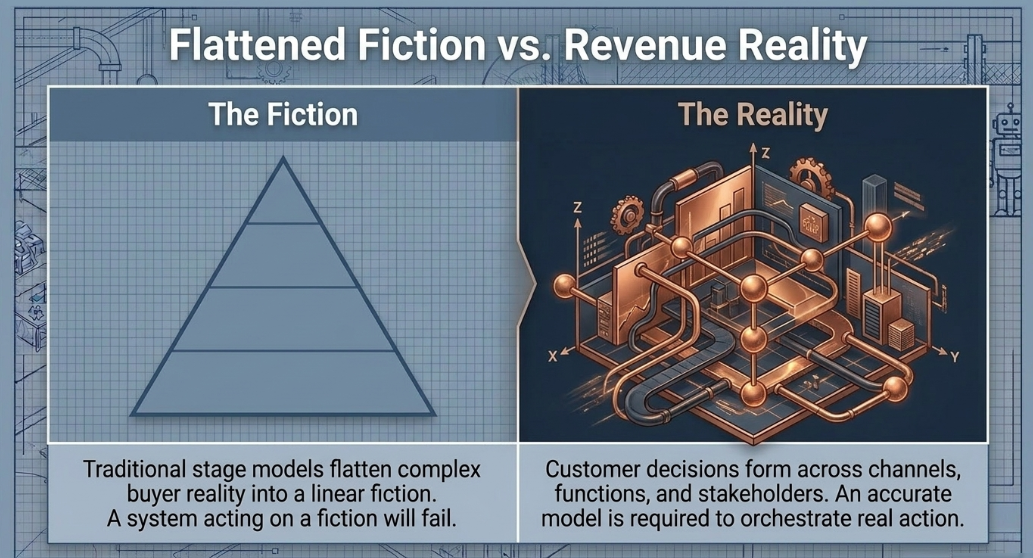
The other half is measurement. Gartner's Sandhya Mahadevan notes that sales leaders trying to prove AI ROI need a reliable baseline and full visibility into productivity and capacity, and the awkward truth is that you cannot prove a process improved if you never measured whether it ran. That's what Revenue Intelligence is for: measuring what the system executed rather than what people logged about it.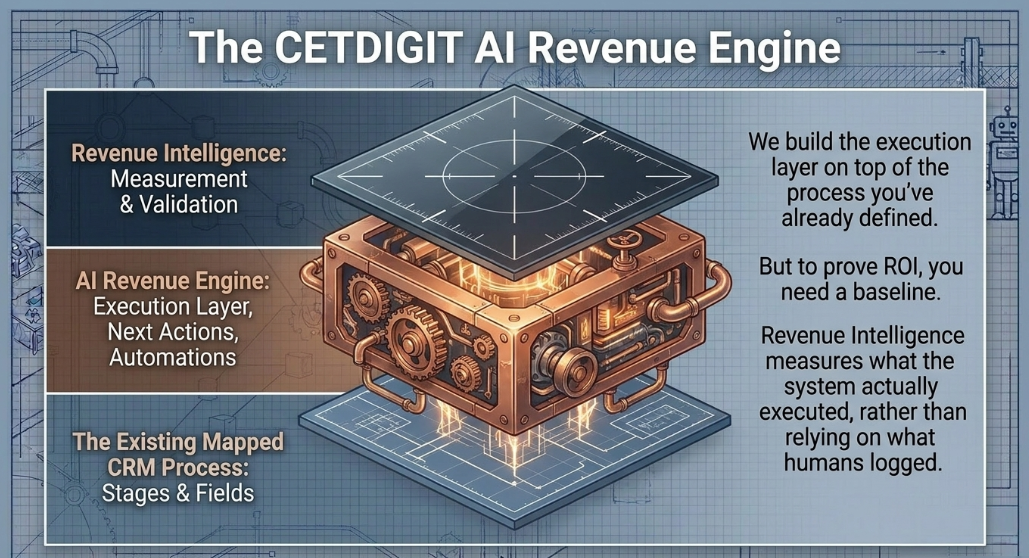
Recommended path
If your process is mapped, enforced, and still waiting on people, the gap isn't in the map. Start by asking what your process does when nobody is looking at it. The answer usually names the work precisely, and it's rarely a training problem.
CETDIGIT's AI Revenue Engine practice is where the execution layer gets built on top of the process you've already defined, and closing the gap between a defined process and one that runs is the specific work of making follow-up, advancement, and next actions happen without someone remembering them. Both sit within CETDIGIT's broader AI services framework, so if you want to see how the pieces connect first.
Frequently asked questions
What is a CRM process?
A CRM process is the set of cross-functional activities an organization uses to manage customer relationships, deciding which customers to pursue, what to offer them, how to reach them across channels, what to know about them, and whether it worked. The key distinction is that a CRM process is not CRM software. The software supports the process; the process is the work, and most of it happens across departments rather than inside a tool.
What are the steps or stages in a CRM process?
Payne and Frow's framework, published in the Journal of Marketing, identifies five cross-functional processes: strategy development (which customers, and why), value creation (what you give and what you get), multichannel integration (delivering it consistently everywhere the customer is), information management (collecting and organizing what you know), and performance assessment (finding out whether it worked). You'll also see CRM described as a customer lifecycle, reach, acquire, convert, retain, grow, which describes the customer's journey rather than your organization's work.
How do you define a CRM process?
Map the stages. For each one, define a checkable exit criterion, the specific thing that must be true before anything advances. Assign an owner. Build it into the CRM as stages, fields, and required actions. Train the team, then hold the line, because a process renegotiated at every deal review isn't a process. The step most often skipped is the cross-functional one: Gartner found organizations collaborating across marketing, sales, and service are 2.4x more likely to achieve strong commercial growth.
What's the difference between a CRM process and a CRM system?
The system is software, the place records live, and the stages are configured. The process is the work the software supports, and it spans functions that the software doesn't. This matters practically: you can buy a CRM system in an afternoon and still not have a CRM process, and plenty of organizations have discovered exactly that. The academic framework is explicit that CRM should be understood as a cross-functional process positioned strategically, rather than as a technology.
Why doesn't our CRM process run on its own?
Because a CRM process is a description of actions the CRM doesn't take. That's what a system of record is: it stores what happened and waits for a person to decide what's next. Every stage in your process is assigned to a human, and the system faithfully documents whether they did it. For most of CRM's history, that was the only available arrangement, which is why the gap has no name in the standard literature. It's architectural, not a discipline problem.
Will AI agents fix a broken CRM process?
No, and Gartner's own data is the reason to be careful here. Gartner predicts AI agents will outnumber human sellers ten to one by 2028, while fewer than 40% of sellers report that agents improved their productivity. Agents added to a process that still waits for a person are just more things that wait. What Gartner found, separating the organizations that get value, is redesigning the workflow so the system can execute, not the number of agents deployed.
Does a System of Action replace salespeople?
No, and Gartner's buyer-side research argues against it directly: B2B buyers were 28 percentage points more likely to say a human rep, not GenAI, helped them advance to the next step, and 32 points more likely to say a rep made them confident in the decision. The dependency worth removing isn't the seller; it's the seller having to remember the process. The judgment stays human; the waiting doesn't have to be.
Revenue Graph Audit
90-day audit, we will show you exactly where the ROI is hiding in your current stack. We'll map how revenue actually moves through your process, and where it's waiting on someone to remember it.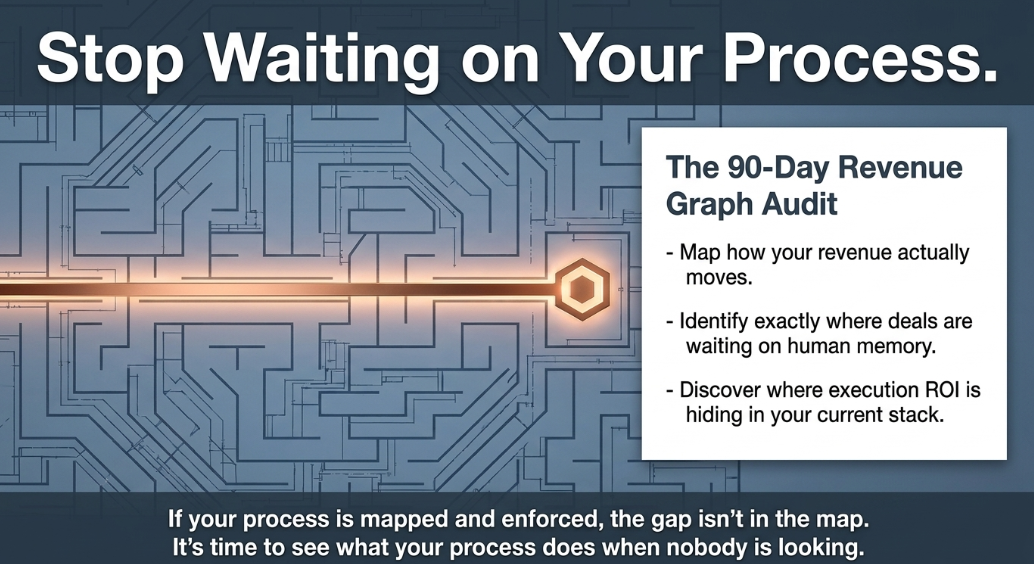

Leave a Comment